


The Future of Customer Service: How Conversational AI is Transforming Customer Experience
Customer expectations are rapidly evolving, with instant, seamless, and personalized experiences now considered the baseline. Conversational AI for customer service is leading this transformation, enabling organizations to deliver responsive, predictive, and deeply personalized support. By embedding conversational AI for customer service into digital platforms, businesses can achieve unprecedented efficiency, cost savings, and customer satisfaction. Platforms like VideoSDK empower companies to provide real-time, omnichannel, and highly tailored service, setting a new standard in customer engagement. As this technology matures, conversational AI is not just a passing trend but the foundation for the future of customer experience.
Why Conversational AI? The Business Case for Customer Service Automation
Traditional customer service models often struggle with slow response times, high operational costs, and inconsistent quality. Scaling support teams to meet growing demand is expensive, and maintaining a consistent brand voice across all agents can be challenging. Customers now expect 24/7 service, while businesses must optimize resources and budgets to remain competitive.
Conversational AI for customer service directly addresses these challenges. AI agents provide instant responses, automate repetitive inquiries, and deliver reliable, always-on support at a fraction of traditional costs. By automating routine interactions, human agents are freed to handle more complex, value-driven tasks, increasing both productivity and job satisfaction. The business case is clear: companies adopting conversational AI for customer service see significant cost reductions, improved customer satisfaction (CSAT), and scalable support operations that do not require linear increases in staffing.
Here’s how conversational AI compares to traditional support:
| Metric | Traditional Support | Conversational AI |
|---|---|---|
| Cost per Interaction | High | Low |
| Response Time | Minutes to hours | Instant |
| Scalability | Linear with headcount | Exponential |
| Personalization | Agent-dependent | Consistent and data-driven |
| Availability | Business hours | 24/7, global |
| Quality Consistency | Variable | Uniform |
Investing in conversational AI for customer service is a strategic move that delivers measurable business value and a competitive edge.
Core Capabilities: What Modern Conversational AI Can Do
Modern conversational AI for customer service goes far beyond basic chatbots. It empowers organizations with capabilities such as:
- Omnichannel Engagement: Engage customers across voice, chat, email, social media, and mobile apps from a unified platform.
- Multilingual and Multicultural Support: Communicate with customers in their preferred language, expanding your reach and inclusivity.
- Automated Query Resolution: Instantly resolve routine questions and intelligently escalate complex issues to human agents when needed.
- Business System Integration: Seamlessly connect with CRM, knowledge bases, inventory, and order management systems to provide real-time, relevant information.
- Personalization at Scale: Use data-driven insights to tailor every interaction, boosting engagement and customer loyalty.
By leveraging these core capabilities, businesses can deliver consistent, high-quality customer service while optimizing operational efficiency. For a deeper dive into the AI voice Agent core components overview, organizations can explore how these foundational elements work together to power advanced conversational AI solutions.
Real-World Use Cases: Conversational AI in Action
Conversational AI for customer service is revolutionizing industries by enhancing efficiency and improving customer outcomes:
- Customer Support: Instantly resolve order issues, process refunds, and onboard new users with AI agents that understand customer intent and context. For example, a leading online retailer reduced average handle time by 40%, allowing human agents to focus on complex queries. To begin your own journey, check out the Voice Agent Quick Start Guide.
- Sales Enablement: AI-powered support can recommend products, qualify leads, and nurture prospects. A SaaS provider increased lead conversions by 30% using conversational AI to automate qualification and follow-ups. Understanding the conversation flow in AI voice Agents is key for building seamless sales and support workflows.
- Technical Support: Troubleshoot common issues and automate ticket creation, reducing backlog and improving first-time resolution rates. In financial services, AI-driven automation has cut support costs by 25% while maintaining compliance. Managing AI voice Agent Sessions ensures each customer interaction is tracked and optimized for quality.
- Industry Examples:
- Retail: Automated returns, order tracking, and personalized promotions.
- Financial Services: Secure identity verification, account management, and fraud alerts. Leveraging AI voice Agent Session Analytics helps financial institutions monitor and improve support performance.
- SaaS: Subscription management, onboarding, and feature education.
- Healthcare: Appointment scheduling, symptom triage, and multilingual patient support.
A healthcare startup shared, "Our multilingual AI support lets us serve patients in over 10 languages, increasing satisfaction and loyalty across demographics." Behind these results, a robust realtime pipeline in AI voice Agents enables instant, reliable interactions.
Tangible Benefits: Measurable ROI from Conversational AI
Implementing conversational AI for customer service delivers clear, quantifiable benefits:
- Faster Response Times: AI agents provide instant answers, reducing customer wait times and improving satisfaction.
- Higher CSAT and NPS: Consistent, personalized support leads to better customer experiences and increased loyalty.
- Reduced Support Costs: Automation lowers the cost per interaction and allows for scalable growth without expanding headcount.
- Increased Agent Productivity: Human agents can focus on complex, high-value cases, which improves morale and retention.
- Actionable Analytics: Continuous data collection enables businesses to identify trends, understand customer needs, and optimize performance.
- Security and Compliance: Modern AI platforms ensure customer data protection and meet regulatory requirements.
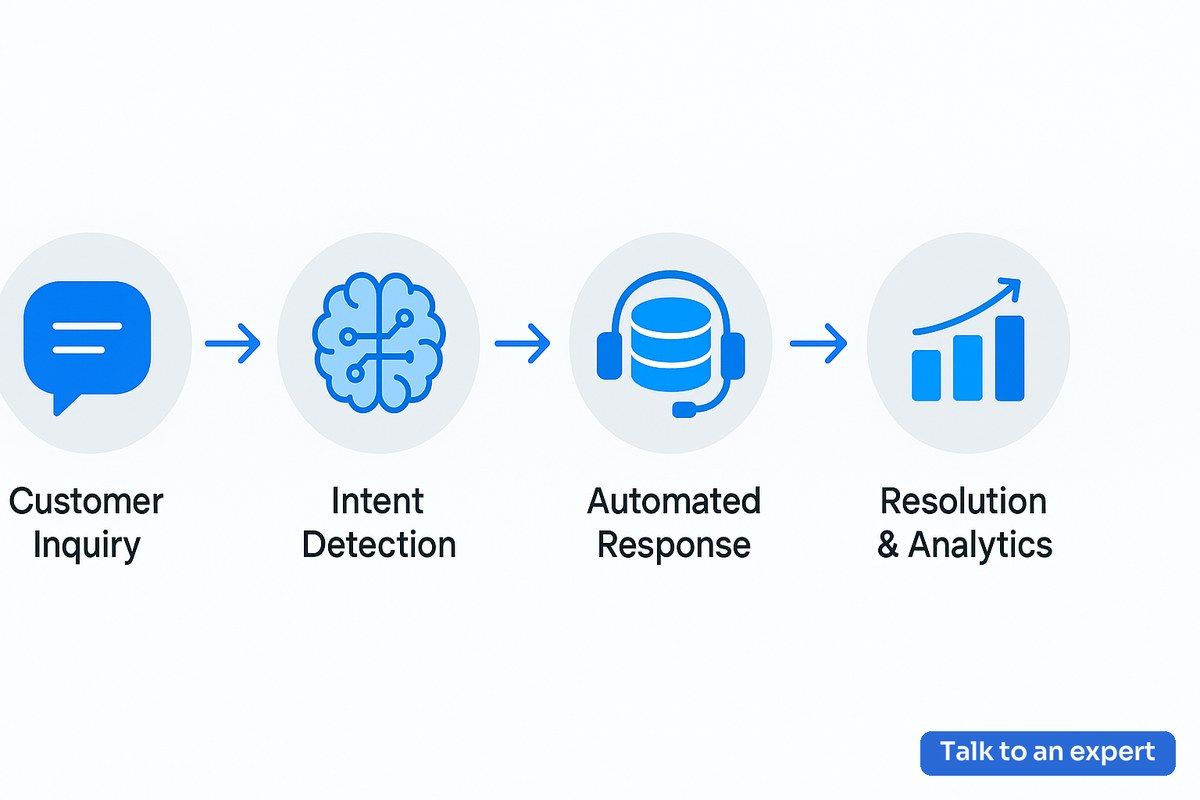
This workflow illustrates how conversational AI accelerates resolution, minimizes bottlenecks, and allows for seamless escalation to human agents when necessary. In situations requiring expert intervention, Human-in-the-loop for AI voice Agents ensures complex cases are handled with care and precision.
Overcoming Common Challenges in Adopting Conversational AI
Adopting conversational AI for customer service is a strategic journey that requires thoughtful planning. Key challenges include:
- Change Management: Teams may resist new workflows. Effective communication and comprehensive training are essential for successful adoption.
- Integrations: Seamless connections to existing systems such as CRM and order management are critical for delivering real value.
- Brand Voice: AI must reflect your brand’s unique tone and standards, ensuring quality across every customer interaction.
- Security and Compliance: Protecting customer data and meeting regulatory requirements are non-negotiable for modern enterprises.
With a clear strategy and the right technology partners, these challenges can be overcome, paving the way for a resilient and future-ready customer service operation. For those ready to move forward, resources like the Voice Agent Quick Start Guide help streamline the adoption process.
The Builder’s Blueprint: Bringing Conversational AI to Life with VideoSDK Agents Framework
The Core Components You'll Need
To successfully implement conversational AI for customer service, your blueprint should include:
- Data Sources: Aggregate FAQs, help documentation, product catalogs, and transactional data to power accurate, context-aware AI responses.
- Communication Channels: Identify where your customers interact, such as web, mobile apps, chat, voice, and social media, and ensure unified coverage.
- Integration Points: Connect with backend systems for real-time order management, CRM updates, and knowledge retrieval.
- NLP Models and Orchestration: Choose robust natural language processing and conversation orchestration tools to handle diverse queries and maintain context.
- Compliance and Security: Build on foundations that protect privacy and comply with industry regulations.
For organizations aiming to scale, understanding AI voice Agent deployment is crucial to ensure your solution is robust, secure, and production-ready.
The Critical Challenge: Real-Time Orchestration
Effective conversational AI for customer service must coordinate complex interactions across channels, systems, and user contexts in real time. Key challenges include:
- Context Switching: Seamlessly move conversations between channels and escalate to human agents without losing conversation history.
- Multi-Channel Coordination: Deliver consistent, up-to-date support across every customer touchpoint.
- Real-Time Analytics: Capture and analyze conversation data as it happens to optimize performance and uncover actionable insights.
To further enhance your AI voice agent’s abilities, consider integrating the OpenAI LLM Plugin for voice agent, which brings advanced language understanding and generation to your customer interactions.
The Solution: The VideoSDK Agents Framework
The VideoSDK Agents Framework is purpose-built to streamline the development and deployment of intelligent virtual agents for customer service. It addresses the challenges of real-time orchestration and multi-channel engagement by providing:
- Unified Orchestration Layer: Manage conversations, escalate seamlessly, and maintain context across channels and integrations.
- Flexible Integration: Connect with leading CRM, knowledge, and analytics systems out of the box or via custom connectors.
- Scalability: Effortlessly support increasing interaction volumes with built-in reliability and elasticity.
- Security and Compliance: Enterprise-grade safeguards ensure data privacy, regulatory alignment, and customer trust.
- Developer Experience: Intuitive APIs and SDKs accelerate deployment and simplify customization.
With VideoSDK, your team can focus on business logic and customer experience, not infrastructure. The result is faster innovation, lower costs, and a platform that empowers you to deliver world-class customer experiences.
Ready to build the next generation of customer service? Start with VideoSDK Agents Framework and turn innovation into measurable ROI.
Conclusion: The Conversational AI Imperative
Conversational AI for customer service is now a business imperative for organizations seeking to lead in 2025 and beyond. The path to exceptional customer experiences, operational efficiency, and measurable ROI begins with a robust, scalable, and secure AI-powered support platform. With frameworks like VideoSDK, every business can unlock the future of customer service and transform support for the digital era. Explore VideoSDK’s resources or request a demo today to start your journey.
Step-by-Step AI Voice Agent Quickstart
FAQ