


Introduction
Choosing between Vonage and RingCentral is a pivotal decision for businesses seeking the best VoIP platform in 2026. The "vonage vs ringcentral" debate centers on which provider delivers the right mix of features, scalability, and value for your unique needs. Both Vonage and RingCentral are industry leaders, but their strengths cater to different business profiles. For companies demanding tailored communication, innovative platforms like VideoSDK are redefining what’s possible, offering custom solutions that go beyond traditional VoIP.
For most organizations, Vonage appeals with its simplicity and cost-effectiveness, while RingCentral stands out for its advanced features and enterprise-grade integrations. In short, Vonage is best for small to midsize businesses seeking an easy, affordable VoIP solution, whereas RingCentral is ideal for larger enterprises needing robust functionality and deep integration. As the communications landscape evolves, understanding these differences is key to making a strategic choice. The "vonage vs ringcentral" question is not just about features, but about aligning your communications platform with your business’s future.
The Battle of Features: Vonage vs RingCentral
Vonage Features
Vonage is known for its reliable VoIP calling, messaging, and video conferencing, making it a strong choice for businesses that prioritize simplicity and flexibility. Its API-driven approach allows for seamless integration with existing systems, supporting rapid deployment and scalability. Vonage also offers mobile apps, virtual receptionists, and call forwarding, which are particularly valuable for distributed teams or businesses with remote workforces.
Vonage’s platform is designed to be user-friendly, with an emphasis on straightforward navigation and minimal configuration. The mobile app enables employees to stay connected from anywhere, supporting both iOS and Android devices. Features like voicemail-to-email, call screening, and spam call blocking help streamline business communications and reduce interruptions. The virtual receptionist feature can be customized to route calls efficiently, ensuring customers reach the right department quickly.
Vonage also supports call recording, conference calling, and team messaging, making it a versatile solution for businesses that need more than just basic phone service. However, while Vonage covers essential communication needs, it may not offer the advanced analytics or granular controls required by complex organizations. For those interested in building custom communication agents, the Voice Agent Quick Start Guide is a helpful resource.
RingCentral Features
RingCentral delivers a comprehensive suite of unified communications features, including advanced call management, video meetings, team messaging, and powerful analytics dashboards. Its robust platform is designed for organizations that require high reliability, detailed reporting, and enterprise-level security. With features like automatic call recording, multi-level IVR, and AI-driven insights, RingCentral is positioned as a leader for businesses with complex communication demands.
RingCentral’s platform goes beyond standard VoIP by offering persistent team chat, file sharing, and task management, all within a single interface. The system supports HD video conferencing for large groups, making it ideal for remote collaboration and virtual meetings. Advanced call routing options, such as skills-based routing and custom call queues, enable businesses to optimize customer service and internal workflows.
Security is a key differentiator, with RingCentral providing end-to-end encryption, role-based access controls, and compliance with industry standards like HIPAA and GDPR. Its extensive app ecosystem and APIs enable deep integration with CRM, productivity, and workflow tools. To further enhance deployment, the AI voice Agent core components overview provides valuable guidance. In practice, vonage vs ringcentral works best when integrated with existing CRM, telephony, and support tools.
Pricing and Cost Considerations
Vonage Pricing
Vonage’s pricing is structured to provide flexibility for small and growing businesses. Its tiered plans start at a lower entry point, making it accessible for startups and SMBs. Vonage offers essential features in its base packages, with add-ons available for advanced needs. This allows organizations to scale their communication tools as they grow, without incurring steep costs. Integrating enhancements like the ElevenLabs TTS Plugin for voice agent can further expand capabilities at a manageable expense. Transparent pricing and no long-term contracts are also key advantages.
Vonage’s pricing model is straightforward, with clear distinctions between plan levels. Businesses can choose from basic, professional, or advanced plans, each offering a different set of features. Optional add-ons, such as international calling, advanced call analytics, and additional integrations, allow companies to customize their service without paying for unnecessary extras. Vonage frequently offers discounts for annual billing, and its month-to-month options appeal to businesses that want flexibility. The lack of hidden fees and the ability to scale up or down as needed make Vonage a cost-effective choice for many organizations.
RingCentral Pricing
RingCentral’s pricing reflects its enterprise orientation. While its plans are generally more expensive than Vonage, they include a broader set of features, such as advanced analytics, unlimited video conferencing, and premium integrations. These plans are designed for organizations with complex needs and larger teams. For businesses that require advanced speech-to-text or AI-driven communication, integrating the OpenAI STT Plugin for voice agent can add significant value. Although the investment is higher, the ROI is realized through increased productivity, reliability, and support.
RingCentral’s pricing structure is tiered, with plans tailored for different business sizes and requirements. Each plan includes a comprehensive set of features, with higher tiers unlocking advanced capabilities like multi-site management, custom app integrations, and priority support. Volume discounts are available for large organizations, and RingCentral often bundles services to provide additional value. The platform’s transparent pricing and detailed plan comparisons make it easier for decision-makers to evaluate costs and benefits. For businesses that require global reach and multi-language support, RingCentral’s international plans are particularly attractive.
User Experience and Ease of Use
Vonage User Experience
Vonage is celebrated for its intuitive interface and quick setup process, making it ideal for businesses without dedicated IT resources. The platform’s simplicity reduces training time and ensures that teams can start communicating efficiently from day one. Vonage’s mobile and desktop applications are designed for ease of use, supporting remote and hybrid work environments. For teams looking to optimize their communication workflows, AI voice Agent Sessions can provide additional operational insights and automation. For organizations exploring vonage vs ringcentral, the priority is measurable ROI and practical deployment.
The onboarding process with Vonage is streamlined, with guided setup wizards and accessible support documentation. Users can personalize their dashboards, manage contacts, and set call preferences with minimal effort. The platform’s reliability means fewer disruptions, and updates are automatically rolled out to ensure security and performance. Vonage’s focus on user experience extends to its customer portal, where billing, service management, and support tickets can be handled efficiently. This makes it a strong choice for organizations that want to minimize administrative overhead and maximize productivity.
RingCentral User Experience
RingCentral offers a more feature-rich environment, which can result in a steeper learning curve. However, this complexity brings greater customization and control, appealing to enterprises with specific requirements. The platform provides detailed admin controls, user management, and security settings, making it suitable for organizations with robust IT support. To help businesses maximize their investment, AI voice Agent Session Analytics enable teams to track usage and optimize performance across departments.
RingCentral’s user interface is designed to support multitasking, with integrated messaging, calling, and meeting tools in a unified workspace. Administrators can configure permissions, monitor system health, and deploy updates remotely. The platform supports single sign-on (SSO) and integrates with identity management systems, making it easier for large organizations to manage user access. RingCentral also provides extensive training resources, including webinars, video tutorials, and certification programs, to help users and admins get the most from the platform. This focus on education and support ensures that businesses can leverage the full power of RingCentral’s features.
Integration and Compatibility
Vonage Integrations
Vonage’s open APIs and flexible integration options allow businesses to connect with a wide range of third-party applications, including CRM, helpdesk, and productivity tools. This adaptability enables organizations to create custom workflows and automate routine tasks, improving efficiency without disrupting existing processes. For those exploring advanced observability and integration, the AI voice Agent tracing and observability guide is a valuable resource. Vonage’s compatibility with leading business tools makes it a strong choice for companies with diverse tech stacks.
Vonage supports integrations with popular platforms such as Salesforce, Microsoft Teams, Zendesk, and G Suite. These integrations facilitate seamless data sharing and enable features like click-to-dial, automatic call logging, and contextual customer insights. Developers can use Vonage’s APIs to build custom applications or connect with industry-specific software, further extending the platform’s capabilities. The flexibility of Vonage’s integration options ensures that businesses can adapt their communication systems as their needs evolve, without being locked into a rigid ecosystem. Leaders evaluating vonage vs ringcentral often start with one high-volume workflow before scaling further.
RingCentral Integrations
RingCentral excels in integration, offering native connections with popular business applications such as Microsoft 365, Google Workspace, Salesforce, and Slack. Its robust app ecosystem supports seamless workflows and data synchronization, allowing organizations to centralize communications and boost productivity. The platform’s APIs also enable custom integrations for specialized needs. For streamlined deployment, the AI voice Agent deployment guide provides step-by-step instructions, ensuring efficient rollout and management.
RingCentral’s App Gallery features hundreds of pre-built integrations, covering everything from project management and HR systems to marketing automation and customer support tools. This breadth of compatibility means that businesses can unify their communication and collaboration platforms, reducing silos and enhancing visibility across teams. Advanced integration options, such as webhooks and custom connectors, allow IT teams to automate processes and create tailored solutions. For global organizations, RingCentral’s support for multi-location deployments and regional compliance further strengthens its position as a top choice for integration.
Customer Support and Reliability
Vonage Support
Vonage provides reliable customer support tailored to the needs of small and midsize businesses. Its support channels include phone, chat, and email, with a focus on quick issue resolution and minimal downtime. Vonage’s knowledge base and community forums offer self-service resources for troubleshooting common problems. For proactive system management, the AI voice Agent Wake-Up Call Feature can help ensure communication readiness and uptime. Teams that adopt vonage vs ringcentral typically measure success through faster response times and lower handle costs.
Vonage’s support team is accessible and responsive, with service level agreements (SLAs) that prioritize urgent issues. The company offers onboarding assistance, regular system health checks, and proactive notifications for maintenance or outages. For businesses with international operations, Vonage provides multi-language support and regional expertise. The combination of live support and comprehensive documentation ensures that users can resolve issues quickly and keep their communication systems running smoothly.
RingCentral Support
RingCentral’s customer support is built for enterprise demands, featuring 24/7 availability, dedicated account managers, and comprehensive onboarding resources. Its support infrastructure is designed to handle complex deployments and mission-critical environments, ensuring that organizations receive timely assistance and guidance. Extensive online documentation, training modules, and a vibrant user community further enhance the support experience.
RingCentral’s premium support options include priority response times, proactive system monitoring, and tailored onboarding programs for large-scale rollouts. The company’s global presence means that support is available in multiple languages and time zones, making it a reliable partner for multinational organizations. Regular updates, security advisories, and best practice guides are provided to help businesses stay ahead of potential issues. The combination of personalized support and robust self-service resources makes RingCentral a strong contender in the vonage vs ringcentral comparison, especially for enterprises with complex needs.
The VideoSDK Advantage
For organizations seeking a modern alternative to traditional VoIP, VideoSDK offers a highly customizable communication platform. Unlike the fixed feature sets of Vonage and RingCentral, VideoSDK empowers businesses to build tailored solutions that align with unique operational needs. With robust APIs, extensive integration options, and a focus on developer flexibility, VideoSDK enables rapid innovation and cost-effective scaling. Companies can design communication systems that fit their workflows, integrate advanced AI features, and adapt quickly as business requirements evolve. By leveraging VideoSDK, businesses position themselves at the forefront of communication technology in 2026.
VideoSDK’s modular architecture allows organizations to pick and choose only the features they need, reducing unnecessary complexity and cost. The platform supports real-time video, voice, and chat, as well as advanced AI capabilities like speech recognition, natural language processing, and sentiment analysis. Developers can deploy VideoSDK across multiple environments, including web, mobile, and on-premises systems, ensuring flexibility and control. With comprehensive documentation and an active developer community, VideoSDK accelerates the deployment of next-generation communication solutions. For businesses evaluating the "vonage vs ringcentral" debate, VideoSDK represents a future-proof alternative that can evolve alongside your organization.
Conclusion
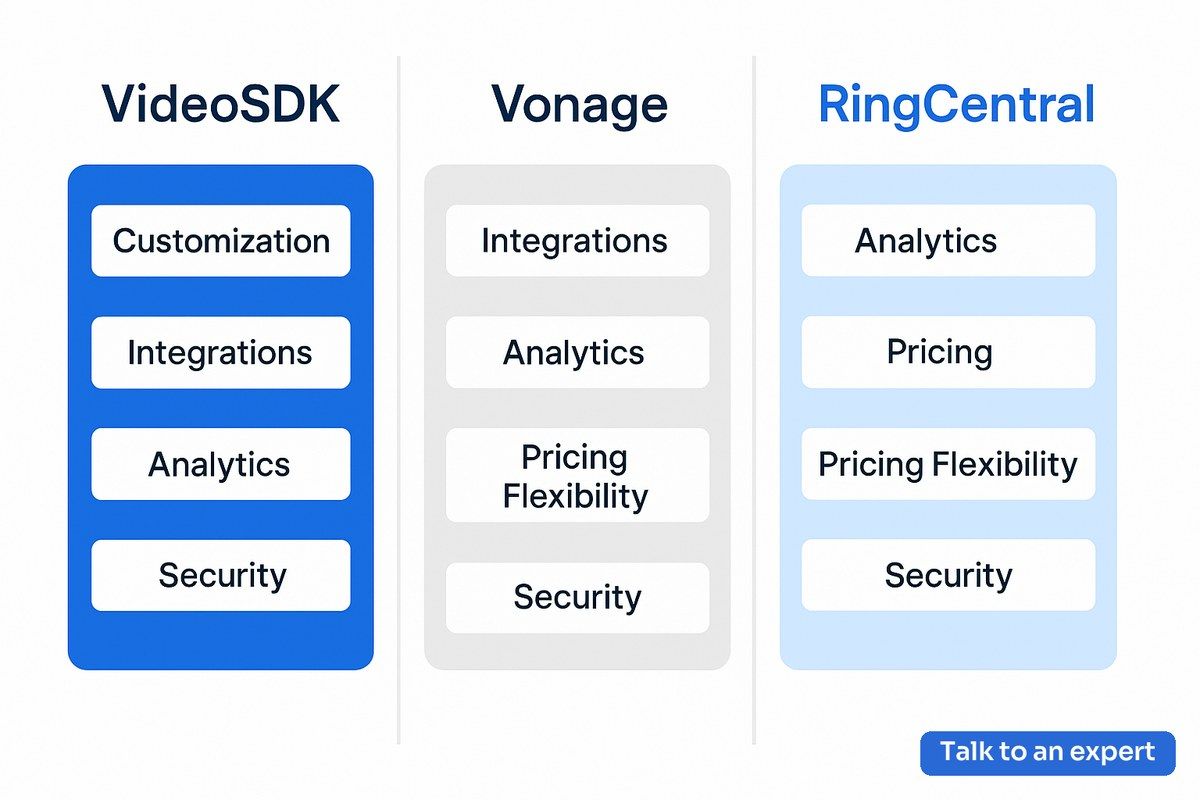
In the ongoing "vonage vs ringcentral" comparison, the right choice depends on your business’s size, goals, and technical requirements. Vonage is best suited for small to midsize organizations prioritizing ease of use and affordability, while RingCentral excels for enterprises demanding advanced features, deep integrations, and robust support. For companies seeking a flexible, customizable solution, VideoSDK stands out as a forward-thinking platform that can be tailored to specific needs. As you evaluate your options for 2026, consider how each solution aligns with your long-term communication strategy and growth ambitions. The "vonage vs ringcentral" decision is not just about today’s needs, but about preparing your business for the evolving demands of tomorrow’s digital workplace.
Step-by-Step AI Voice Agent Quickstart
FAQ