


The Power of Phonemes: Unlocking New Value in Speech Technology
Behind every breakthrough in modern speech technology lies an unsung hero: the phoneme. This approachs, the smallest distinct units of sound in language, power the most advanced speech recognition, conversational AI, and real-time voice processing systems in 2026. For business leaders, product managers, and entrepreneurs, understanding the strategic power of phoneme technology is no longer optional, it's an imperative. From unlocking hyper-accurate transcriptions to enabling truly inclusive digital experiences, phoneme-centric solutions are transforming how organizations interact with customers and drive ROI. In this article, we'll decode the business value of phoneme technology, explore real-world use cases, and provide a practical blueprint for building the next generation of speech-enabled products. The phoneme is at the heart of this transformation, shaping the future of digital communication and user engagement.
Phoneme Fundamentals: The Building Blocks of Speech Intelligence
A this technology is not just a linguistic curiosity, it's the foundation of digital speech intelligence. Linguistically, a these solutions is the smallest sound unit that can distinguish meaning between words (for example, the difference between "bat" and "pat"). In speech technology, recognizing these units enables systems to segment, analyze, and interpret spoken language with precision.
Let's clarify some related concepts:
| Term | Definition |
|---|---|
| Phone | Any distinct speech sound or gesture |
| Phoneme | Smallest unit of sound that carries meaning |
| Allophone | Variations of a this approach that do not change meaning |
Digital systems leverage sophisticated algorithms to detect and segment this technologys from audio streams, mapping them to linguistic meaning. This process is foundational for building natural language understanding and real-time speech processing capabilities. Importantly, phoneme sets vary across languages, a crucial factor for businesses operating globally. Adapting to these differences is key to delivering localized and culturally relevant speech services. For a comprehensive understanding of the architecture behind these solutions, you can refer to the AI voice Agent core components overview.
The science of phoneme recognition involves several technical layers. First, audio signals are digitized and processed to identify the boundaries between different sounds. Advanced machine learning models, such as deep neural networks, are trained on vast datasets to distinguish between subtle variations in pronunciation. These models must account for coarticulation, where the articulation of one sound affects the next, and for speaker variability, such as accent, pitch, and speed. By focusing on the phoneme, speech technology can achieve a level of granularity that is unattainable with word-level or syllable-level analysis alone. This enables more accurate speech-to-text conversion, improved voice synthesis, and better language understanding for AI systems.
From Classroom to Boardroom: Why Phonemes Now Matter for Business
These solutionss were once the domain of linguists and educators. Today, they are at the heart of enterprise speech solutions. The leap from academic theory to boardroom strategy is driven by the need for unparalleled accuracy, speed, and personalization in voice-driven applications.
Consider the following business-critical use cases:
- Real-time Transcription: Phoneme-level recognition eliminates ambiguity, boosting accuracy for meeting notes, legal records, and healthcare documentation. Leveraging tools like the OpenAI STT Plugin for voice agent can further enhance transcription quality and speed.
- Voice Authentication: Unique phoneme patterns enable secure, frictionless user verification.
- Accessibility: This approach technology powers assistive tools for users with speech or hearing impairments, broadening market reach. For example, integrating Silero Voice Activity Detection can help systems better detect speech activity, even in challenging environments.
- Personalized Voice Agents: By understanding speech at the phoneme level, AI agents deliver contextually relevant, human-like interactions.
This technology-enabled intelligence isn't just a technical upgrade, it's a strategic lever for ROI. Enhanced accuracy reduces costly errors, real-time responses improve customer satisfaction, and personalized experiences drive loyalty and new revenue streams.
| Feature | Traditional Speech Tech | Phoneme-Enabled Solutions |
|---|---|---|
| Accuracy | Moderate | High |
| Speed | Variable | Real-time |
| Personalization | Limited | Advanced |
| Cost | Higher (error-driven) | Lower (efficiency gains) |
The adoption of phoneme technology empowers organizations to address a wider range of customer needs. For example, in global enterprises, these solutions-based systems can be tailored to support multilingual environments, ensuring that users from different linguistic backgrounds receive the same high level of service. This adaptability is crucial for companies looking to expand internationally or serve diverse populations. Additionally, the granular data provided by phoneme analysis can fuel advanced analytics, helping businesses identify trends in customer interactions, optimize workflows, and develop targeted training programs for staff. By leveraging the power of the phoneme, companies can unlock new levels of operational efficiency and competitive differentiation.
The Pain Points: Challenges in Leveraging Phoneme Technology
While the promise of this approach-driven solutions is immense, the path to implementation is not without obstacles. Technically, accurate this technology segmentation is challenging, especially in noisy environments or with diverse accents. Real-time processing demands ultra-low latency, while scaling to millions of users introduces concurrency and reliability headaches. Utilizing an Audio Denoising Plugin can help mitigate the impact of background noise and improve segmentation accuracy.
On the business side, organizations must weigh the cost of integration, the scalability of their chosen tech stack, and the rigorous demands of privacy and security. Sensitive speech data must be protected, and compliance with regional regulations is non-negotiable.
Here's a high-level view of a typical speech AI pipeline leveraging phoneme detection:
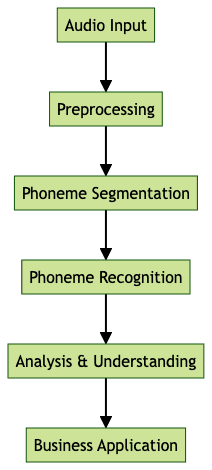
Each stage introduces its own latency and security considerations, underscoring the need for an integrated, robust orchestration layer.
Another key challenge is the quality and diversity of training data. Phoneme recognition models require vast amounts of annotated audio data, representing different languages, dialects, and speaking styles. Without sufficient data, models may struggle with generalization, leading to decreased accuracy in real-world scenarios. Furthermore, ethical considerations come into play when collecting and processing voice data, especially in regulated industries such as healthcare and finance. Organizations must establish clear data governance policies and ensure transparency with users regarding how their voice data is used and protected.
Finally, the rapid pace of innovation in speech technology means that businesses must continuously evaluate and update their phoneme processing pipelines. Staying ahead of the curve requires ongoing investment in research and development, as well as partnerships with leading technology providers. By proactively addressing these challenges, organizations can maximize the value of their phoneme-driven solutions and maintain a competitive edge in the market.
Practical Applications: Transforming Products and Customer Experiences
Phoneme technology is not just a theoretical advance, it's actively reshaping industries and customer experiences right now.
- Healthcare: Real-time, phoneme-accurate transcription supports telehealth consultations, ensuring medical records are precise and compliant.
- EdTech: Personalized pronunciation feedback and adaptive language learning become possible, enabling truly engaging digital classrooms.
- Customer Support: Voice bots equipped with phoneme intelligence understand customer intent more deeply, resolving issues faster and boosting satisfaction.
- Accessibility: Speech-to-text and text-to-speech tools, powered by phoneme-level processing, empower users with disabilities and open new market segments.
Tangible benefits are clear:
- Compliance: Accurate records and secure data handling meet industry standards.
- Inclusion: Products become accessible to diverse users, supporting ESG and growth mandates.
- Efficiency: Automation and real-time responses reduce resource overhead.
- New Revenue Streams: Premium features and differentiated user experiences attract new customers.
For product managers, building phoneme-powered features starts with ideation workshops: map user journeys, identify speech friction points, and envision how these solutions-level insights can create smoother, smarter interactions. To measure the impact of these features, leveraging AI voice Agent Session Analytics can provide actionable insights and drive continuous improvement.
Beyond these core industries, phoneme technology is fueling innovation in entertainment, automotive, and smart home sectors. In entertainment, real-time dubbing and voice synthesis allow content to be localized for global audiences, enhancing user engagement. Automotive systems use this technology recognition to improve voice commands, making in-car experiences safer and more intuitive. Smart home devices leverage these solutions analysis to better understand user intent, even in noisy environments with multiple speakers. By embedding this approach intelligence across diverse product lines, companies can deliver seamless, context-aware interactions that delight users and set new standards for digital experiences.
The Builder's Blueprint: Bringing Phoneme Intelligence to Your Product
The Core Components You'll Need
To create a robust this technology-driven solution, your architecture must integrate several critical components:
| Component | Description |
|---|---|
| Data Sources | High-quality, diverse audio samples |
| Data Labeling | Phoneme-accurate annotation for training and validation |
| Processing Engine | Algorithms for segmentation and recognition |
| Real-Time Streaming | Low-latency, scalable audio processing |
| Analytics | Dashboards and insights for continuous improvement |
If you're looking to get started quickly, the Voice Agent Quick Start Guide offers step-by-step instructions for building and deploying your own AI voice agent.
A successful phoneme-driven product also requires a feedback loop for continuous learning. By collecting user feedback and monitoring system performance, teams can identify areas for improvement and retrain models to address new use cases or emerging linguistic trends. Integration with analytics platforms enables data-driven decision-making, helping organizations optimize their speech technology investments and deliver maximum value to users. Additionally, collaboration between linguists, data scientists, and product managers is essential to ensure that phoneme models are both accurate and aligned with business objectives.
The Critical Challenge: Real-Time Orchestration
Business leaders want instant, reliable results. Achieving real-time this approach processing at scale is a formidable challenge. The orchestration layer must juggle live audio streams, manage latency, ensure concurrency for thousands of sessions, and deliver ironclad reliability. Pitfalls include:
- Latency Spikes: Even minor delays degrade user experience and trust.
- Concurrency Bottlenecks: Scaling to many simultaneous sessions can expose architectural weaknesses.
- Reliability Gaps: Downtime or errors in processing can have regulatory and reputational costs.
To address these challenges, organizations should invest in robust infrastructure and adopt best practices for system monitoring and fault tolerance. Load balancing, horizontal scaling, and automated failover mechanisms are critical for maintaining performance under heavy loads. Regular stress testing and performance benchmarking help identify potential bottlenecks before they impact users. By taking a proactive approach to orchestration, businesses can ensure that their phoneme-driven solutions deliver consistent, high-quality results at scale.
The Solution: The VideoSDK Agents Framework
This is where the VideoSDK Agents Framework becomes a game-changer. Purpose-built for speech AI applications, the framework abstracts away the orchestration headaches, letting your team focus on business logic and value creation.
Key features include:
- Real-time Audio Streaming: Ultra-low latency and high concurrency by design.
- Flexible Integration: Easily connect to your preferred AI/ML models and analytics platforms.
- Enterprise-Grade Security: End-to-end encryption and compliance-ready by default.
- Scalability: Seamlessly grow from MVP to millions of users.
Case in Point: A leading EdTech provider reduced time-to-market by 60% and cut operational costs by 40% by adopting VideoSDK for their phoneme-based pronunciation app. Their team rapidly iterated on features, confident that orchestration and reliability were handled.
With VideoSDK, building this technology intelligence into your product is not just feasible, it's a strategic advantage. For guidance on scaling your solution, see the AI voice Agent deployment documentation for best practices and deployment strategies.
The VideoSDK Agents Framework also supports rapid prototyping and experimentation, enabling teams to test new phoneme-driven features without disrupting existing workflows. Its modular architecture allows for easy integration with third-party APIs, cloud services, and custom AI models. This flexibility is essential for organizations that need to adapt quickly to changing market demands or regulatory requirements. By leveraging the power of the VideoSDK platform, businesses can accelerate innovation cycles, reduce development costs, and deliver cutting-edge speech technology solutions that set them apart from the competition.
Conclusion: The Future Is Phoneme-Driven
In 2025 and beyond, the organizations that harness the power of these solutions technology will define the next era of digital products. This approach-level intelligence delivers the accuracy, speed, and personalization required to win in a voice-first world. The business case is clear: improved customer experience, operational efficiency, and new revenue streams.
Now is the time to explore how VideoSDK can accelerate your journey to phoneme-driven innovation. Transform your products, delight your users, and lead the market, one sound at a time. By embracing the these solutions as the cornerstone of speech technology, your organization can unlock unprecedented value, foster deeper connections with users, and stay ahead in the rapidly evolving digital landscape.
Step-by-Step AI Voice Agent Quickstart
FAQ