


LiveKit Voice Agent Alternatives: Best Options
In 2026, businesses seeking advanced communication platforms are increasingly evaluating LiveKit voice agent alternatives to support scalable, real-time AI voice interactions. With customer expectations rising and operational demands expanding, selecting the right voice agent solution is critical for business growth, customer satisfaction, and technical agility. The demand for robust, flexible, and future-proof voice AI solutions has never been higher, and organizations are actively comparing LiveKit voice agent alternatives to ensure they can deliver seamless, high-quality voice experiences to users across the globe.
For decision-makers, the best LiveKit voice agent alternatives offer improved scalability, lower latency, and broader multilingual support compared to LiveKit. These platforms help organizations overcome limitations in performance or global reach, enabling seamless integration with existing workflows and delivering superior user experiences. As the voice AI landscape evolves, businesses must assess not only the technical features but also the long-term strategic fit of their chosen platform.
What is LiveKit?
LiveKit is a developer-focused platform for building real-time voice applications. It equips engineers with APIs and SDKs to embed voice communication into digital products, supporting use cases from customer support to in-app collaboration. While LiveKit provides a solid foundation for voice functionality, it can struggle with scalability and latency as user numbers grow. Its limited multilingual capabilities may also pose challenges for global enterprises aiming to deliver localized experiences at scale. As a result, many organizations begin to explore LiveKit voice agent alternatives that can better meet their evolving needs.
Understanding LiveKit's Architecture
LiveKit utilizes a centralized server-based architecture, exposing APIs that developers integrate into their apps for real-time voice. This design simplifies initial deployment but can create bottlenecks as concurrent users increase, leading to higher latency and potential service interruptions during peak loads. For businesses with fluctuating or rapidly growing user bases, these architectural constraints can become a significant barrier to delivering consistent, high-quality voice experiences. As voice AI adoption accelerates, the need for platforms that can handle dynamic scaling and global distribution becomes more urgent, prompting many to consider LiveKit agent alternatives.
Use Cases for LiveKit
LiveKit is often chosen by small and midsize businesses needing straightforward voice features, such as real-time customer support, virtual events, or in-app voice chat. Its ease of integration makes it suitable for startups and agile teams launching MVPs or niche products. However, as organizations scale or expand internationally, LiveKit's architectural and feature limitations may prompt a search for more robust alternatives. Businesses that anticipate rapid growth, require advanced AI voice features, or need to support multiple languages often find that LiveKit voice agent alternatives provide the flexibility and capabilities necessary for long-term success.
Key Features and Capabilities
LiveKit's core capabilities include:
- Real-time Communication: Enables instant voice interactions within digital environments.
- Developer Tooling: Offers SDKs and APIs for rapid integration and customization.
- Basic Multilingual Support: Supports a limited set of languages, restricting true global reach.
While these features meet the needs of early-stage projects, they may not suffice for enterprises requiring enterprise-grade scalability, advanced analytics, or seamless multilingual experiences. The need for more comprehensive solutions becomes apparent as organizations strive to deliver personalized, AI-powered voice interactions to a diverse, global audience.
Enhancing Communication with LiveKit
LiveKit can improve team and customer communication by providing a reliable, developer-friendly platform for voice. Its tools allow for rapid prototyping and deployment of voice features. Yet, for organizations anticipating high concurrency, global expansion, or the need for advanced AI-driven voice analytics, exploring LiveKit voice agent alternatives becomes essential to avoid future technical debt and customer dissatisfaction. Modern businesses require platforms that not only support current needs but also offer the flexibility to adapt as market demands and user expectations evolve. This is where agent alternatives with advanced AI capabilities, robust analytics, and seamless integration options stand out.
Pros and Cons
Pros
- Comprehensive developer tools for rapid voice app development.
- Real-time communication capabilities for interactive experiences.
- Straightforward implementation for MVPs and small-scale projects.
Cons
- Scalability challenges as concurrent user numbers rise.
- Increased latency during peak usage, impacting real-time quality.
- Limited multilingual support, restricting international growth.
- Fewer advanced AI features compared to leading voice agent alternatives.
Top Alternatives to LiveKit
VideoSDK
VideoSDK is a leading alternative that addresses LiveKit's core limitations. It delivers:
- Ease of Integration: Simple SDKs and APIs for frictionless onboarding.
- Scalability: Cloud-native infrastructure enabling high concurrency.
- Latency: Optimized for ultra-low latency across geographies.
- Multilingual Support: Supports a wide array of languages for global use.
- Cost: Transparent, competitive pricing.
- Support: Dedicated technical and onboarding support for enterprise clients.
- Advanced AI Capabilities: Built-in support for AI-driven voice analytics and intelligent routing.
Why Choose VideoSDK?
VideoSDK is built for businesses that demand reliability and scale. Its architecture supports thousands of simultaneous voice sessions without service degradation. Extensive multilingual support and robust analytics make it a top choice for global enterprises and fast-growing startups. VideoSDK's commitment to developer experience and customer success ensures a smooth transition from LiveKit or other platforms. The platform is designed to help organizations future-proof their voice AI stack, offering flexibility for custom integrations, compliance, and proprietary workflows. For companies seeking LiveKit voice agent alternatives that can grow with their business, VideoSDK stands out as a comprehensive solution.
Build-Your-Own with VideoSDK Agents
For organizations with unique requirements, the VideoSDK Agents framework empowers teams to design custom AI voice agents. This approach offers:
- Full Feature Control: Tailor voice logic, routing, and integrations to specific business needs.
- Human-in-the-Loop: Blend AI automation with human oversight for complex interactions.
- Advanced Analytics: Deep visibility into agent performance and user journeys.
- Custom Compliance: Adapt workflows to meet regulatory or industry-specific standards.
Building with VideoSDK Agents is ideal for enterprises seeking differentiation, compliance, or proprietary workflows in their voice AI stack. The flexibility to create a tailored automated voice assistant ensures that organizations can address unique customer needs, integrate with existing systems, and maintain control over data and privacy. This level of customization is often a key factor for businesses comparing LiveKit agent alternatives, especially in regulated sectors like healthcare, finance, or government.
Twilio Flex
Twilio Flex is a cloud-based contact center platform that serves as a strong LiveKit voice agent alternative for businesses prioritizing customization and CRM integration. Key features include:
- Customization: Highly configurable UI and workflows for bespoke contact centers.
- Integration: Deep connectivity with popular CRMs and business tools.
- Scalability: Handles large-scale, multi-channel customer interactions.
- Support: Extensive documentation and active developer community.
- Omnichannel Capabilities: Unify voice, chat, messaging, and digital channels in one platform.
Twilio Flex in Action
Twilio Flex powers enterprise-grade contact centers, enabling businesses to unify voice, chat, and digital channels. Its flexibility allows teams to design tailored customer journeys, automate repetitive tasks, and scale support operations globally. Flex's robust API ecosystem accelerates innovation and integration with existing business systems. Companies looking for LiveKit voice agent alternatives often choose Twilio Flex for its ability to adapt to complex workflows, support high volumes of interactions, and provide a seamless customer experience across multiple channels. The platform's strong developer support and active community also make it easier for teams to implement and optimize their solutions.
Amazon Connect
Amazon Connect is AWS's cloud-native contact center solution, offering a compelling alternative for organizations seeking AI-driven customer engagement. Standout capabilities include:
- AI Integration: Seamlessly connects with AWS AI services for natural language understanding and analytics.
- Cost-Effectiveness: Pay-as-you-go pricing minimizes upfront investment.
- Scalability: Built on AWS's global infrastructure for elastic scaling.
- Intelligent Routing: Uses AI to direct calls and messages to the right agent or automated system.
- Real-Time Analytics: Provides actionable insights into customer interactions and agent performance.
Leveraging Amazon Connect
Amazon Connect empowers businesses to deploy intelligent, scalable contact centers with minimal operational overhead. Its integration with AWS AI tools enables real-time transcription, sentiment analysis, and personalized customer experiences. The flexible pricing model appeals to both SMBs and large enterprises seeking predictable costs and global reach. For organizations evaluating LiveKit voice agent alternatives, Amazon Connect offers the advantage of deep AI integration, robust analytics, and the ability to scale rapidly as business needs change. The platform's global infrastructure ensures reliable performance and low latency for users worldwide.
Comparison Table: LiveKit vs. Alternatives
| Feature | LiveKit | VideoSDK | Twilio Flex | Amazon Connect |
|---|---|---|---|---|
| Ease of Integration | Moderate | High | High | Moderate |
| Scalability | Limited | Excellent | High | Excellent |
| Latency | Higher | Lower | Moderate | Lower |
| Multilingual Support | Limited | Extensive | Moderate | Extensive |
| Cost | Varies, potentially higher | Competitive, cost-effective | Varies | Pay-as-you-go |
| Support | Basic | Comprehensive | Strong | Comprehensive |
| AI Capabilities | Basic | Advanced | Advanced | Advanced |
When to Choose LiveKit vs. Building with VideoSDK
Choose LiveKit if your requirements are basic, your user base is stable, and you do not anticipate rapid scaling or global expansion. LiveKit may suit early-stage projects or pilots where simplicity is the priority. Opt for VideoSDK if you need a future-proof platform with high scalability, low latency, and advanced multilingual support. Building with VideoSDK Agents is recommended for businesses seeking complete control and customization over their AI voice workflows, especially in regulated or highly differentiated industries. As your organization grows, the ability to quickly adapt to new requirements and integrate advanced AI features becomes a key differentiator, making LiveKit voice agent alternatives like VideoSDK a strategic investment.
Choosing Twilio Flex or Amazon Connect
Twilio Flex is best for enterprises needing a highly customizable, omnichannel contact center that integrates deeply with existing CRM and business systems. Its flexibility and developer resources make it a top choice for complex customer support operations. Amazon Connect is ideal for organizations prioritizing AI-powered customer engagement and elastic scaling, with the added benefit of seamless AWS ecosystem integration. Both platforms are strong LiveKit voice agent alternatives for businesses looking to enhance customer experience, automate workflows, and scale operations efficiently.
Implementation Considerations for Teams Building Voice AI
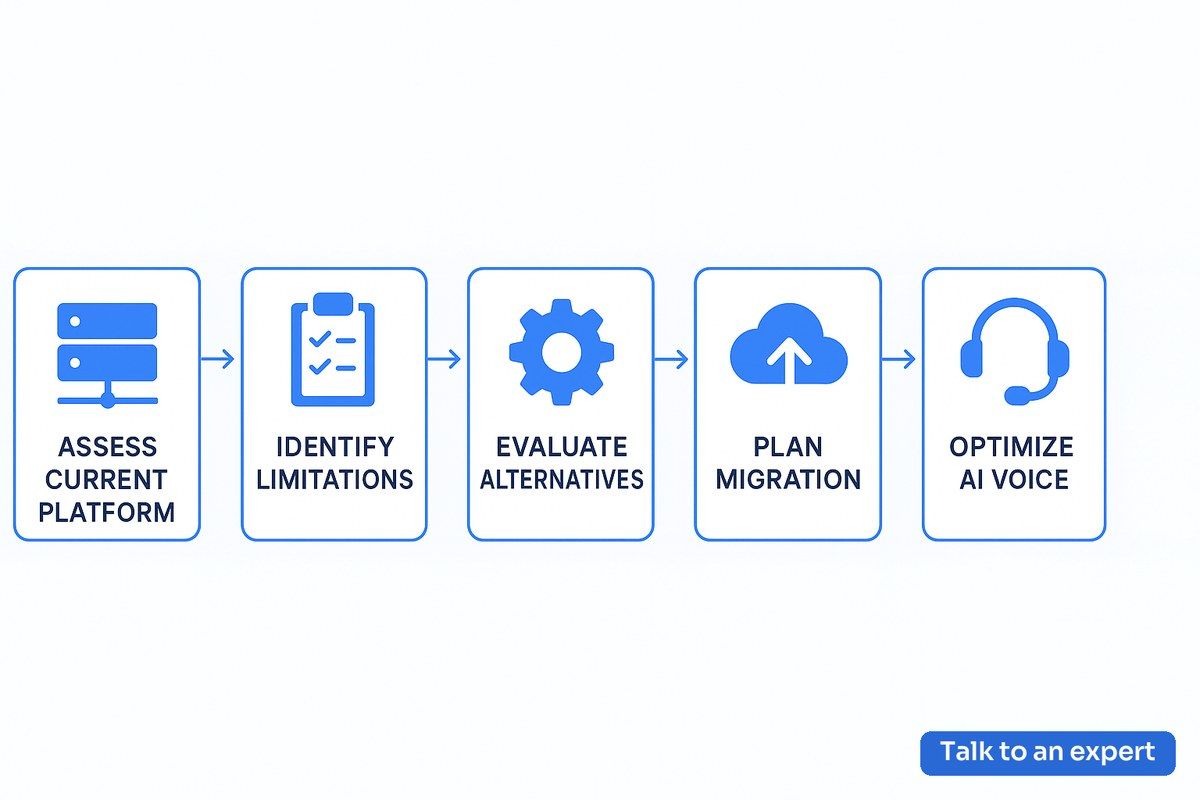
Migrating from LiveKit or launching a new voice agent platform requires a strategic approach. Teams should consider:
- Assessment: Audit current workflows, user needs, and technical constraints.
- Planning: Define migration goals, success metrics, and timelines.
- Implementation: Ensure data integrity and minimal disruption during platform transition.
- Testing: Leverage AI voice Agent tracing and observability for end-to-end monitoring and troubleshooting.
- Training: Upskill team members on new platform features and best practices.
Detailed Transition Strategy
- Stakeholder Engagement: Involve IT, business, and customer-facing teams from the outset to align objectives and secure buy-in.
- Pilot Testing: Run controlled pilots to surface integration or performance issues before full deployment.
- Feedback Loops: Collect user and stakeholder feedback to refine configuration and optimize adoption.
- Documentation and Knowledge Transfer: Maintain thorough documentation and facilitate knowledge sharing to ensure a smooth transition for all teams involved.
- Security and Compliance Review: Evaluate the new platform's compliance with industry standards and data privacy regulations to mitigate risk.
Training and Support
Robust training and ongoing support are essential for a successful migration or new deployment. Invest in comprehensive onboarding resources, including webinars, documentation, and hands-on tutorials. Engage with vendor support teams and leverage community forums to resolve issues quickly and foster continuous learning. This approach minimizes downtime and accelerates ROI on your chosen voice agent platform. Additionally, consider establishing internal champions or super-users who can provide peer support and drive adoption within your organization. Ongoing education and access to updated resources ensure your team remains proficient as new features and capabilities are introduced by your chosen LiveKit voice agent alternative.
Conclusion
For organizations seeking to future-proof their voice communication strategy, evaluating LiveKit voice agent alternatives is essential. VideoSDK stands out for its scalability, performance, and multilingual support, making it a compelling choice for businesses aiming to deliver world-class AI voice experiences. By adopting VideoSDK or another robust alternative, companies can unlock new levels of efficiency, customer engagement, and operational flexibility in 2026. The right platform enables seamless integration, advanced AI capabilities, and global reach, ensuring your business stays ahead in a rapidly evolving digital landscape. As the demand for intelligent voice solutions grows, choosing the best LiveKit voice agent alternatives will be a decisive factor in achieving long-term success.
External References
Step-by-Step AI Voice Agent Quickstart
FAQ