


Introduction
In the rapidly evolving landscape of voice AI technology, businesses searching for the best solutions often start with a deepgram voice agent review and alternatives. This article is designed for technology leaders, product managers, and entrepreneurs evaluating advanced voice AI platforms for real-time transcription, multilingual support, and seamless integration. Here, we deliver a detailed review of Deepgram's voice agent, highlight its strengths and weaknesses, and provide a side-by-side analysis of top alternatives, including custom builds with VideoSDK. For organizations exploring deepgram voice agent review and alternatives, the priority is measurable ROI and practical deployment.
For those seeking a quick answer: Deepgram is a leading voice AI platform offering robust speech-to-text and text-to-speech services, with high accuracy and multilingual support. However, alternatives like VideoSDK, AssemblyAI, Speechify, and BigSpeak each bring unique capabilities and trade-offs, so the right choice depends on your business’s need for customization, scalability, and integration flexibility.
What is Deepgram?
Deepgram is a sophisticated voice AI platform renowned for its robust suite of services, including Speech-to-Text, Text-to-Speech, and an advanced Voice Agent API. These services are designed to enhance communication by providing real-time transcription and multilingual support, critical for industries demanding high accuracy and speed. Deepgram's technology leverages deep learning models that continuously evolve, ensuring businesses benefit from cutting-edge AI advancements. According to Google Cloud Research, the use of deep learning in voice AI is a key driver for improved accuracy and adaptability in enterprise environments.
Deep Learning Models
Central to Deepgram's technology are its deep learning models, which provide a powerful framework for voice recognition. These models are trained on diverse datasets, enabling them to understand various accents and dialects, an essential feature for global businesses. The continuous refinement of these models ensures users have access to the most accurate and efficient voice recognition capabilities available. When planning deepgram voice agent review and alternatives, align stakeholders on data privacy, workflow design, and clear escalation paths.
To illustrate, consider a multinational corporation that operates in regions with diverse linguistic backgrounds. Deepgram's models can adapt to the local dialects, ensuring that communication remains clear and effective across all branches, thereby improving operational consistency and customer satisfaction.
Use Cases Across Industries
Deepgram's voice AI solutions are versatile, applicable across numerous sectors. In healthcare, real-time transcription aids in maintaining accurate patient records. In customer service, voice agents streamline operations by managing routine inquiries, allowing human agents to focus on complex issues. The education sector benefits from real-time transcription of lectures, enhancing accessibility for students. According to McKinsey, AI-driven transcription is transforming documentation and compliance in regulated industries.
Implementation in Healthcare
In healthcare, integrating Deepgram's voice AI can significantly improve patient care and operational efficiency. By embedding real-time transcription into electronic health records (EHR) systems, healthcare providers can ensure accurate documentation, reduce administrative burdens, and enhance patient interactions, ultimately improving patient outcomes and streamlining workflows.
Moreover, consider the scenario of a busy hospital where doctors need to update patient records swiftly. Deepgram's real-time transcription allows them to dictate notes directly into the system, minimizing errors and freeing up more time for patient care. Leaders evaluating deepgram voice agent review and alternatives often start with one high-volume workflow before scaling further.
Enhancing Customer Service
For customer service, Deepgram's voice agents can be integrated into call centers to efficiently handle high volumes of calls. By automating routine inquiries and providing instant responses, businesses can reduce wait times and enhance customer satisfaction. Additionally, voice agents can escalate complex issues to human agents, ensuring customers receive the best possible service.
For example, a telecommunications company might deploy Deepgram's voice agents to handle billing inquiries, freeing up human agents to address more technical issues, thus optimizing resource allocation and improving service quality.
Key Features and Capabilities
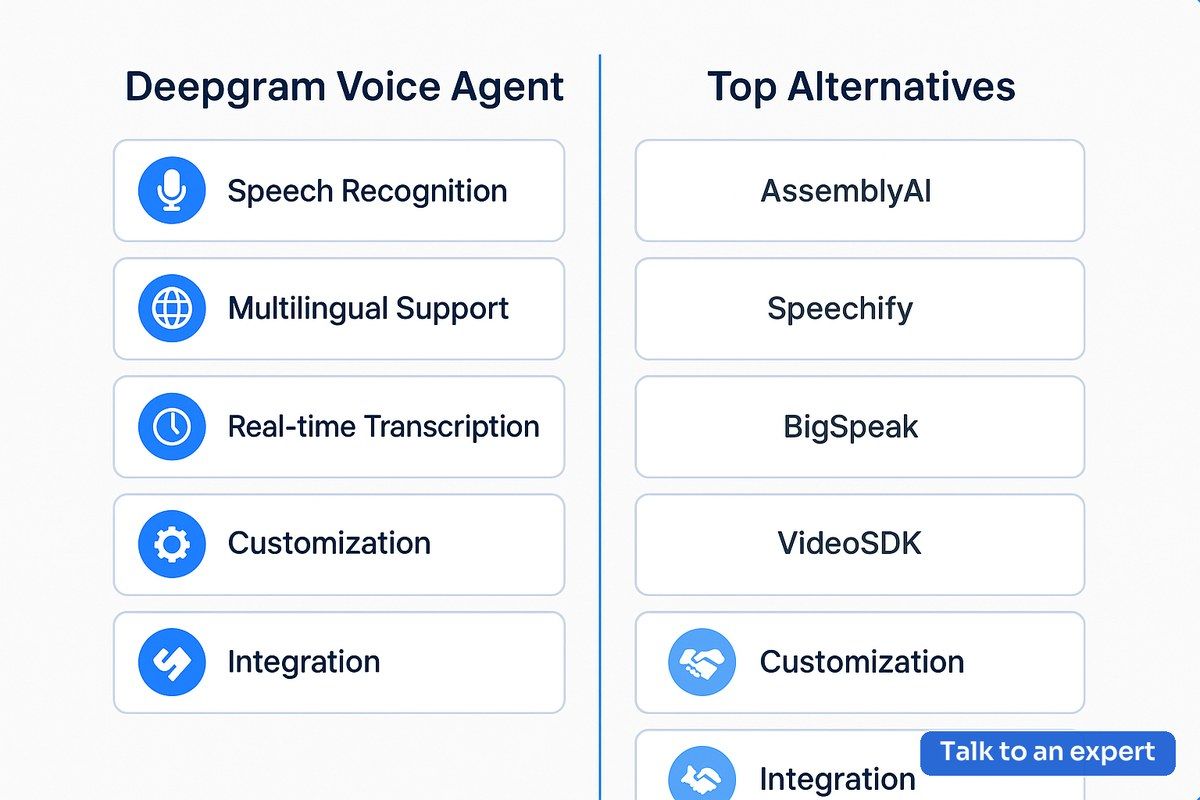
Deepgram is celebrated for its high accuracy rates, customizable models, and seamless integration capabilities. These features significantly enhance operational efficiency and promise substantial returns on investment (ROI). Businesses can tailor Deepgram's models to meet specific industry needs, enhancing user experience. Key features include:
- High Accuracy: Deepgram's AI models deliver precise transcriptions, essential for industries where accuracy is paramount.
- Customizable Models: Businesses can adapt the technology to their specific needs, ensuring a tailored solution.
- Multilingual Support: Facilitates communication across diverse languages, making it suitable for global enterprises.
- Real-time Processing: Provides instant transcription and analysis, crucial for time-sensitive operations. A practical roadmap for deepgram voice agent review and alternatives begins with a pilot use case, defined KPIs, and a path to production.
Integration and Scalability
A standout feature of Deepgram is its ability to integrate seamlessly with existing systems. This capability is crucial for businesses looking to enhance their current infrastructure without overhauling it completely. Furthermore, Deepgram's scalable solutions allow businesses to start small and expand as their needs grow, making it a cost-effective choice for companies of all sizes.
Consider a startup that initially requires basic transcription services but plans to expand into multilingual support as it grows. Deepgram's scalable architecture can accommodate this growth, allowing the startup to upgrade its services without significant downtime or cost.
Customization for Industry Needs
Deepgram's customizable models allow businesses to fine-tune their voice AI solutions to specific industry requirements. For instance, in the legal industry, precise transcription is crucial for maintaining accurate records of legal proceedings. By customizing the models to understand legal terminology and jargon, firms can ensure that their documentation is both accurate and reliable.
Pros and Cons
Pros
- High Accuracy: Provides precise transcriptions, crucial for industries requiring high accuracy.
- Customizable Models: Allows businesses to adapt the technology to their specific needs, offering a tailored solution.
- Multilingual Support: Facilitates communication across diverse languages, making it suitable for global enterprises.
Cons
- Integration Complexity: Some users report challenges when integrating with existing systems, which can hinder deployment.
- Cost Considerations: While competitive, pricing can vary significantly based on specific usage patterns, potentially impacting budget planning.
Top Alternatives to Deepgram Voice Agent
When considering a deepgram voice agent review and alternatives, it is essential to evaluate the strengths and weaknesses of competing platforms. Each alternative offers different advantages based on your business’s priorities, whether it is seamless integration, large-scale processing, or deep customization.
AssemblyAI
AssemblyAI offers robust speech recognition capabilities with flexible APIs that simplify integration. It is praised for its straightforward setup and cost-effective solutions, though it may lack some advanced features of Deepgram.
Integration and Features
AssemblyAI's API is designed for ease of use, enabling developers to quickly integrate speech recognition into their applications. While it may not offer the same level of customization as Deepgram, its simplicity and affordability make it an attractive option for startups and small businesses.
Speechify
Speechify excels in accessibility and user-friendly interfaces, offering exceptional text-to-speech services. It's ideal for businesses focusing on enhancing accessibility and user engagement.
Accessibility Focus
Speechify's emphasis on accessibility makes it a valuable tool for educational institutions and organizations that prioritize inclusivity. Its text-to-speech capabilities can convert written content into audio, making information more accessible to individuals with visual impairments or reading difficulties.
BigSpeak
BigSpeak is known for its large-scale voice processing capabilities, excelling in environments requiring extensive data handling and high throughput.
Large-scale Processing
BigSpeak's infrastructure is designed to handle vast amounts of data, making it suitable for enterprises with significant voice processing needs. Its ability to manage high throughput ensures that businesses can maintain efficient operations even during peak times. Teams that adopt deepgram voice agent review and alternatives typically measure success through faster response times and lower handle costs.
VideoSDK
VideoSDK offers a unique approach by allowing businesses to build custom voice AI solutions tailored to their specific needs. With extensive documentation and support, VideoSDK provides unmatched flexibility and control over the voice AI development process.
Customization and Support
VideoSDK stands out for its customizable solutions, allowing businesses to develop voice AI applications that align perfectly with their operational requirements. The platform's comprehensive documentation and robust support system enable teams to overcome challenges during development and deployment.
For example, a company looking to integrate voice AI into its existing video conferencing tools can use VideoSDK to create a seamless solution that enhances communication and collaboration. According to NVIDIA AI Resources, leveraging customizable AI frameworks can accelerate innovation and ensure alignment with unique business needs.
Comparison Table
| Feature/Capability | Deepgram | AssemblyAI | Speechify | BigSpeak | VideoSDK | |
|---|---|---|---|---|---|---|
| Real-time Transcription | Yes | Yes | No | Yes | Yes | |
| Multilingual Support | Yes | Yes | No | Yes | Yes | |
| Customizable Models | Yes | No | Yes | No | Yes | |
| Large-scale Processing | No | No | No | Yes | Yes | |
| Integration Flexibility | Moderate | High | Moderate | Moderate | High | In practice, deepgram voice agent review and alternatives works best when integrated with existing CRM, telephony, and support tools. |
When to Choose Deepgram vs Building with VideoSDK
Choosing between Deepgram and building with VideoSDK depends on your specific needs. Deepgram offers ready-to-use solutions with high accuracy and multilingual support, making it ideal for businesses looking for immediate deployment. However, if customization and integration with existing systems are priorities, VideoSDK provides unmatched flexibility and control, allowing businesses to develop bespoke solutions that align with their unique requirements.
Strategic Decision-Making
When deciding between these platforms, consider the long-term strategic goals of your business. If rapid deployment and proven technology are crucial, Deepgram offers a reliable choice. Conversely, if your business requires a tailored solution with the potential for future expansion and customization, VideoSDK's platform is a more suitable option. Industry experts at Gartner emphasize aligning technology choices with strategic business objectives for maximum ROI.
Industry-Specific Considerations
For industries like finance or healthcare, where data security and compliance are paramount, VideoSDK's customizable approach allows for the integration of specific security protocols and compliance measures. This ensures that sensitive information is handled appropriately, aligning with industry standards and regulations. Across industries, deepgram voice agent review and alternatives is most effective when paired with human oversight for complex edge cases.
Implementation Considerations for Teams Building Voice AI
When building voice AI solutions, consider factors such as integration complexity, scalability, and cost. VideoSDK offers extensive documentation and support, making it easier to tailor solutions to your needs. For a comprehensive start, refer to the Voice Agent Quick Start Guide. Additionally, understanding AI voice Agent Sessions is crucial for maintaining effective interactions. For further insights, explore NVIDIA AI Resources and Google Cloud Research for cutting-edge developments in AI technology. For organizations exploring deepgram voice agent review and alternatives, the priority is measurable ROI and practical deployment.
Workflow Optimization
To optimize workflows when implementing voice AI, ensure that your team is familiar with the tools and resources available. Regular training sessions and workshops can enhance team proficiency, leading to more efficient deployment and operation of voice AI technologies. Workflow optimization can also involve automating repetitive tasks, integrating analytics for performance tracking, and establishing feedback loops for continuous improvement.
Training and Support
Investing in ongoing training and support for your team can significantly impact the success of your voice AI implementation. By keeping your team updated on the latest features and best practices, you can ensure that your voice AI solutions are used to their full potential, maximizing ROI and operational efficiency. Consider leveraging third-party resources such as OpenAI Research for additional learning materials and best practices.
Conclusion
Exploring the deepgram voice agent review and alternatives highlights the potential of voice AI technology for 2026 and beyond. Platforms like VideoSDK empower businesses to develop custom solutions that enhance communication and drive efficiency. By understanding the unique capabilities and limitations of each platform, businesses can make informed decisions that align with their strategic goals. The right voice AI solution will depend on your priorities for accuracy, customization, scalability, and integration flexibility, ensuring your organization is ready for the next wave of voice-driven innovation.
FAQ