


Why Conversational AI Services Are Reshaping Business Communication
In 2026, digital transformation is accelerating, and conversational AI services are at the forefront of this evolution. Organizations are leveraging conversational AI services to automate customer interactions, deliver personalized experiences, and provide instant, always-on support. These solutions are rapidly becoming essential for businesses aiming to outperform their competitors in a fast-changing market.
Conversational AI services empower leaders to achieve operational efficiency, superior customer engagement, and round-the-clock availability. This guide will clarify the landscape, providing actionable insights for adopting conversational AI in your next digital product. Whether you are a product manager, entrepreneur, or innovation leader, you will learn how to harness these services for measurable ROI, and why choosing the right platform, such as VideoSDK, can accelerate your success.
What Are Conversational AI Services? Unpacking the Essentials
Conversational AI services are advanced technology solutions that enable machines to interpret, process, and respond to human language in natural, intuitive ways. Unlike early rule-based chatbots, modern conversational AI services use sophisticated natural language processing (NLP), machine learning, and real-time orchestration to deliver human-like interactions across channels.
There are three main categories of conversational AI services:
- Text-based agents: Powering chatbots, in-app messaging, and web chat for customer support and sales.
- Voice-based agents: Enabling voice assistants, IVR systems, and real-time voice bots for hands-free, natural conversations.
- Multimodal agents: Integrating text, voice, and video or AR elements to create immersive experiences in sectors like gaming, healthcare, and education.
If you want to build a voice-based agent, the Voice Agent Quick Start Guide provides a practical, step-by-step approach.
Core enabling technologies include NLP for understanding intent and context, machine learning for continuous learning, and real-time orchestration to ensure seamless, context-rich interactions across multiple platforms. These capabilities form the foundation of modern conversational AI services, allowing businesses to deliver smarter, more engaging digital experiences that adapt and improve over time.
Tangible Business Benefits: Why Leaders Are Doubling Down
Adopting conversational AI services is a strategic investment that yields measurable business outcomes. Here are the core benefits:
Cost Savings and Operational Efficiency
Conversational AI significantly reduces manual intervention in routine interactions. Organizations implementing conversational AI services often achieve operational cost reductions of 20-30% by automating support queries, appointment scheduling, and internal workflows. This shift enables teams to focus on higher-value activities and drives productivity gains.
Improved Customer Satisfaction and Loyalty
With real-time, context-aware support, customers receive faster, more personalized responses. No more waiting in queues or repeating information across channels. This leads to higher satisfaction scores and stronger brand loyalty, with many organizations experiencing notable improvements in Net Promoter Score (NPS) after deploying conversational AI services.
Enhanced Data Collection and Personalization
Conversational AI services generate valuable data with every interaction. These insights help businesses refine user profiles, identify unmet needs, and deliver more relevant recommendations. By combining AI-driven insights with web scraping tools, companies can further enrich personalization and support data-driven decision-making. This approach deepens customer engagement and supports smarter business strategies.
For a detailed look at the technology behind these solutions, explore the AI voice Agent core components overview.
ROI: Metrics That Matter
The table below highlights the business impact of conversational AI services:
| Metric | Before Conversational AI | After Conversational AI |
|---|---|---|
| Average response time | 20 minutes | 30 seconds |
| Cost per interaction | $6 | $1.50 |
| Customer satisfaction | 72% | 89% |
| First contact resolution | 58% | 85% |
| Lead conversion rate | 12% | 22% |
These improvements showcase how conversational AI services can deliver both immediate and long-term value, making them a compelling choice for forward-thinking organizations.
Common Use Cases: From Customer Support to Immersive Experiences
Conversational AI services are transforming a wide range of business functions. Here is how leading organizations are putting them to work:
Customer Service and Support Automation
Automate FAQs, troubleshoot issues, and resolve tickets faster, freeing live agents for complex cases. Conversational AI ensures consistent, accurate, and always-available support. To design effective customer interactions, understanding the conversation flow in AI voice Agents is essential for mapping intuitive dialogues.
Sales and Marketing
AI-powered agents qualify leads, guide prospects through the sales funnel, and answer product questions in real time. This accelerates conversions and improves pipeline velocity. When you are ready to launch, the AI voice Agent deployment guide offers best practices for deploying agents across channels.
Training, Onboarding, and Internal Knowledge Sharing
Conversational AI streamlines onboarding, delivers interactive training, and surfaces relevant knowledge for internal teams. This boosts learning and productivity. Monitoring your agent’s performance is crucial, leverage AI voice Agent Session Analytics to optimize user experiences.
Immersive Experiences: AR, VR, and 3D AI Characters
Innovative industries like gaming, healthcare, and education use multimodal conversational AI to create lifelike guides, virtual tutors, or patient assistants. These solutions enhance user engagement and accessibility. Integrating the Simli avatar plugin for AI voice Agents can bring your AI agents to life with realistic avatars for more immersive interactions.
Use Case Mapping Diagram
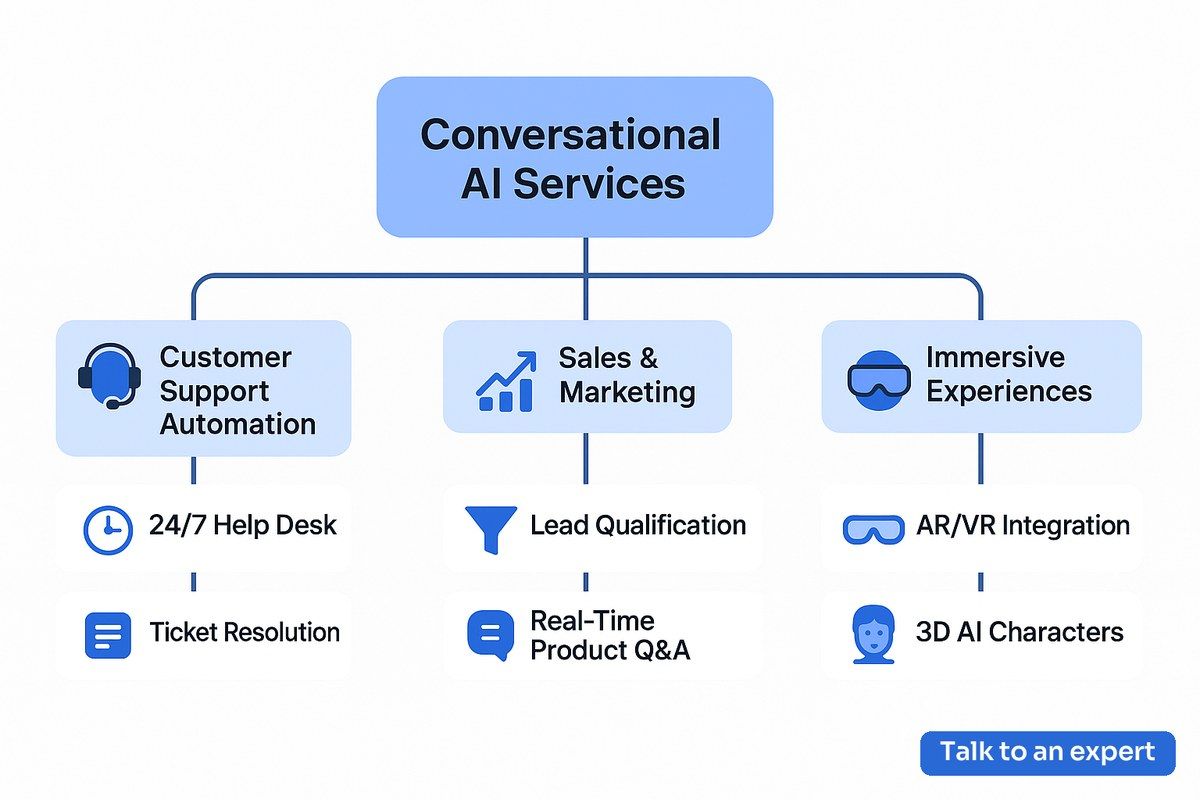
This diagram illustrates the broad applications of conversational AI services across business functions, highlighting their flexibility and scalability.
Key Challenges in Implementing Conversational AI Services
While conversational AI services offer significant advantages, they also present unique implementation challenges:
Integration with Legacy Systems and Data Silos
Enterprises often rely on complex, interconnected systems. Integrating conversational AI with platforms like CRMs, ERPs, and proprietary databases requires robust APIs and thoughtful architecture planning.
Maintaining Context and Real-Time Responsiveness
Customers expect seamless interactions that remember past conversations and adapt instantly to new information. Achieving real-time context management and low-latency responses is a major technical and operational challenge. Advanced plugins such as the OpenAI LLM Plugin for voice agent help AI agents better understand and respond to nuanced queries.
Security, Privacy, and Compliance
Handling sensitive conversational data demands strong security, encryption, and compliance with regulations like GDPR and HIPAA. Any lapse can erode trust and expose your business to legal risks.
User Adoption and Change Management
Widespread adoption requires clear communication, intuitive design, and ongoing training for both end-users and internal teams. Overcoming resistance and maximizing ROI depends on these factors. For natural-sounding interactions, integrate the ElevenLabs TTS Plugin for voice agent to deliver high-quality, human-like speech.
The Builder’s Blueprint: Fast-Tracking Your Conversational AI Solution with VideoSDK
To unlock the full value of conversational AI services, you need a clear blueprint and a reliable technology partner. Here is how to accelerate your journey:
The Core Components You’ll Need
Building robust conversational AI services requires a technology stack that includes:
- NLP Engines: For natural language understanding and intent recognition
- APIs: To integrate with CRMs, ERPs, and third-party systems
- Real-Time Data Streaming: For timely, contextual responses
- Flexible UI/UX: To deliver consistent experiences across web, mobile, and immersive platforms
- Omnichannel Deployment: To reach users on web, mobile, AR/VR, and more
Experiment and iterate using the AI Agent playground, an invaluable tool for testing conversational flows before launch.
The Critical Challenge: Real-Time Orchestration
Real-time, multi-modal communication is not just about speed. It requires context switching, personalization, and scaling across millions of concurrent interactions. Key challenges include:
- Maintaining context as users move between devices or channels
- Scaling to meet spikes in demand
- Minimizing latency for natural, conversational experiences
The Solution: The VideoSDK Agents Framework
VideoSDK’s Agents Framework gives you a competitive edge by abstracting the complexity of real-time orchestration. Your team can focus on designing conversations and business logic, not infrastructure.
- Live Orchestration: Manage context, hand-offs, and multi-agent conversations across channels in real time.
- API Integrations: Seamlessly connect to your tech stack, embedding conversational AI services into core business processes.
- Developer Experience: A unified framework enables rapid prototyping, easier iteration, and simplified maintenance, freeing resources for innovation.
Real-World Example: Financial Services Accelerator
A leading fintech company used the VideoSDK Agents Framework to launch a voice-enabled virtual assistant for customer onboarding. Leveraging real-time orchestration and seamless CRM integration, they reduced onboarding time by 60%, improved customer satisfaction by 25%, and saved $500K in operational costs in the first year. This demonstrates the transformative impact of building with VideoSDK at the core.
Getting Started: Steps to Launch Your Conversational AI Service
Launching conversational AI services involves a series of strategic steps:
- Discovery: Define business goals, user personas, and use cases.
- Design: Map conversational flows and identify required integrations.
- Prototyping: Use VideoSDK’s developer tools to rapidly build and test your agent. For a streamlined start, refer to the Voice Agent Quick Start Guide.
- Deployment: Launch across selected channels with robust monitoring.
- Iteration: Continuously refine based on analytics and user feedback.
VideoSDK offers comprehensive developer resources, support, and best practices to accelerate your conversational AI implementation, helping you stay ahead in a competitive landscape.
Conclusion: The Future Is Conversational, Are You Ready?
The imperative for conversational AI services is undeniable: increased efficiency, deeper engagement, and measurable ROI. With platforms like VideoSDK, deploying these solutions is more accessible than ever. Embrace the future of business communication, unlock the power of conversational AI services and VideoSDK in 2026.
Step-by-Step AI Voice Agent Quickstart
FAQ