


Introduction to Cartesia Voice Agent Review and Alternatives
For businesses navigating the fast-paced landscape of AI-powered voice solutions, making the right technology choice is crucial. This article delivers a comprehensive Cartesia voice agent review and alternatives, helping decision-makers compare leading platforms for business communication. We assess Cartesia’s strengths, compare it with top competitors, and provide practical guidance for teams considering AI voice agents in 2026.
Businesses seeking to improve customer experience and operational efficiency with AI voice technology will find actionable insights here. In summary, Cartesia Voice Agent stands out for its realistic, reliable voice interactions and robust multilingual support, but alternatives like Dialogflow, Amazon Polly, and custom solutions via VideoSDK offer compelling options for different needs and budgets.
What is Cartesia Voice Agent?
Cartesia Voice Agent is an advanced AI-driven platform designed to elevate business communications through intelligent, human-like voice interactions. With a focus on speed, realism, and accuracy, Cartesia minimizes hallucinations and errors, ensuring conversations are both natural and dependable. This solution is tailored for organizations aiming to automate customer service, sales, and internal communications with scalable, multilingual voice technology.
Key Features and Capabilities
Cartesia Voice Agent brings a suite of features that cater to modern enterprise needs:
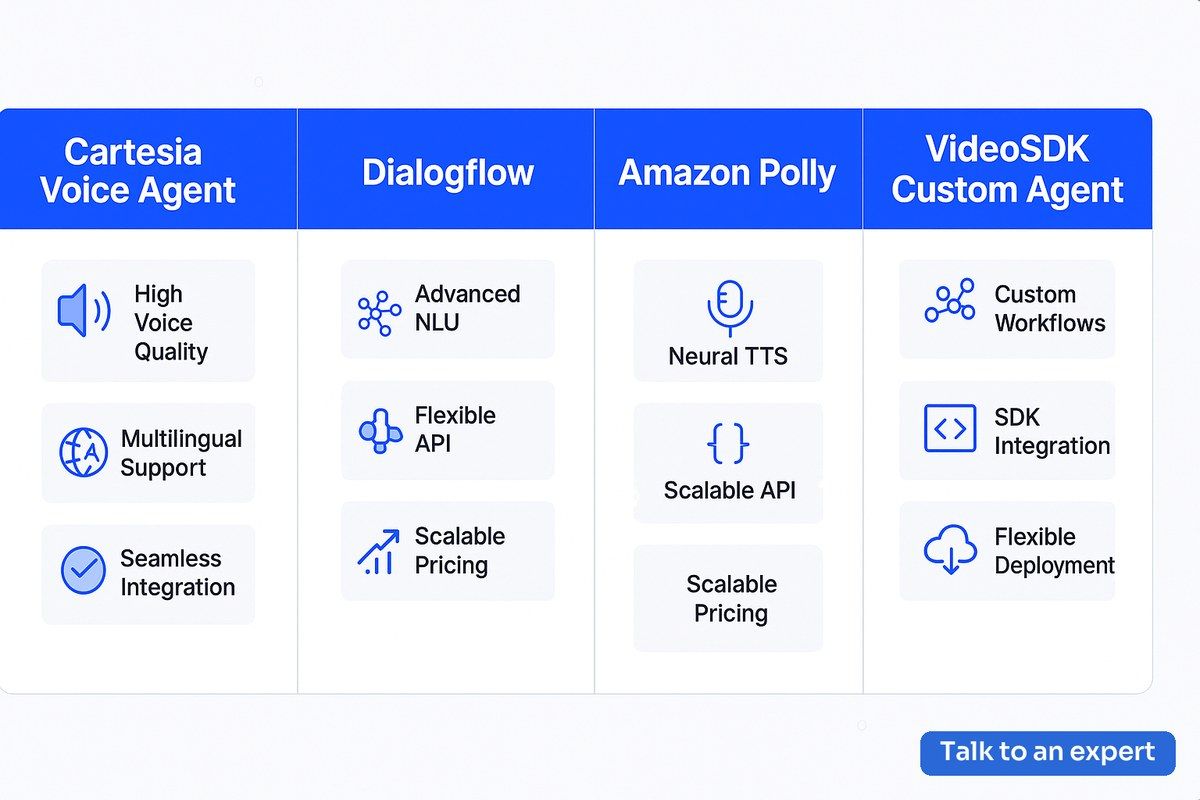
- Multilingual Support: Enables businesses to engage global audiences, supporting a wide range of languages and dialects.
- Customizable Voice Tones: Offers flexibility in brand voice, allowing organizations to align the agent’s tone with their identity.
- Seamless Integration: Easily connects with CRM, ERP, and other business systems, minimizing disruption during deployment.
- Low Latency: Provides rapid, real-time responses, critical for customer-facing applications.
- High Voice Quality: Utilizes advanced AI to deliver lifelike, expressive speech.
- Extensive Customization: Businesses can fine-tune interactions, workflows, and responses to match specific operational requirements.
These capabilities make Cartesia suitable for diverse use cases such as customer support, sales enablement, appointment scheduling, and internal knowledge assistants. According to Gartner research, conversational AI platforms like Cartesia are increasingly vital for digital transformation strategies. In practice, cartesia voice agent review and alternatives works best when integrated with existing CRM, telephony, and support tools.
Pros and Cons of Cartesia Voice Agent
Pros
- High Voice Quality: Delivers highly realistic, human-like interactions that enhance user trust and satisfaction.
- Low Latency: Fast response times support seamless customer experiences.
- Extensive Customization: Wide range of voice tones, settings, and workflow options.
- Multilingual Support: Facilitates communication with global customers and teams.
- Enterprise Integration: Connects with major business systems for streamlined workflows.
Cons
- Cost: Pricing may be higher than some alternatives, especially for large-scale deployments.
- Complexity: Initial setup and customization can require specialized expertise.
- Vendor Lock-in: Proprietary features may limit flexibility if switching platforms in the future.
Top Alternatives to Cartesia
While Cartesia Voice Agent is a market leader, several alternatives offer strong value for different business scenarios. This section explores Google Cloud’s Dialogflow, Amazon Polly, and the option to build a custom voice agent using VideoSDK. Each alternative brings unique strengths in natural language processing, voice synthesis, and integration flexibility.
Google Cloud's Dialogflow
Dialogflow is Google Cloud’s flagship conversational AI platform, widely used for building sophisticated voice and chat agents. It leverages Google’s natural language understanding (NLU) and integrates seamlessly with the broader Google Cloud ecosystem, making it a top choice for enterprises seeking scalability and advanced analytics. Teams that adopt cartesia voice agent review and alternatives typically measure success through faster response times and lower handle costs.
Key features include intent recognition, context management, and support for both voice and text channels. Dialogflow’s integration with Google Cloud services like BigQuery and Contact Center AI enables deep analytics and omnichannel experiences. According to Google Cloud Research, Dialogflow is trusted by global brands for mission-critical conversational experiences.
Implementation with Dialogflow
Deploying Dialogflow involves defining intents, entities, and dialogue flows to capture user queries and deliver accurate responses. Its machine learning models continuously improve with usage, allowing businesses to refine agent performance over time. Integration with telephony and messaging platforms is straightforward, reducing time-to-market for new voice applications.
Amazon Polly
Amazon Polly is Amazon Web Services’ cloud-based text-to-speech (TTS) service, known for its high-quality, lifelike speech output. Polly’s neural TTS models support dozens of languages and voices, enabling developers to deliver engaging, accessible voice experiences in various applications.
Polly is ideal for businesses that prioritize voice synthesis quality, such as e-learning, media, and customer service. Its pay-as-you-go pricing and API-driven approach make it accessible for projects of any size. NVIDIA AI Resources highlight Polly’s use in advanced speech applications, leveraging deep learning for expressive, natural-sounding audio. For organizations exploring cartesia voice agent review and alternatives, the priority is measurable ROI and practical deployment.
Use Cases for Amazon Polly
- E-learning: Converts educational content into speech for accessibility and engagement.
- Customer Service: Powers automated voice responses, reducing the burden on human agents.
- Media & Entertainment: Generates voiceovers for video, podcasts, and interactive content.
Building Your Own Voice Agent with VideoSDK
For organizations seeking maximum flexibility, building a custom voice agent with VideoSDK offers a powerful alternative. VideoSDK provides a comprehensive platform for real-time voice processing, API-driven customization, and seamless integration with existing business systems. The OpenAI TTS Plugin further enhances voice synthesis, enabling natural, expressive interactions.
Benefits of Using VideoSDK
- Customization: Full control over voice agent design, workflow, and integration.
- Integration: Connects easily with CRMs, ERPs, and proprietary systems.
- Scalability: Supports deployments from pilot projects to enterprise-wide rollouts.
- Open Ecosystem: Avoids vendor lock-in, enabling future innovation and adaptation.
Developing with VideoSDK
Development with VideoSDK involves leveraging its APIs to build tailored workflows, integrate with business logic, and deploy voice agents across web, mobile, and contact center environments. Teams can iterate quickly, experiment with different voice models, and fine-tune agent behavior to meet evolving business needs. For advanced implementations, VideoSDK supports real-time analytics and monitoring for continuous improvement.
Comparison Table: Cartesia vs. Alternatives
| Feature | Cartesia | Dialogflow | Amazon Polly |
|---|---|---|---|
| Latency | Low | Medium | Medium |
| Voice Quality | High | Medium | High |
| Customization Options | Extensive | Limited | Extensive |
| Language Support | Multilingual | Multilingual | Multilingual |
| Integration | Seamless | Google Cloud | AWS Ecosystem |
| Pricing Model | Subscription | Usage-based | Usage-based |
| AI Capabilities | Proprietary | Advanced NLU | Neural TTS |
| Vendor Lock-in | Moderate | Low | Low |
When to Choose Cartesia vs. Building with VideoSDK
Choosing between Cartesia and a custom solution built with VideoSDK depends on your organization’s priorities, technical resources, and long-term goals. Here are key decision criteria: Leaders evaluating cartesia voice agent review and alternatives often start with one high-volume workflow before scaling further.
- Cartesia: Best for businesses seeking a turnkey, enterprise-grade voice agent with minimal development overhead. Ideal when rapid deployment, high voice quality, and advanced features are top priorities.
- VideoSDK: Suited for organizations that require deep customization, integration flexibility, and control over the voice agent’s roadmap. VideoSDK empowers teams to build differentiated experiences, experiment with new voice models, and avoid vendor lock-in.
Considerations for Cartesia
Cartesia is optimal for companies that value speed-to-market and want to leverage proven AI voice technology without investing heavily in custom development. Its advanced features and multilingual support make it a strong fit for global enterprises, but costs and proprietary architecture may be limiting for some.
Considerations for VideoSDK
VideoSDK is ideal for businesses with skilled development teams, unique workflow requirements, or a desire to innovate beyond out-of-the-box solutions. It provides the building blocks for tailored voice agents, enabling organizations to iterate rapidly and adapt as needs evolve.
Implementation Considerations for Teams Building Voice AI
Successful deployment of voice AI solutions requires careful planning and attention to integration, scalability, multilingual support, and security. Here are critical factors to address: For organizations exploring cartesia voice agent review and alternatives, the priority is measurable ROI and practical deployment.
Integration with Existing Systems
Seamless integration with current business systems is essential for maximizing ROI and minimizing operational disruption. Evaluate how each platform connects with your CRM, ERP, and communication tools. Platforms like Cartesia and VideoSDK offer robust integration APIs, while Dialogflow and Amazon Polly provide connectors for popular cloud ecosystems.
Scalability
Your voice AI solution should scale with your business. Assess the platform’s ability to handle increasing call volumes, support new languages, and expand to additional channels. According to McKinsey, scalable voice AI is a key driver of digital transformation and customer satisfaction.
Multilingual Support
In a global marketplace, supporting multiple languages and dialects is crucial. Ensure your chosen platform offers robust multilingual capabilities, including localization and accent adaptation. Both Cartesia and Amazon Polly excel in this area, while VideoSDK allows you to integrate third-party TTS and NLU models for maximum flexibility.
Security and Compliance
Protecting sensitive data and meeting regulatory requirements are non-negotiable in 2026. Assess each platform’s security certifications, compliance with standards like GDPR and HIPAA, and data handling practices. Leading vendors publish their security documentation and undergo regular audits, providing assurance for enterprise deployments.
Conclusion
Selecting the right voice agent platform is a strategic decision that impacts customer experience, operational efficiency, and long-term innovation. This Cartesia voice agent review and alternatives guide equips you with the knowledge to compare leading solutions, from Cartesia’s advanced features to the flexibility of VideoSDK and the strengths of Dialogflow and Amazon Polly.
By aligning your choice with business objectives, technical resources, and future growth plans, you can unlock the full potential of AI-driven voice communication. Explore the AI voice Agent deployment process to ensure a seamless rollout and sustained success in 2026.
Step-by-Step AI Voice Agent Quickstart
FAQ