


Introduction
In the fast-paced world of artificial intelligence (AI), selecting the right tools can significantly impact innovation, efficiency, and business outcomes. Assembly AI is renowned for its advanced speech-to-text and audio intelligence solutions, but exploring assembly ai alternatives can open the door to improved performance, cost efficiency, and greater customization. This review is designed for tech leaders, product managers, and entrepreneurs seeking to diversify their AI strategy and maximize value from their voice recognition investments.
Assembly ai alternatives include leading platforms and custom solutions that offer similar or enhanced capabilities in voice recognition, transcription, and audio processing. By considering these alternatives, businesses can find options that better align with their performance requirements, budget, and feature needs.
What is Assembly AI?
Assembly AI is a leading provider of speech-to-text and audio intelligence APIs, empowering developers to convert speech into accurate text and extract valuable insights from audio data. Its robust platform is popular among teams building voice-enabled applications for sectors such as healthcare, legal, finance, and media. Assembly AI stands out for its high transcription accuracy, seamless API integration, and strong developer support. However, some organizations encounter challenges like higher costs at scale and limited language coverage, prompting them to evaluate assembly ai alternatives that may better fit their global or budget-sensitive use cases.
Key Features and Capabilities
Assembly AI excels in delivering precise transcription, advanced audio intelligence, and a developer-friendly API. Its platform supports a range of use cases, from automated meeting notes and compliance monitoring to media captioning and customer service analytics. Despite these strengths, some users report challenges with pricing at high volumes and limited support for less common languages, motivating a search for assembly ai alternatives that can address these gaps.
High Transcription Accuracy
Assembly AI is widely recognized for its industry-leading accuracy in converting speech to text. Its models leverage advanced deep learning techniques and are continuously refined using diverse datasets, resulting in reliable transcription even in noisy environments or with complex terminology. This makes Assembly AI a strong choice for industries where accuracy is mission-critical, such as legal transcription, medical documentation, and financial reporting. According to Google Cloud Research, accuracy is a key differentiator in enterprise adoption of speech-to-text solutions.
Seamless API Integration
The Assembly AI API is designed for ease of use, enabling developers to quickly add voice recognition capabilities to existing systems. Its RESTful endpoints, clear documentation, and robust SDKs help teams accelerate time to market. For businesses aiming to enhance digital experiences without major infrastructure changes, seamless API integration is essential. This capability is often compared with other leading vendors in the space, such as Microsoft Azure Cognitive Services, which also emphasizes developer-centric integration.
Robust Developer Support
Assembly AI provides extensive resources for developers, including detailed documentation, active community forums, and responsive support channels. This commitment to developer success ensures smoother implementation, faster troubleshooting, and ongoing platform improvements. Strong developer support is a critical factor for organizations prioritizing rapid deployment and minimal downtime, as highlighted in Gartner's AI Infrastructure research.
Pros and Cons
Pros
- High transcription accuracy: Delivers reliable, enterprise-grade data conversion, vital for regulated sectors like finance and healthcare.
- Easy API integration: Enables swift deployment and faster go-to-market for new voice-enabled applications.
- Strong developer support: Offers comprehensive resources, reducing development friction and accelerating innovation.
Cons
- Higher costs for extensive usage: Pricing can become prohibitive for large-scale deployments, making cost management essential for high-volume users.
- Limited localized language support: Coverage for niche or regional languages is limited, which may restrict adoption by global businesses with diverse linguistic needs.
Top Alternatives to Assembly AI
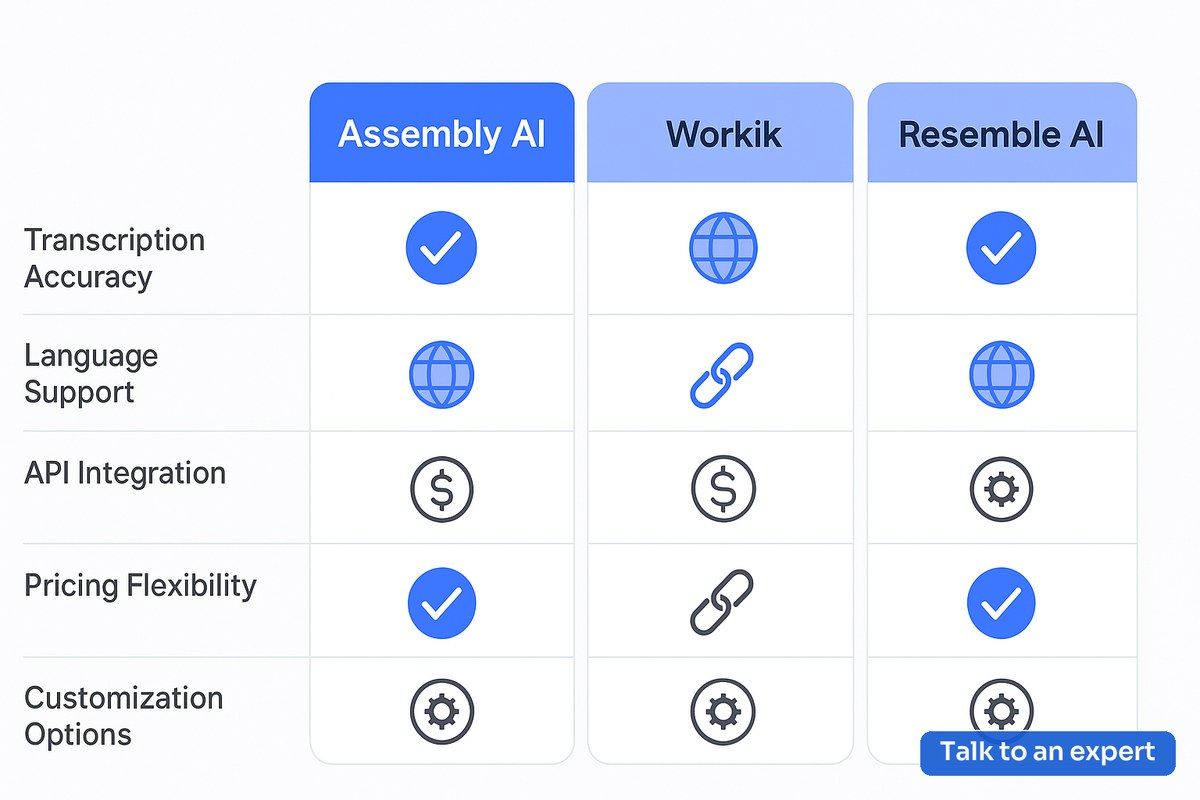
Exploring assembly ai alternatives can help organizations discover platforms that are better aligned with their technical and business requirements. Among the top contenders are Workik and Resemble AI, each offering distinct advantages in customization, scalability, and specialized features. Additionally, building custom solutions with VideoSDK provides unmatched flexibility for teams seeking to tailor voice AI to their unique needs.
Workik
Workik provides a flexible platform for building and deploying customizable AI models, making it ideal for rapid prototyping and iterative development. The user-friendly interface and modular architecture enable teams to quickly adapt to changing requirements. Workik's usage-based pricing model allows businesses to scale their AI initiatives efficiently, making it particularly attractive for startups and SMBs seeking to balance agility and cost control.
Implementation with Workik
To maximize value from Workik, organizations should start by defining their primary voice AI objectives, such as language coverage, accuracy thresholds, or integration needs. Workik's intuitive tools make it easy to prototype, test, and refine models before scaling to production. Its flexible pricing ensures that companies only pay for what they use, supporting budget-conscious innovation. For teams with evolving requirements, Workik's adaptability is a key differentiator.
Resemble AI
Resemble AI is recognized for its advanced voice cloning and multilingual support, making it a leading choice for businesses focused on personalized voice experiences. Its subscription-based pricing offers predictable costs, which is especially valuable for enterprises managing long-term projects or recurring workloads. Resemble AI's technology is widely used in entertainment, media, and customer engagement applications where unique, branded voice interactions are a competitive advantage.
Use Cases for Resemble AI
Resemble AI's voice cloning capabilities are transformative for industries like gaming, virtual reality, and digital media, where creating lifelike, immersive experiences is crucial. Its multilingual support enables organizations to reach global audiences and localize content efficiently. Integrating Resemble AI involves connecting its API to your existing platforms, allowing seamless deployment of custom voice features that enhance user engagement and satisfaction.
Comparison of Top Alternatives
| Alternative | Key Features | Pricing | Unique Selling Points |
|---|---|---|---|
| Workik | Customizable AI models, user-friendly interface | Usage-based, flexible | Best for rapid prototyping and agile teams |
| Resemble AI | Voice cloning, multilingual support | Subscription-based | Leading for personalized and global voice apps |
| VideoSDK | Modular, developer-centric, plugin ecosystem | Cost-effective, scalable | Ideal for custom, extensible voice AI solutions |
These assembly ai alternatives represent a spectrum of options, from out-of-the-box platforms to fully customizable frameworks. Workik excels in adaptability for fast-moving teams, Resemble AI leads in voice personalization and multilingual reach, while VideoSDK empowers organizations to build tailored solutions with full control over features, integrations, and deployment.
Building Your Own Solution with VideoSDK
VideoSDK enables developers to create custom AI-driven voice applications with maximum flexibility and cost efficiency. Its modular architecture and extensive plugin ecosystem make it easy to integrate advanced speech-to-text, text-to-speech, and conversational AI capabilities into any tech stack. For teams seeking to move beyond the limitations of pre-built platforms, VideoSDK provides a future-proof foundation for innovation.
Key Features of VideoSDK
- Flexible integration: Adapts to a wide range of development environments, supporting everything from web to mobile and embedded systems.
- Cost-effectiveness: Reduces total cost of ownership by allowing teams to build only what they need, avoiding unnecessary features and licensing fees.
- Rapid prototyping and deployment: Accelerates the development lifecycle, enabling faster experimentation and iteration.
- Plugin ecosystem: Supports integration with best-in-class AI providers, including OpenAI STT and Google TTS, to extend functionality.
Steps to Get Started
- Sign Up: Register for a VideoSDK account to access the platform.
- Explore Features: Review available tools, documentation, and integration options.
- Prototype: Build a proof-of-concept or pilot project to validate core requirements.
- Deploy: Scale your solution using AI voice Agent deployment strategies, leveraging modular components for ongoing enhancements.
Advanced Customization with VideoSDK
VideoSDK's modular design allows teams to create highly tailored voice AI solutions. Developers can integrate third-party plugins, such as the OpenAI STT Plugin or Google TTS Plugin, to enhance speech recognition or synthesis. This flexibility supports complex workflows, multilingual deployments, and integration with existing enterprise systems, making VideoSDK a compelling choice for organizations with unique or evolving requirements.
When to Choose Assembly AI vs Building with VideoSDK
Choosing between Assembly AI and building with VideoSDK depends on your organization's priorities and technical needs. Assembly AI is ideal for teams that require high transcription accuracy, robust out-of-the-box features, and strong support without significant customization. It is well-suited for regulated industries and projects where rapid deployment is critical.
In contrast, VideoSDK is the preferred option for businesses seeking flexibility, cost control, and the ability to build bespoke voice AI solutions. Its modular approach enables deep customization, integration with a wide range of AI providers, and scalability for future growth. For organizations with unique workflows, multilingual demands, or the desire to innovate beyond standard offerings, VideoSDK offers a powerful foundation.
Implementation Considerations for Teams Building Voice AI
When evaluating assembly ai alternatives, teams should consider their technical requirements, budget, and long-term strategy. Building with VideoSDK empowers organizations to tailor solutions to precise business needs, but may require more upfront development effort. Key considerations include:
- Scalability: Ensure the chosen platform can handle projected growth and usage spikes.
- Integration: Assess compatibility with existing systems, APIs, and data workflows.
- Cost management: Compare licensing, usage, and support costs across platforms.
- Language and feature support: Verify coverage for required languages, dialects, and advanced features like sentiment analysis or speaker identification.
Strategic Planning for AI Integration
Successful AI integration starts with a clear understanding of business objectives and technical constraints. Teams should conduct a thorough assessment of their current infrastructure, identify gaps, and prioritize features that drive ROI. Engaging with platform providers, reviewing documentation, and piloting solutions can help de-risk implementation. According to McKinsey's AI adoption insights, aligning AI investments with strategic goals is essential for maximizing business impact.
Conclusion
Evaluating assembly ai alternatives is essential for organizations seeking to navigate the complexities of modern voice AI development. Custom solutions built with VideoSDK can accelerate innovation, reduce costs, and create differentiated user experiences. Leveraging plugins like the OpenAI STT Plugin or Google TTS Plugin further expands your application's capabilities.
Empower your team by exploring VideoSDK's flexible offerings. Schedule a demo or start a free trial to experience the difference in your AI development journey. Consider launching an AI voice Agent Session to unlock the full potential of your voice AI integration.
By carefully assessing your needs and comparing the strengths of each platform, you can make informed decisions that drive innovation, efficiency, and business growth in 2026 and beyond.
FAQ