


Introduction
In the rapidly evolving world of artificial intelligence, the debate over "agentic AI vs generative AI" is front and center for business leaders seeking to future-proof their organizations. As AI technologies mature, understanding the differences between agentic and generative AI is essential for making strategic decisions that drive innovation and competitive advantage. Agentic AI excels in autonomous decision-making and proactive task execution, while generative AI is renowned for its creative pattern recognition and content generation. For 2026, knowing when and how to deploy each type can shape operational excellence and customer experiences.
The core distinction is that agentic AI acts with autonomy to achieve set goals, while generative AI creates new content or solutions based on input data. Choosing the right approach can determine your organization's ability to innovate, automate, and scale effectively in a digital-first economy. As organizations face increasingly complex challenges and dynamic markets, the agentic AI vs generative AI comparison becomes even more relevant for those aiming to leverage the full spectrum of artificial intelligence capabilities.
Understanding Agentic AI
Agentic AI represents a transformative paradigm where intelligent systems act with a high degree of autonomy, making real-time decisions to achieve defined objectives. These AI agents are not just reactive, they proactively adapt to their environment, learning and optimizing actions to fulfill their goals. For organizations exploring autonomous systems, the Voice Agent Quick Start Guide provides foundational steps for deploying agentic voice agents.
Characteristics of Agentic AI
Agentic AI is defined by its ability to operate independently, making decisions without constant human oversight. These systems are:
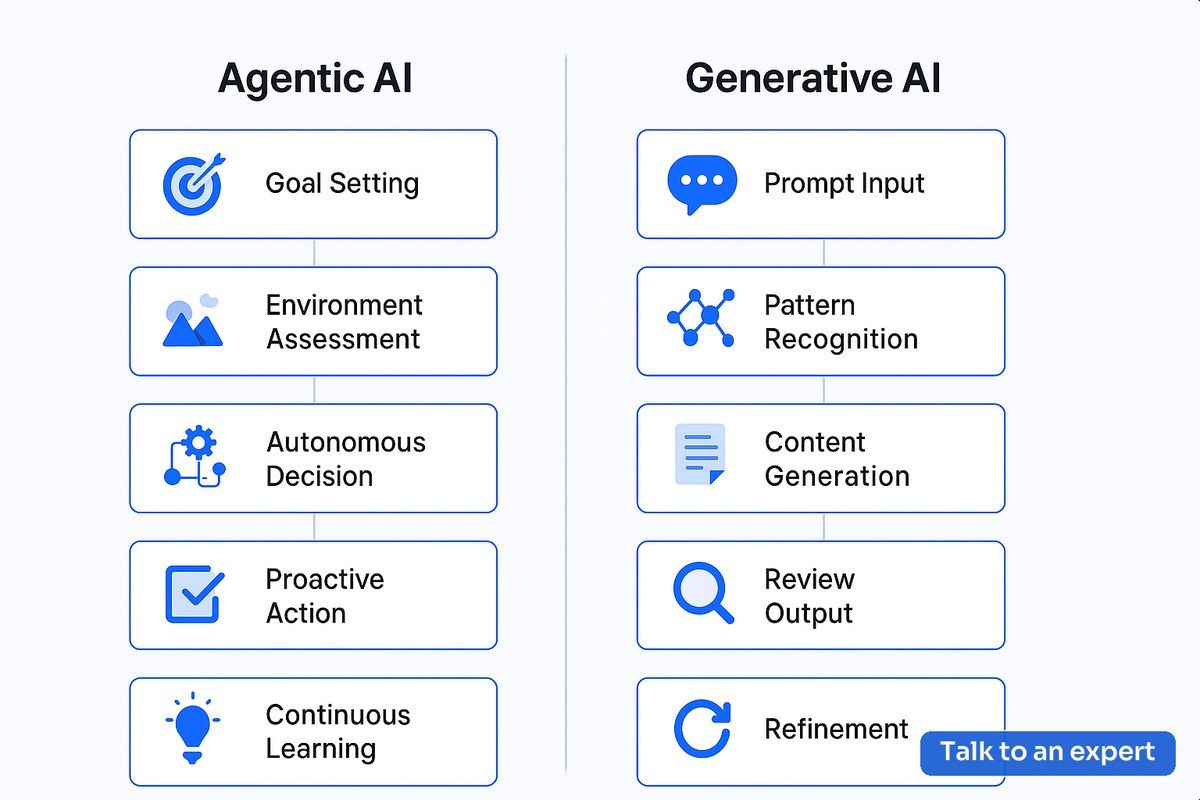
- Goal-driven: Programmed to pursue specific outcomes, adjusting strategies as conditions change.
- Context-aware: Continuously assess their environment to inform choices.
- Proactive: Initiate actions rather than waiting for explicit instructions.
- Adaptive: Learn from new data and experiences to improve performance over time.
These attributes enable agentic AI to dynamically interact with complex environments, making them ideal for tasks that require ongoing judgment and flexibility. For a deeper dive into the architecture, see the AI voice Agent core components overview.
Agentic artificial intelligence often incorporates reinforcement learning, multi-agent collaboration, and advanced decision trees. These features allow agentic AI to not only react to immediate stimuli but also to anticipate future scenarios, plan accordingly, and adjust its actions based on feedback. For example, in supply chain management, agentic AI systems can optimize routes, manage inventory, and proactively resolve disruptions by analyzing real-time data and historical trends. This level of autonomy reduces the need for human intervention and increases operational reliability.
Real-World Applications
- Autonomous Vehicles: Agentic AI powers self-driving cars, allowing them to navigate traffic, avoid obstacles, and make split-second decisions to ensure safety.
- Smart Assistants: AI agents manage calendars, emails, and reminders, learning user preferences and acting independently to optimize productivity. The OpenAI LLM Plugin for voice agent enhances these assistants with advanced language understanding.
- Industrial Robotics: In manufacturing, agentic AI automates complex processes, adapts to production line changes, and maintains efficiency with minimal human input. Deployment strategies are detailed in the AI voice Agent deployment guide.
Agentic AI is also making strides in sectors like healthcare, where intelligent agents can monitor patient data, detect anomalies, and trigger alerts or interventions without waiting for human review. In finance, agentic AI systems can autonomously execute trades, monitor compliance, and detect fraudulent activities by continuously analyzing market conditions and transaction patterns. These real-world applications highlight the versatility and transformative potential of agentic AI across industries. For organizations exploring agentic ai vs generative ai, the priority is measurable ROI and practical deployment.
| Industry | Application | Benefit |
|---|---|---|
| Automotive | Autonomous Navigation | Enhanced safety and efficiency |
| Consumer | Smart Personal Assistants | Personalized user experiences |
| Manufacturing | Robotics Automation | Increased production efficiency |
| Healthcare | Patient Monitoring | Early intervention and improved outcomes |
| Finance | Automated Trading | Faster, data-driven decisions |
Exploring Generative AI
Generative AI is at the forefront of creative and analytical innovation, producing new content and solutions by recognizing and extrapolating from patterns in data. Unlike agentic AI, generative AI is prompt-driven, relying on input queries to generate outputs ranging from text to images and audio.
Key Traits
Generative AI is characterized by:
- Creativity: Generates original content such as articles, code, designs, and music.
- Pattern Recognition: Learns from massive datasets to identify trends and synthesize new ideas.
- Prompt Dependency: Requires user input or prompts to initiate content generation.
- Scalability: Can produce large volumes of content quickly, supporting marketing, R&D, and customer engagement.
For organizations aiming to enhance voice-driven experiences, the ElevenLabs TTS Plugin for voice agent brings lifelike speech synthesis to generative AI applications.
Generative AI models, such as large language models (LLMs), generative adversarial networks (GANs), and diffusion models, have revolutionized how businesses approach content creation and problem-solving. These systems are capable of producing human-like text, realistic images, and even synthetic audio or video, opening up new possibilities for automation and personalization. The versatility of generative AI makes it a powerful tool for industries that rely on creativity, rapid prototyping, and customer engagement. In practice, agentic ai vs generative ai works best when integrated with existing CRM, telephony, and support tools.
Real-World Applications
- Content Creation: Generative AI automates the production of blog posts, social media content, and advertising copy, enabling brands to scale their messaging and storytelling.
- Design and Art: AI models generate unique graphics, logos, and digital artworks, opening new creative avenues for designers and agencies.
- Language Models: Used in chatbots and virtual assistants, generative AI powers natural, human-like conversations and customer support interactions.
- Drug Discovery: In pharmaceuticals, generative AI helps design novel molecules, accelerating research and reducing development costs.
- Personalization Engines: Retailers and e-commerce platforms use generative AI to tailor recommendations, offers, and content to individual users, enhancing engagement and conversion rates.
Generative AI's ability to synthesize information and create new solutions is also valuable in fields such as architecture, where AI-generated designs can inspire innovative structures, or in education, where personalized learning materials can be created on demand. The impact of generative AI continues to expand as models become more sophisticated and accessible.
| Industry | Application | Benefit |
|---|---|---|
| Media | Automated Content | Faster, scalable content production |
| Design | AI-Generated Art | Creative assets with reduced manual effort |
| Customer Service | Conversational AI | Enhanced customer engagement |
| Pharma | Drug Discovery | Accelerated R&D and lower costs |
| Retail | Personalization | Improved user experience and loyalty |
Agentic AI vs Generative AI: A Comparative Analysis
When evaluating "agentic AI vs generative AI," it is critical to understand their unique strengths and limitations. The following table highlights key differences for decision-makers:
| Feature | Agentic AI | Generative AI |
|---|---|---|
| Initiative | Proactive | Reactive |
| Focus | Decision-making | Content generation |
| Core Functionality | Task execution and autonomy | Creativity and pattern output |
| Input Requirement | Minimal, operates autonomously | Prompt-driven, needs input |
| Best For | Automation, optimization | Creative tasks, content creation |
| Adaptability | Learns from environment | Learns from data patterns |
| Output | Actions, decisions | Text, images, audio, code |
Agentic AI is designed to take initiative, making autonomous decisions that drive business processes forward. In contrast, generative AI excels at producing novel content and solutions in response to specific prompts. Both paradigms have transformative potential, but the choice depends on your organization's goals and operational context.
When considering agentic artificial intelligence vs generative AI, it is important to note that agentic AI is often better suited for environments where ongoing, autonomous action is required. For example, in logistics, agentic AI can manage fleets and optimize delivery routes in real time. Generative AI, on the other hand, is ideal for tasks that require creativity, such as generating marketing copy, designing new products, or creating personalized experiences for customers. Some organizations are beginning to explore hybrid models that combine the strengths of both, enabling systems that can both act autonomously and generate creative solutions as needed.
Business Implications and Opportunities
ROI and Productivity Gains
Adopting agentic or generative AI can unlock significant ROI and productivity improvements. Agentic AI reduces manual intervention, streamlining workflows and minimizing operational costs. This leads to faster decision-making and increased throughput in sectors like logistics, manufacturing, and finance. Generative AI, meanwhile, empowers businesses to scale creative output, personalize customer interactions, and accelerate product development cycles. Companies leveraging both can differentiate themselves through innovation and efficiency.
For example, in the insurance industry, agentic AI can automate claims processing, while generative AI can draft personalized policy documents or customer communications. In retail, agentic AI can optimize inventory management, while generative AI creates tailored marketing campaigns. The synergy between these two AI paradigms can drive end-to-end digital transformation, enabling organizations to respond more quickly to market demands and customer needs.
Implementation Challenges
Despite their promise, implementing agentic and generative AI systems comes with challenges: Leaders evaluating agentic ai vs generative ai often start with one high-volume workflow before scaling further.
- Cost and Complexity: Developing and deploying sophisticated AI models requires investment in infrastructure, talent, and integration.
- System Integration: Ensuring seamless operation with legacy systems can be complex, often demanding custom middleware and robust APIs.
- Change Management: Upskilling teams to collaborate with AI and redesigning workflows are essential for successful adoption.
- Data Quality: Both agentic and generative AI depend on high-quality, relevant data to deliver accurate and reliable results. Organizations must invest in data governance and management to maximize AI effectiveness.
Understanding AI voice Agent Sessions can help organizations monitor and optimize agentic AI deployments.
Ethical and Security Considerations
As AI adoption accelerates, ethical and security concerns become more pronounced:
- Data Privacy: Both agentic and generative AI handle sensitive data, requiring strict privacy controls.
- Bias and Fairness: AI models can inadvertently perpetuate biases present in training data, impacting decision quality and fairness.
- Transparency: Ensuring explainability in AI decisions is vital for regulatory compliance and stakeholder trust.
- Security Risks: Malicious actors may attempt to exploit vulnerabilities in AI systems, making robust security protocols and monitoring essential. Teams that adopt agentic ai vs generative ai typically measure success through faster response times and lower handle costs.
Tools for AI voice Agent tracing and observability can help organizations monitor AI behavior and address compliance requirements. Industry leaders such as Google Cloud Research and Microsoft Research provide additional guidance on responsible AI deployment.
Future Trends and Industry Impact
Looking toward 2026, the convergence of agentic and generative AI is set to redefine industry standards. Hybrid AI architectures are emerging, combining the autonomy of agentic AI with the creative power of generative models. This fusion enables:
- End-to-End Automation: Systems that not only make decisions but also generate the content or actions needed to execute those decisions.
- Personalized Experiences: AI that adapts both its actions and outputs to individual users, driving loyalty and satisfaction.
- Continuous Learning: Integrated feedback loops allow AI to learn from outcomes, improving over time.
- Scalable Innovation: Organizations can rapidly prototype, test, and deploy new solutions by leveraging the complementary strengths of both AI types.
Industries from healthcare to finance are piloting these hybrid systems to streamline operations and unlock new business models. According to Gartner, organizations that invest in multi-modal AI will be better positioned to innovate and respond to market shifts.
The agentic AI vs generative AI debate is also influencing regulatory frameworks and industry standards, as policymakers and industry groups work to ensure responsible AI development and deployment. Businesses that stay ahead of these trends will be better equipped to manage risk, ensure compliance, and capitalize on new opportunities as AI technologies continue to advance.
Conclusion
In 2026 and beyond, mastering "agentic AI vs generative AI" will be central to business transformation. The ability to distinguish and strategically deploy these AI paradigms will define leaders in every industry. Companies that harness agentic AI for automation and generative AI for innovation will unlock new levels of efficiency and creativity. Platforms like VideoSDK provide the building blocks for robust, scalable AI applications, empowering organizations to stay ahead in a rapidly changing digital landscape.
Understanding the nuances of agentic artificial intelligence vs generative AI will help leaders make informed investments, balance risk, and maximize value from their AI initiatives. As hybrid approaches become more prevalent, organizations that embrace both agentic and generative AI will be best positioned to drive sustainable growth, foster innovation, and deliver superior customer experiences in the years ahead.
FAQ