


Introduction
In 2026, banks face mounting pressure to deliver seamless, secure, and efficient Know Your Customer (KYC) processes. An AI voice agent for banking KYC is rapidly emerging as the industry’s most effective tool for transforming compliance and customer onboarding. By automating identity verification and regulatory checks through advanced voice technology, banks can accelerate KYC, reduce operational costs, and deliver a frictionless customer experience. AI voice agents for banking KYC enable institutions to meet strict regulatory requirements while building trust and loyalty with customers. For organizations exploring ai voice agent for banking kyc, the priority is measurable ROI and practical deployment.
AI voice agents for banking KYC use conversational AI and voice biometrics to verify identities, collect documentation, and ensure compliance in real time. These solutions not only streamline onboarding but also minimize human error, reduce fraud risk, and boost both operational efficiency and customer satisfaction. As digital banking continues to evolve, the adoption of AI voice agents for banking KYC is becoming a strategic imperative for banks aiming to stay competitive and compliant in an increasingly regulated environment.
Understanding KYC in Banking
Know Your Customer (KYC) is a foundational pillar of the banking sector, essential for regulatory compliance and effective risk management. Traditionally, KYC in banking has relied on manual document checks, in-person interviews, and labor-intensive verification processes. These legacy methods are slow, costly, and susceptible to human error, often resulting in delays that frustrate customers and increase risk exposure. For organizations exploring ai voice agent for banking kyc, the priority is measurable ROI and practical deployment.
KYC protocols require banks to authenticate customer identities, assess their eligibility for services, and monitor transactions for legitimacy. Manual KYC workflows can create bottlenecks, introduce inaccuracies, and erode customer trust. As regulatory scrutiny intensifies and digital banking expands, the need for scalable, automated KYC solutions has never been greater. AI voice agents for banking KYC are now at the forefront of this transformation, offering a path toward operational excellence and regulatory confidence.
The significance of KYC in banking extends beyond compliance. Effective KYC processes help prevent financial crimes such as money laundering, terrorist financing, and identity theft. By ensuring that only legitimate customers access financial services, banks protect not only themselves but also the broader financial ecosystem. The shift toward digital banking has amplified the importance of robust KYC, making automation and AI-driven solutions a necessity rather than a luxury. In practice, ai voice agent for banking kyc works best when integrated with existing CRM, telephony, and support tools.
The Role of AI Voice Agents in KYC
How AI Voice Agents Work
AI voice agents for banking KYC leverage state-of-the-art voice recognition, natural language processing, and machine learning to automate critical compliance tasks. These intelligent agents engage customers in secure, real-time conversations, guiding them through identity verification, document submission, and risk assessment. With voice biometrics, AI voice agents can authenticate users, detect anomalies, and ensure that only legitimate customers gain access to financial services. For a deeper dive into the architecture, the AI voice Agent core components overview is a valuable resource.
A typical workflow involves the AI voice agent greeting the customer, requesting identification documents, verifying details through voice and document analysis, and confirming compliance with KYC regulations. This entire process can occur over the phone or via digital channels, providing unmatched convenience and speed.
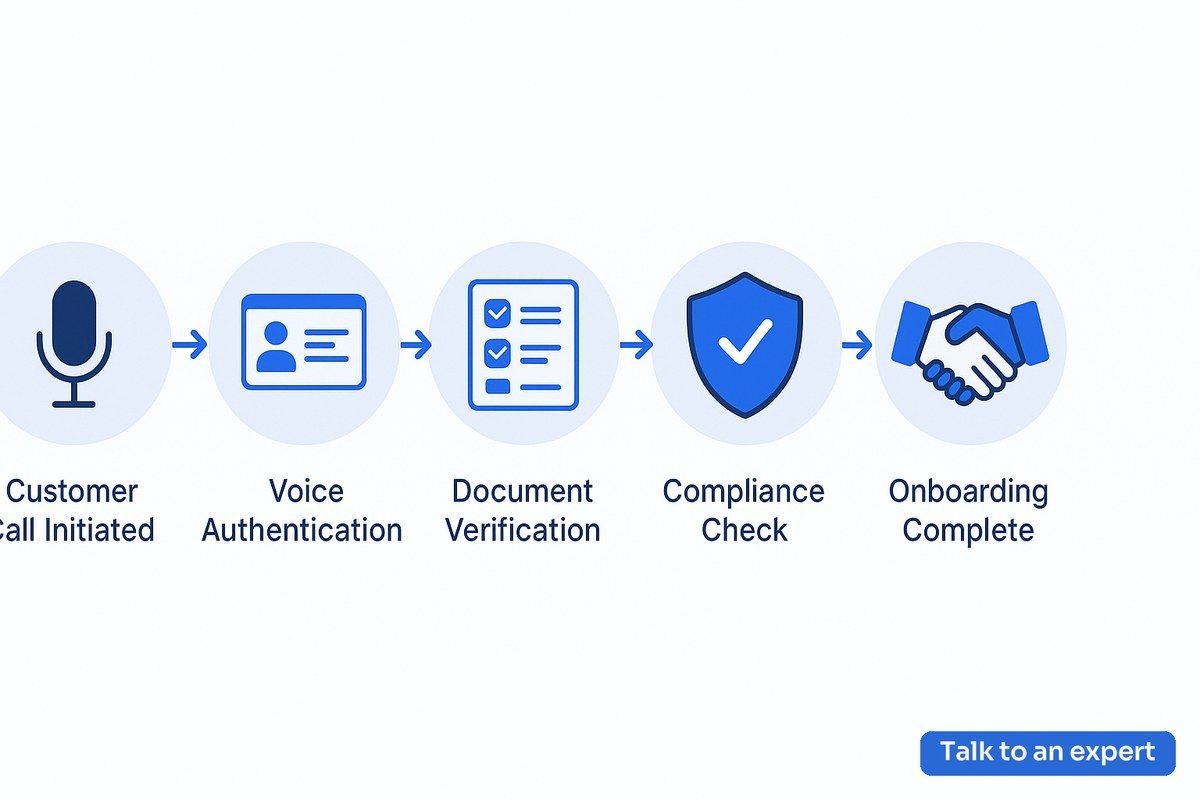
AI voice agents for banking KYC are designed to integrate seamlessly with existing banking systems. They can pull data from core banking platforms, validate information against government databases, and update customer profiles in real time. This level of integration ensures that compliance checks are both thorough and efficient, reducing the risk of oversight or error. Additionally, advanced AI voice agents can handle multiple languages and dialects, making them suitable for banks with diverse customer bases.
Advantages Over Traditional Methods
Implementing an AI voice agent for banking KYC delivers significant advantages over manual and legacy approaches. Most notably, it reduces KYC processing time from days or weeks to minutes, dramatically improving operational efficiency. AI voice agents automate repetitive tasks, freeing staff to focus on complex cases and value-added services.
Accuracy is another critical benefit. AI voice agents minimize human error, ensure consistent adherence to regulatory standards, and reduce the risk of compliance breaches. Enhanced security features, such as voice biometrics and real-time fraud detection, further protect both banks and customers.
By streamlining onboarding and verification, AI voice agents for banking KYC also elevate the customer experience. Customers enjoy faster account openings, fewer manual steps, and personalized support, which drives higher satisfaction and loyalty.
Furthermore, AI voice agents can operate 24/7, providing round-the-clock service that traditional methods cannot match. This always-on availability is especially valuable for global banks serving customers across different time zones. Automated voice assistants can also scale effortlessly to handle spikes in demand, ensuring that service levels remain high even during peak periods.
Practical Use Cases
Real-world Applications
Leading banks worldwide are already deploying AI voice agents for banking KYC to transform their compliance operations. For example, a global financial institution integrated AI voice agents into its onboarding process, automating document verification and voice-based identity checks. This reduced onboarding time from several days to under an hour, resulting in a measurable boost in customer satisfaction and retention. Teams that adopt ai voice agent for banking kyc typically measure success through faster response times and lower handle costs.
AI voice agents are also used for ongoing customer due diligence, conducting periodic background checks and monitoring transactions for suspicious activity. These agents can flag anomalies in real time, helping banks comply with anti-money laundering (AML) regulations while maintaining operational agility. For implementation guidance, the Voice Agent Quick Start Guide is essential, and for details on session management, see AI voice Agent Sessions.
In another scenario, regional banks have adopted AI voice agents for banking KYC to automate customer outreach for KYC updates, reducing manual call center workload and ensuring regulatory deadlines are met.
AI voice agents can also be deployed for specialized use cases such as remote account opening, where customers may not be able to visit a branch in person. By leveraging voice biometrics and secure document uploads, banks can onboard customers from anywhere, expanding their reach and improving accessibility. Additionally, AI voice agents can assist in re-verifying existing customers when regulations change, ensuring ongoing compliance without disrupting the customer relationship.
ROI and Business Benefits
Investing in an AI voice agent for banking KYC delivers compelling business value. By automating compliance tasks, banks achieve immediate cost reductions through decreased manual labor and faster processing. These savings are compounded by lower error rates, fewer regulatory penalties, and improved fraud prevention.
The long-term ROI is equally attractive. Enhanced customer experiences drive higher retention and acquisition rates, while operational agility enables banks to scale KYC processes to match business growth. Banks that position themselves as early adopters of AI voice agents for banking KYC are perceived as innovators, attracting digitally savvy customers and partners. According to Gartner, AI-driven automation is expected to be a primary driver of cost savings and compliance efficiency in banking by 2026.
In addition to direct financial benefits, AI voice agents for banking KYC contribute to stronger brand reputation and customer trust. By demonstrating a commitment to security and innovation, banks can differentiate themselves in a crowded market. The ability to quickly adapt to regulatory changes and customer needs further enhances the value proposition of AI-powered KYC solutions.
Implementing AI Voice Agents in Banking
Steps to Integration
Integrating an AI voice agent for banking KYC requires a strategic, phased approach. Banks should begin by mapping their existing KYC workflows and identifying high-impact automation opportunities. This assessment will reveal where AI voice agents can deliver the greatest value, such as onboarding, periodic reviews, or transaction monitoring.
Next, selecting the right AI voice agent platform is critical. Key criteria include scalability, ease of integration with core banking systems, support for multi-language interactions, and robust compliance features. The AI voice Agent deployment guide offers a comprehensive roadmap for successful implementation.
Banks must also plan for change management, staff training, and customer education to ensure smooth adoption. Continuous monitoring and feedback loops help optimize agent performance and customer satisfaction.
A successful implementation also involves collaborating with technology partners who understand both the technical and regulatory aspects of banking KYC. Banks should conduct pilot programs to validate the effectiveness of AI voice agents in real-world scenarios before scaling up deployment. Regular performance reviews and updates ensure that the AI voice agent remains aligned with evolving business goals and compliance requirements. When planning ai voice agent for banking kyc, align stakeholders on data privacy, workflow design, and clear escalation paths.
Overcoming Implementation Challenges
Data privacy and security are paramount when deploying AI voice agents for banking KYC. Banks must ensure that all customer data is encrypted, stored securely, and handled in accordance with local and international regulations. The AI voice Agent tracing and observability tools provide critical oversight for compliance and risk management.
Navigating the regulatory landscape is another challenge. AI voice agents for banking KYC must be regularly updated to reflect evolving compliance standards and industry best practices. The Human-in-the-loop for AI voice Agents approach allows for human oversight in complex or ambiguous cases, ensuring accuracy and accountability.
Banks should also address potential customer concerns about interacting with AI by providing clear communication, opt-out options, and seamless escalation to human agents when needed. Leaders evaluating ai voice agent for banking kyc often start with one high-volume workflow before scaling further.
Furthermore, banks must consider the ethical implications of using AI in sensitive processes like KYC. Transparency in how AI voice agents make decisions, as well as clear documentation of processes, helps build trust with both customers and regulators. Ongoing training for both AI systems and human staff ensures that the technology continues to perform accurately and ethically as regulations and customer expectations evolve.
Future Trends and Innovations
The future of AI voice agents for banking KYC is shaped by rapid advancements in conversational AI, voice biometrics, and regulatory technology. By 2026, AI voice agents will be capable of handling even more complex compliance scenarios, including multilingual verification, emotion detection, and adaptive risk assessment.
Emerging trends include the integration of AI voice agents with blockchain-based digital identity platforms, enabling secure, tamper-proof KYC verification across institutions. Banks are also exploring the use of AI voice agents for proactive fraud detection and customer support, further enhancing operational resilience. According to McKinsey, banks that invest in AI-driven KYC automation will gain a significant competitive edge in the coming years.
As customer expectations for digital banking rise, AI voice agents for banking KYC will play a central role in delivering personalized, compliant, and efficient services at scale.
Another innovation on the horizon is the use of AI voice agents for real-time regulatory reporting. By automating the collection and submission of compliance data, banks can respond more quickly to regulatory inquiries and audits. The ability to analyze vast amounts of voice and transaction data also opens new possibilities for predictive analytics, helping banks anticipate compliance risks before they materialize.
Conclusion
AI voice agents for banking KYC are redefining how banks approach compliance, customer onboarding, and operational efficiency. By embracing these advanced solutions, financial institutions can accelerate KYC processes, reduce costs, and deliver superior customer experiences. In 2026 and beyond, adopting an AI voice agent for banking KYC will be essential for banks seeking to lead in innovation, meet regulatory demands, and build lasting customer trust.
As the regulatory landscape continues to evolve, the flexibility and scalability of AI voice agents will enable banks to adapt quickly and maintain a competitive edge. The future of banking KYC lies in the seamless collaboration between human expertise and AI-powered automation, ensuring that compliance is not only achieved but also optimized for efficiency and customer satisfaction.
Step-by-Step AI Voice Agent Quickstart
FAQ