


STUN (Session Traversal Utilities for NAT) is a protocol that helps VoIP devices discover their public IP address and port when sitting behind a NAT router. In "stun voip" deployments, STUN enables SIP signaling and RTP media to traverse NAT boundaries by mapping internal addresses to externally reachable ones. VideoSDK handles NAT traversal automatically within its WebRTC-based rooms, but understanding STUN remains essential for anyone building or debugging real-time communication systems.
If you have ever deployed a SIP phone behind a home router and watched the call connect with perfect signaling but zero audio in one direction, you have met the NAT problem. The phrase "stun voip" surfaces in developer searches because STUN is the first tool most engineers reach for when calls fail behind NAT. It is not a silver bullet, but without it, most consumer-grade VoIP deployments simply do not work.
NAT (Network Address Translation) exists because IPv4 addresses are scarce. Routers translate private addresses to a single public address, which works fine for web browsing but breaks real-time protocols that embed IP addresses inside their payloads. SIP carries IP addresses in its headers, and RTP carries them in SDP descriptions. When those addresses are private, the remote endpoint cannot send media back.
This article walks through how STUN solves part of this problem, where it falls short, and how to configure, monitor, and troubleshoot "stun voip" setups in production. Whether you are configuring SIP phones, building a PBX with OpenSIPS, or integrating WebRTC through VideoSDK's real-time communication platform, understanding STUN is foundational.
What is NAT and Why It Breaks VoIP?
NAT is defined as a network function that remaps one IP address space into another by modifying network address information in packet headers. It was introduced to conserve IPv4 addresses, allowing multiple devices on a private network to share a single public IP. While NAT is transparent for most internet traffic, it creates serious problems for peer-to-peer protocols like SIP and RTP.
The core issue is that SIP and RTP are not NAT-aware. SIP embeds the device's IP address inside its message body (the SDP session description). When a SIP phone registers with a server, it advertises its private IP address, something like 192.168.1.50. The server tries to send RTP media back to that address, which is unreachable from the public internet. The result is one-way audio or no audio at all.
There are several types of NAT, and each behaves differently:
- Full Cone NAT: Maps the same internal address to the same external address for any destination. Easiest to traverse.
- Restricted Cone NAT: Maps the same internal address to the same external address, but only accepts inbound traffic from addresses the internal device has already contacted.
- Port-Restricted Cone NAT: Similar to restricted cone, but also restricts by port.
- Symmetric NAT: Assigns a different external port for each destination. This is the hardest to traverse and breaks STUN in many cases.
Symmetric NAT is particularly problematic for "stun voip" because STUN discovers the public mapping for the STUN server's address, but that mapping may differ from the one used for the actual RTP stream. This is why STUN alone is insufficient for symmetric NAT, and TURN becomes necessary.
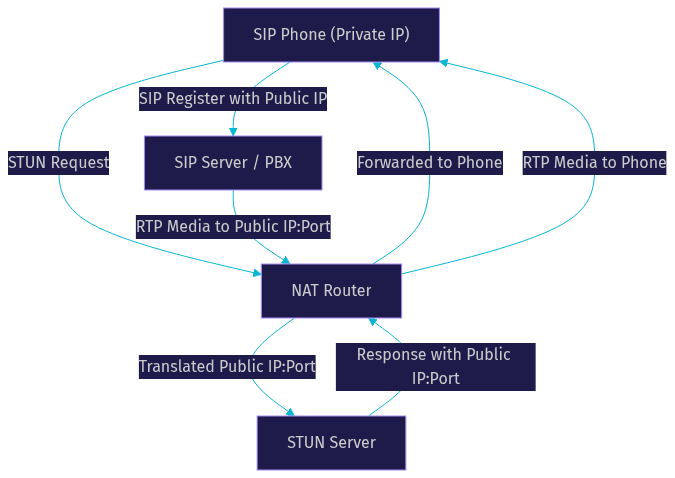
Here is a simplified NAT traversal flow showing where STUN fits:
STUN VoIP: Basics for NAT Traversal
STUN (Session Traversal Utilities for NAT) is defined as a lightweight protocol that allows a client behind a NAT to discover its public IP address and port mapping. In "stun voip" contexts, STUN is the mechanism that lets a SIP phone learn how the outside world sees it, so it can advertise that address in SIP and SDP messages instead of its private one.
The protocol works through a simple request-response cycle. The STUN client sends a binding request to a STUN server on the public internet. The server observes the source IP and port of the incoming packet (which is the NAT's public address and port mapping) and includes that information in its response. The client now knows its reflexive transport address, the address reachable from the public internet.
STUN was originally defined in RFC 3489 and later revised in RFC 8489, which is the current version as of 2026. The revision cleaned up the protocol's classification of NAT types (the old NAT type discovery mechanism was removed because it was unreliable) and focused STUN on its core purpose: address discovery and binding maintenance.
For VoIP specifically, STUN serves two purposes. First, it discovers the public address for SIP signaling. Second, it discovers the public address for RTP media streams. These are often different because SIP and RTP use different ports, and NAT may map them differently. A common mistake is assuming one STUN query covers both.
STUN also supports binding keep-alives. NAT mappings expire after a period of inactivity (typically 30 to 60 seconds for UDP). STUN binding requests sent periodically keep the NAT mapping alive, preventing the port from closing mid-call. This is critical for long VoIP calls where silence could cause the NAT mapping to expire and audio to drop.
STUN VoIP Message Flow
The STUN message exchange follows a straightforward pattern. The client constructs a binding request containing a transaction ID (a unique 96-bit identifier) and sends it via UDP to the STUN server on port 3478 (the standard STUN port, with 5349 for STUN over TLS). The server receives the packet, notes the source IP and port as observed on the public internet, and constructs a binding success response. This response contains an XOR-MAPPED-ADDRESS attribute, which encodes the reflexive address using XOR obfuscation for security. The client decodes this attribute to recover its public IP and port.
According to RFC 8489, the message structure includes a fixed 20-byte header (message type, message length, and magic cookie) followed by zero or more attributes. The XOR-MAPPED-ADDRESS attribute is the most important for "stun voip" because it carries the NAT-discovered public address that the SIP phone will use in its SDP offers.
STUN vs TURN vs ICE: When to Use Each
STUN, TURN, and ICE are three complementary protocols that solve NAT traversal at different levels. Understanding when to use each is essential for any "stun voip" deployment.
STUN is the lightest solution. It works when the NAT mapping is consistent across destinations, which is true for full cone, restricted cone, and port-restricted cone NAT. STUN adds minimal latency (a single round trip for discovery) and no ongoing bandwidth cost beyond periodic keep-alives. Use STUN when the NAT type is cooperative and direct peer-to-peer media is possible.
TURN (Traversal Using Relays around NAT) is the fallback when STUN fails. TURN servers relay media traffic between peers, meaning all RTP packets flow through the TURN server. This works for symmetric NAT and restrictive corporate firewalls, but it adds latency (media must detour through the relay) and bandwidth costs (the server handles all traffic). Use TURN when direct media is impossible, such as symmetric NAT environments or when both peers are behind restrictive firewalls.
ICE (Interactive Connectivity Establishment) is the framework that ties them together. ICE gathers all possible candidate addresses (host, server-reflexive via STUN, and relayed via TURN) and tests them in priority order to find the best working path. ICE is the standard approach in WebRTC and modern SIP implementations. Use ICE whenever possible because it automatically falls back from direct connection to STUN-assisted to TURN-relayed as needed.
| Protocol | Best For | Latency Impact | Bandwidth Cost | NAT Types Supported |
|---|---|---|---|---|
| STUN | Cooperative NAT types | Minimal (one round trip) | Negligible (keep-alives only) | Full cone, restricted cone, port-restricted |
| TURN | Symmetric NAT, restrictive firewalls | Moderate (relay detour) | High (all media relayed) | All types |
| ICE | Automatic fallback across all scenarios | Varies (selects best path) | Varies (only uses TURN when needed) | All types |
In practice, most production VoIP systems use ICE with both STUN and TURN configured. VideoSDK's WebRTC infrastructure handles this automatically, selecting the optimal path without manual configuration. For SIP-based systems, ICE support depends on the PBX and endpoint capabilities.
Choosing and Configuring a STUN Server for VoIP
Selecting the right STUN server is a practical decision that affects call reliability. Several public STUN servers are available, including Google's STUN server (stun.l.google.com on port 19302) and others maintained by various organizations. However, relying on public STUN servers for production VoIP is risky because they offer no SLA, may rate-limit requests, and could be decommissioned without notice.
For production "stun voip" deployments, running your own STUN server is the recommended approach. Popular open-source options include coturn, which combines STUN and TURN in a single package. When configuring your own server, consider these parameters:
- IP address and port: The standard STUN port is 3478 for UDP and TCP, with 5349 for TLS. Ensure the server's public IP is directly reachable (not behind another NAT).
- Timeout settings: Configure binding timeouts to match your NAT's mapping lifetime. A common practice is sending keep-alives every 20 seconds, which is shorter than most NAT timeouts.
- Redundancy: Deploy at least two STUN servers in different network segments. ICE clients will query multiple servers and use the best response.
- Security: If running TURN alongside STUN, use long-term credentials with short-lived passwords. STUN itself does not require authentication, but TURN does.
For SIP devices, the STUN server address is typically configured in the network or NAT settings section. The device sends a STUN binding request on startup and uses the discovered public address for SIP registration and SDP offers. In OpenSIPS, STUN can be integrated at the proxy level using the STUN module, which allows the proxy to assist with NAT traversal for clients that do not support STUN natively.
When tuning parameters, pay attention to the retransmission interval (the time between STUN request retransmissions if no response is received). The default in most implementations is 500 milliseconds with exponential backoff. For high-latency links, increasing the initial timeout can reduce false negatives.
Redundant STUN Server Setup
A redundant STUN configuration ensures that if one server becomes unreachable, clients can fall back to another without call failure. ICE supports multiple STUN servers natively by allowing the client to gather server-reflexive candidates from each.
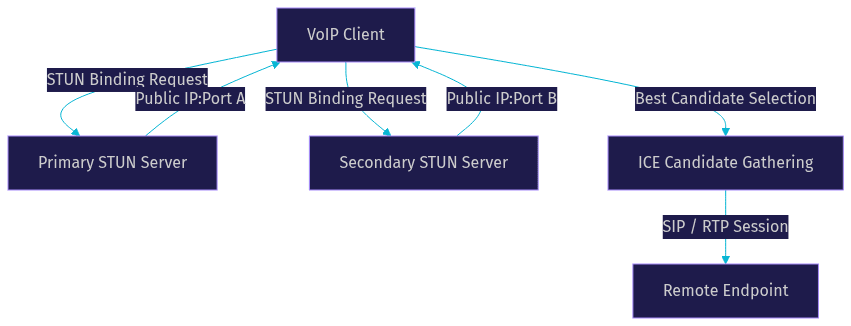
In this setup, the client queries both servers simultaneously. If both respond, ICE selects the best candidate. If only one responds, the client still has a valid reflexive address. This redundancy is especially important for mobile VoIP clients that frequently switch between networks.
Integrating STUN into SIP Devices
SIP phones, soft-clients, and PBX systems integrate STUN at different layers. IP desk phones typically have a NAT settings page where you enter the STUN server address. The phone queries the server on boot, discovers its public IP, and uses that address in SIP Contact headers and SDP connection information.
Soft-clients (like Zoiper, Linphone, or MicroSIP) follow the same pattern. The STUN server is specified in the account or network settings. The client uses the discovered address for both signaling and media, though some clients allow separate STUN configuration for RTP.
PBX systems like Asterisk and FreeSWITCH can use STUN for their own outbound connections. In Asterisk, the STUN module discovers the public address and uses it for SDP negotiation when the PBX is behind NAT. This is important when the PBX acts as a media endpoint rather than just a signaling proxy.
A common integration pattern in WebRTC-based systems uses STUN server addresses in ICE server configuration. VideoSDK's real-time communication SDKs handle this internally, but developers building custom SIP-to-WebRTC gateways need to configure STUN on both sides of the bridge.
For OpenSIPS integrations, the STUN module processes STUN requests that arrive on the same port as SIP signaling (5060). This allows the proxy to respond to STUN queries from clients without requiring a separate server. The proxy can also use the discovered public address to fix SIP Contact headers via NAT traversal helpers like the nathelper module.
One subtle issue: the public IP discovered via STUN may not match the IP that the SIP registrar sees. This happens when the SIP signaling path goes through a different NAT or proxy than the STUN query. Always verify that the STUN-discovered address matches the observed source address in SIP packets.
Common Configuration Mistakes in STUN VoIP Deployments
Several recurring errors plague "stun voip" configurations:
- Wrong STUN port: Using port 19302 (Google's default) when your server listens on 3478, or vice versa. Always confirm the port matches the server configuration.
- Missing NAT type detection: Assuming STUN will work without checking whether the NAT is symmetric. Symmetric NAT requires TURN, not just STUN.
- Mismatched advertised IP: The SIP phone discovers its public IP via STUN but still advertises its private IP in the SDP because the NAT settings are not applied to media. Check that both signaling and media use the STUN-discovered address.
- No keep-alives: NAT mappings expire during long calls if no traffic flows. Configure STUN or SIP keep-alive intervals shorter than the NAT timeout (typically every 20 to 30 seconds).
- STUN server behind NAT: The STUN server itself must have a public IP. A STUN server behind its own NAT will report the wrong address to clients.
Monitoring and Troubleshooting STUN VoIP Deployments
Troubleshooting "stun voip" issues requires a systematic approach. Start by verifying that the STUN server is reachable. Send a binding request and confirm a response returns with a valid XOR-MAPPED-ADDRESS. If no response arrives, check firewall rules, server availability, and port configuration.
Next, verify the discovered public address. Compare the STUN-discovered IP and port with the source address observed in SIP packets at the registrar. If they differ, the signaling path may traverse a different NAT than the STUN query, and you need to adjust the NAT handling in your SIP proxy.
Packet captures are invaluable for diagnosing NAT traversal issues. Capture traffic on both the client and server sides. Look for STUN binding requests and responses, SIP REGISTER messages, and RTP streams. If you see SIP signaling succeed but no RTP packets in one direction, the NAT mapping for the media port is likely incorrect or blocked.
SIP debug logs from the PBX or proxy reveal whether the Contact header and SDP connection address contain the correct public IP. If the SDP still shows a private IP, the STUN discovery is not being applied to media negotiation. This is a configuration issue in the endpoint, not a STUN protocol failure.
For WebRTC-based systems, the ICE candidate gathering process logs show which candidates were collected and which connectivity checks succeeded or failed. VideoSDK provides session analytics through its REST API that can help identify NAT-related connection issues in production.
Future Trends: IPv6 and Enhanced NAT Traversal
The long-term solution to NAT traversal problems is IPv6, which provides enough addresses to eliminate NAT entirely. As IPv6 adoption grows through 2026 and beyond, the need for STUN in VoIP will gradually diminish for networks that support end-to-end IPv6 connectivity. However, the transition period will be long, and dual-stack deployments (IPv4 and IPv6) will require NAT traversal for the IPv4 path for years to come.
RFC 8489, the current STUN specification, introduced improvements over the original RFC 3489, including better security through the XOR-MAPPED-ADDRESS attribute and removal of the unreliable NAT type classification mechanism. Future updates may focus on STUN over QUIC, which could reduce latency for address discovery.
ICE remains the dominant framework for NAT traversal in WebRTC, and its adoption in SIP continues to grow. The combination of ICE with TURN relay servers, potentially using WebTransport or QUIC for the relay path, represents the next evolution of NAT traversal technology. VideoSDK's infrastructure already leverages these modern approaches within its WebRTC-based telephony integration, bridging SIP networks with WebRTC rooms.
Definitions Glossary
STUN (Session Traversal Utilities for NAT): A protocol that allows a device behind NAT to discover its public IP address and port mapping by querying a STUN server on the public internet. In "stun voip" deployments, this discovered address is used in SIP and SDP messages so remote endpoints can send media back.
NAT (Network Address Translation): A network function that maps private IP addresses to a single public IP address. NAT breaks VoIP because SIP and RTP embed IP addresses in their payloads, and private addresses are unreachable from the public internet.
TURN (Traversal Using Relays around NAT): A protocol that relays media traffic through a server when direct peer-to-peer connection fails, typically due to symmetric NAT or restrictive firewalls. TURN adds latency and bandwidth cost but works where STUN cannot.
ICE (Interactive Connectivity Establishment): A framework that gathers all possible connection candidates (host, server-reflexive via STUN, relayed via TURN) and tests them in priority order to find the best working media path between two endpoints.
Reflexive Transport Address: The public IP and port that a NAT assigns to an internal device's connection, as observed by an external server. STUN discovers this address so it can be advertised in SIP and SDP.
Symmetric NAT: A NAT type that assigns a different external port for each destination address. This breaks STUN because the mapping discovered for the STUN server differs from the mapping used for the actual RTP stream.
Key Takeaways
- STUN is the first line of defense for NAT traversal in VoIP, enabling devices to discover their public IP and port for SIP signaling and RTP media.
- STUN works for full cone, restricted cone, and port-restricted cone NAT but fails for symmetric NAT, where TURN relay is required.
- ICE is the recommended framework for production deployments because it automatically selects the best path, falling back from direct to STUN-assisted to TURN-relayed as needed.
- Running your own STUN server with redundancy is essential for production VoIP, as public STUN servers offer no reliability guarantees.
- Common "stun voip" failures stem from mismatched advertised IPs, missing keep-alives, wrong port configuration, and undetected symmetric NAT.
- VideoSDK's WebRTC-based infrastructure handles NAT traversal automatically, including STUN and TURN fallback, within its real-time communication rooms.
Conclusion
STUN remains a foundational protocol for VoIP NAT traversal, and understanding "stun voip" mechanics is essential for anyone building or maintaining real-time communication systems. While STUN alone cannot solve every NAT scenario, combining it with TURN and ICE through a platform like VideoSDK's WebRTC infrastructure gives you a production-ready solution that handles the complexity automatically.
If you are building a VoIP application, video calling platform, or SIP-to-WebRTC bridge, VideoSDK's documentation covers the full integration path with automatic NAT traversal built in. You can start free with VideoSDK's developer account and join the Discord community of over 3,000 developers building real-time communication apps.
What are you building with VideoSDK? Drop a comment below, I would love to hear what kind of VoIP or real-time communication use case you are working on.
FAQ