



Text to speech (TTS) is technology that converts written text into spoken audio using speech synthesis, typically powered by neural networks. Modern neural TTS produces human-like voices in dozens of languages and can run in real time through cloud APIs or self-hosted models. Developers integrate TTS into apps for accessibility, e-learning, call centers, and AI voice agents, with providers like Amazon Polly, Google Cloud Text-to-Speech, and Microsoft Azure Speech offering managed services.
Text to speech has quietly become one of the most widely deployed AI technologies in software. Every time your navigation app reads a street name aloud, your phone reads a message, or a call center plays an automated appointment reminder, a speech synthesis model is turning raw text into audible speech in milliseconds.
For developers, TTS is no longer a niche accessibility feature. It is a core building block of voice assistants, AI voice agents, IVR systems, e-learning platforms, and real-time conversational applications. Understanding how it works, what it costs, and how to implement it well has become a practical skill for anyone building voice-enabled products.
This guide covers what text to speech is, how the modern neural pipeline works, where it delivers value, and how to choose an implementation path in 2026.
What Is Text to Speech?
Text to speech is defined as the computational process of converting written text into synthesized spoken audio. It works by analyzing the linguistic content of the input text, predicting how it should sound, and generating a waveform that reproduces natural human speech.
The term matters because TTS sits at the intersection of accessibility, content production, and conversational AI. For users with visual impairments or reading difficulties, TTS is the primary interface to digital text. For content creators, it converts written assets into audio at a fraction of the cost of studio voice-over. For developers building interactive products, it is the output half of any voice experience, paired with speech-to-text as the input half.
Modern TTS is overwhelmingly neural. Earlier systems stitched together recorded speech fragments, which produced the robotic cadence most people associate with old automated phone systems. Neural text to speech, by contrast, learns the mapping between linguistic features and audio directly from large datasets of human recordings, producing voices that are frequently indistinguishable from human speech in blind listening tests.
Historical Milestones in Text to Speech
The field is older than most people expect. In the 18th century, mechanical speaking machines used bellows and resonant chambers to approximate vowel sounds. In 1939, Bell Laboratories demonstrated the Voder, an electronic speech synthesizer operated manually at the World's Fair.
The 1970s and 1980s brought rule-based formant synthesis, followed by concatenative synthesis in the 1990s, which joined recorded speech units into utterances. The turning point arrived in 2016 when DeepMind's WaveNet demonstrated that a neural network could generate raw audio waveforms directly, dramatically improving naturalness. Tacotron 2 and FastSpeech refined the architecture, and by the early 2020s neural TTS was commercially mainstream through cloud APIs.
How Does Text to Speech Work?
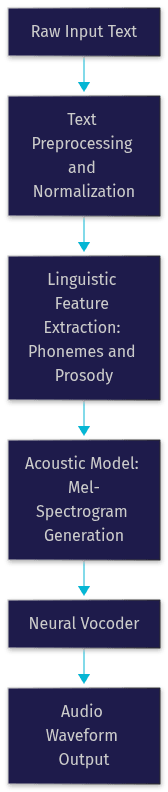
A modern neural TTS system works by passing text through a multi-stage pipeline: preprocessing, linguistic analysis, acoustic modeling, and waveform generation. Each stage transforms the input one step closer to audible speech, and the quality of every stage affects the final output.
The pipeline begins with raw text, which is messy by nature. It contains abbreviations, numbers, dates, currency symbols, and punctuation that must be interpreted before any sound can be predicted. Preprocessing converts this into a clean, normalized linguistic form.
Next, the system performs linguistic feature extraction. The normalized text is converted into phonemes, the smallest units of sound in a language, and prosody is predicted: which words are stressed, where pitch rises and falls, and how long each sound lasts. Prosody is what separates natural speech from flat, robotic delivery.
The acoustic model then converts phonemes and prosody into a mel-spectrogram, a time-frequency representation of the audio that captures the spectral shape of the target speech. Finally, a neural vocoder transforms the mel-spectrogram into an actual audio waveform that can be played through a speaker.
Text Preprocessing and Normalization
Text normalization converts the written form of language into its spoken form. The system tokenizes the input, expands abbreviations, and converts numbers, dates, and currency into words. For example, a payment amount must be read as "nineteen dollars and ninety-nine cents," not as a raw string of digits. This stage is deceptively important: normalization errors are one of the most common causes of unnatural TTS output.
Linguistic Feature Extraction
After normalization, the text is converted into a phoneme sequence using a pronunciation dictionary and grapheme-to-phoneme rules for unknown words. In parallel, the model predicts prosody: sentence-level intonation, word-level stress, and timing. This stage determines whether the output sounds like a question, a statement, or an emphatic remark, even before any audio exists.
Acoustic Model and Neural Vocoder
The acoustic model maps phonemes and prosody into a mel-spectrogram. Landmark architectures include Tacotron 2, an end-to-end sequence-to-sequence model, and FastSpeech, which replaced the slow autoregressive generation with parallel prediction, cutting synthesis time dramatically and enabling real-time use.
The vocoder then converts the mel-spectrogram into a waveform. WaveNet generates audio sample-by-sample with high fidelity but high computational cost. WaveGlow and similar flow-based vocoders generate audio in parallel, making them fast enough for production. GPU acceleration is what makes real-time neural TTS practical: without it, generating a second of speech could take longer than playing it.
Key Benefits of Text to Speech
Text to speech delivers value across four main dimensions: accessibility, productivity, global reach, and cost. Each benefit maps to concrete product decisions developers make every day.
- Accessibility: TTS makes digital content consumable by people with visual impairments, dyslexia, and other reading barriers, and it is often a legal requirement under accessibility regulations.
- Productivity: Audio lets people consume content while driving, exercising, cooking, or working with their hands.
- Multilingual reach: A single TTS engine can speak dozens of languages and accents, letting one product serve a global audience.
- Cost savings: AI-generated narration replaces expensive studio voice-over for many content types, and scales without per-session human cost.
Accessibility for Visual Impairments
For blind and low-vision users, TTS is the foundation of screen readers, the software that reads on-screen content aloud. It also enables independent consumption of documents, articles, and interfaces without human assistance. For developers, building TTS into a product is one of the highest-impact accessibility improvements available, and regulations in many jurisdictions effectively require it for public-sector and enterprise software.
Hands-Free Consumption and Productivity
Audio content fits into moments where reading is impossible: commuting, cooking, working out, or operating machinery. Developers building podcast-style features, article narration, or in-app audio playback extend their product into these moments. The result is higher engagement, because users can keep consuming content in situations where a text-only product would be closed.
Multilingual and Accent Support
Modern TTS providers offer language packs covering dozens of languages and regional accents, often with multiple voice options per language. This means a single integration can serve users in English, Spanish, Hindi, Arabic, and more, with accent customization for regional audiences. For products expanding internationally, TTS is dramatically cheaper than recording localized voice talent for every market.
Cost-Effective Content Creation
Producing professional voice-over traditionally requires studio time, talent, and editing. TTS converts a written manuscript into finished audio in minutes at a small fraction of the cost. For audiobooks, course narration, and marketing content, AI-generated audio has become the default starting point, with human recording reserved for premium productions.
Popular Use Cases and Industries
Text to speech use cases span nearly every industry that communicates with users through language. The most mature deployments cluster in education, media, customer service, healthcare, and publishing.
E-Learning and Education
Educational platforms use TTS to narrate lessons, read assessment questions, and support language learning with pronunciation modeling. Learners can listen to course material on the go, and students with reading difficulties get an equal path through the curriculum. Language-learning apps additionally use TTS to demonstrate correct pronunciation of vocabulary and phrases across target languages.
Media, Entertainment, and Gaming
Games use TTS for dynamic narration and character dialogue that would be impractical to pre-record for every possible player action. Procedurally generated quests, sports commentary, and virtual reality experiences all benefit from speech that adapts to game state in real time. Media companies use TTS for automated article narration, turning written newsrooms into audio products without additional production staff.
Customer Service and Call Centers
Call centers were early TTS adopters and remain among the largest. Interactive voice response (IVR) systems use TTS to read dynamic content like account balances, appointment times, and order statuses that cannot be pre-recorded. Outbound notification systems use TTS for appointment reminders, delivery updates, and payment alerts. Multilingual TTS lets a single system serve callers in multiple languages, and modern deployments pair TTS with AI voice agents that hold full conversations rather than playing static prompts.
Healthcare and Telemedicine
Healthcare uses TTS for patient reminders, medication instructions, and post-discharge guidance delivered by phone. Because health information is sensitive, HIPAA-compliant TTS deployments are a specific category: providers must ensure their TTS vendor processes data under business associate agreements and does not retain protected health information. Telemedicine platforms also use TTS in voice interfaces for scheduling and triage.
Publishing and Audiobooks
Publishers convert back-catalog text assets into audiobooks at scale using TTS, reaching listeners on audio platforms without funding full studio productions for every title. Newsletters, blogs, and documentation sites increasingly offer audio versions generated on demand, a pattern that has become a standard reader-expectation rather than a novelty.
Implementation Options
Developers implementing TTS choose between self-hosted open-source models and managed cloud services. The right choice depends on latency requirements, cost tolerance, compliance constraints, and how much control you need over the voice.
Self-Hosted Solutions
Self-hosting means running open-source TTS models on your own infrastructure, typically GPU-equipped servers. Frameworks like NVIDIA NeMo and NVIDIA Riva provide production-grade neural TTS pipelines, and open-source community models cover many languages. Self-hosting gives you full control over data, no per-character API fees, and the ability to fine-tune or clone custom voices. The trade-offs are real: GPU hardware or rented instances are expensive, you own the operational burden of scaling and updates, and reaching the naturalness of top commercial voices requires significant tuning.
Managed Cloud Services
Managed services handle the models, scaling, and updates for you. Amazon Polly, Google Cloud Text-to-Speech, and Microsoft Azure Speech are the three dominant providers, each offering neural voices across dozens of languages with pay-as-you-go pricing, generally billed per million characters synthesized. Managed services scale instantly, require no ML expertise, and expose consistent APIs. The trade-offs are per-use costs at high volume, data flowing through a third party, and less control over voice customization, though most providers now offer custom voice training on paid tiers.
Integration Workflow
Integrating a managed TTS service follows a consistent pattern regardless of provider. You authenticate with credentials issued by the provider, send normalized text to the synthesis endpoint, and receive generated audio, typically as a downloadable file or stream. Most implementations add a caching layer so repeated phrases, common prompts, or frequently narrated passages are synthesized once and reused, which cuts both latency and cost. For real-time applications like voice agents, streaming synthesis that begins returning audio before the full utterance is generated is essential to keep perceived response time low.
For developers building real-time voice experiences, TTS is one component of a larger pipeline. VideoSDK's AI voice agent platform connects speech-to-text, large language models, and TTS providers into a single real-time pipeline, with built-in TTS caching and turn detection that handle the latency-critical parts of conversational speech.
Choosing the Right Text to Speech Provider
Choosing a TTS provider comes down to five criteria, and the weighting depends on your application.
Voice quality is the first filter: run the same sample text through candidate providers and compare naturalness in your target languages. Quality varies significantly between providers and between voices within a single provider.
Language coverage matters if you serve international users. Verify that your specific languages and regional accents are supported with neural voices, not just standard voices.
Latency is decisive for conversational applications. For IVR prompts, hundreds of milliseconds is acceptable. For a real-time AI voice agent, you need streaming synthesis that begins producing audio almost immediately, or the conversation feels broken.
Pricing scales with usage. Per-character pricing looks trivial at prototype scale and becomes a major line item when narrating large content libraries or serving high call volumes. Model your realistic volume before committing, and use caching aggressively.
Security and compliance can eliminate providers entirely. Healthcare applications need HIPAA-compliant processing under business associate agreements. European deployments need GDPR-compliant data handling. Enterprise buyers increasingly require guarantees that submitted text is not used for model training.
Future Trends in Text to Speech
TTS is evolving quickly, and four trends are shaping what developers will build next.
Emotional and expressive TTS is moving from research to product. Models can now convey emotion, emphasis, and speaking style, and controllable emotional delivery is appearing in commercial APIs. This unlocks applications from empathetic customer service voices to expressive audiobook narration.
Singing TTS is emerging as models extend beyond speech into sung audio with melody and rhythm control, opening creative applications in music production and entertainment.
Real-time voice cloning is becoming practical, letting a short reference recording produce a custom voice. This is powerful for personalization and media production, and it raises serious consent and fraud concerns that responsible implementations must address with clear policies.
Edge inference and multimodal AI round out the picture. Compact TTS models now run on-device, enabling offline and low-latency use in cars, wearables, and embedded systems. Meanwhile, TTS is becoming one output modality of multimodal AI systems that speak, display, and show avatars in a unified experience, a direction visible in VideoSDK's support for AI voice agents with avatars and vision capabilities.
Definitions Glossary
Text to Speech (TTS): Technology that converts written text into synthesized spoken audio, using rule-based, concatenative, or neural methods. Modern neural TTS produces near-human naturalness and is typically accessed by developers through cloud APIs.
Neural Text to Speech: Speech synthesis performed by neural networks that learn the mapping from linguistic features to audio directly from human recordings, replacing older recorded-fragment stitching. It is the dominant approach in 2026 commercial systems.
Phoneme: The smallest unit of sound in a language that distinguishes one word from another. TTS systems convert normalized text into phoneme sequences before generating audio.
Mel-Spectrogram: A time-frequency representation of audio that captures the spectral shape of speech. Neural acoustic models predict mel-spectrograms, which vocoders then convert into playable waveforms.
Neural Vocoder: The model that transforms a mel-spectrogram into an audio waveform. Architectures like WaveNet and WaveGlow made high-fidelity, real-time neural TTS commercially viable.
Text Normalization: The preprocessing step that converts written forms into spoken forms, expanding abbreviations and converting numbers, dates, and currency into words. Normalization errors are a leading cause of unnatural TTS output.
Key Takeaways
- Text to speech is the technology that converts written text into spoken audio, and modern neural TTS produces voices that are frequently indistinguishable from human speech.
- The neural TTS pipeline runs through four stages: text preprocessing and normalization, linguistic feature extraction, acoustic modeling into mel-spectrograms, and vocoder-based waveform generation.
- TTS delivers four core benefits: accessibility for users with visual impairments and reading barriers, hands-free content consumption, multilingual reach, and lower content production costs.
- The highest-volume use cases are e-learning, gaming and media, call centers and IVR, healthcare communication, and audiobook and article narration.
- Developers choose between self-hosted open-source models for control and compliance, and managed services like Amazon Polly, Google Cloud Text-to-Speech, and Azure Speech for speed and scalability, with provider selection driven by voice quality, language coverage, latency, pricing, and compliance.
Conclusion
Text to speech has moved from a robotic novelty to a production-grade AI capability that powers accessibility, education, customer service, and real-time conversational agents. Understanding the pipeline, from text normalization through neural vocoders, helps you make better implementation decisions whether you are narrating content or building a live voice experience.
The practical next step is to experiment. Most managed TTS services offer free tiers, and open-source models let you test locally. If you are building real-time voice applications, explore how VideoSDK's AI voice agents integrate TTS into a full speech-to-text, LLM, and TTS pipeline, and try it free by signing up at app.videosdk.live.
What are you building with text to speech? Drop a comment, I'd love to hear what kind of voice experience you're working on.
Free $20 Balance for AI Voice Agents & Video Calls
FAQ