


Vosk speech recognition is an open-source, offline speech-to-text toolkit built on the Kaldi ASR engine, supporting multilingual models, real-time streaming transcription, and speaker identification. It runs entirely on-device without cloud dependencies, making it ideal for privacy-first applications, embedded systems, and low-latency edge deployments. Developers can integrate Vosk through bindings for Python, Java, Node.js, C#, Rust, and mobile platforms, with models as small as 50 MB for resource-constrained environments.
Introduction
Speech recognition that depends on a cloud round-trip introduces latency, requires constant bandwidth, and creates privacy exposure for every utterance processed. For applications running on embedded devices, in secure environments, or under poor network conditions, offline speech recognition eliminates those constraints entirely. Vosk has emerged as one of the most widely adopted open-source solutions for this problem, offering real-time transcription that runs locally on hardware ranging from Raspberry Pi to server clusters.
This article walks through how Vosk speech recognition works, from its Kaldi-based architecture to model selection, recognizer configuration, and cross-platform integration. You will learn how to evaluate Vosk against cloud alternatives, choose the right language model for your accuracy and footprint requirements, and avoid the common pitfalls that trip up developers building offline ASR pipelines.
Understanding Vosk Speech Recognition
Vosk speech recognition is defined as an open-source speech-to-text toolkit that provides offline, real-time transcription using compact acoustic and language models derived from the Kaldi ASR engine. Kaldi, developed at Johns Hopkins University, is one of the most respected speech recognition frameworks in the research community. Vosk wraps Kaldi's decoder in a lightweight, easy-to-use package with bindings for multiple programming languages, removing the steep learning curve that traditionally kept developers away from Kaldi-based systems.
Vosk works by loading a pre-trained language model into memory, accepting a stream of audio data, and producing JSON-formatted transcription results that include partial results, final results, word-level timestamps, and speaker identification labels when configured. The toolkit ships with models for over 20 languages, including English, Chinese, French, German, Spanish, Hindi, Arabic, and Russian, with vocabulary sizes and accuracy profiles tuned for different deployment scenarios.
Typical use cases for Vosk include voice-controlled chatbots, smart home automation, live subtitle generation, medical transcription in HIPAA-compliant offline environments, and interactive voice response systems on embedded hardware. Developers building real-time communication applications can also pair offline ASR engines like Vosk with platforms such as VideoSDK to add transcription capabilities within video or audio calling sessions, though VideoSDK also offers built-in real-time transcription for developers who prefer a managed solution.
Vosk Architecture Overview
The Vosk processing pipeline follows a classic speech recognition flow with optimizations for real-time streaming. Audio enters the system as raw PCM samples, gets converted into Mel-frequency cepstral coefficients for feature extraction, passes through a Kaldi acoustic model that maps features to phoneme probabilities, and finally reaches a decoder that combines acoustic scores with language model probabilities to produce the most likely word sequence.
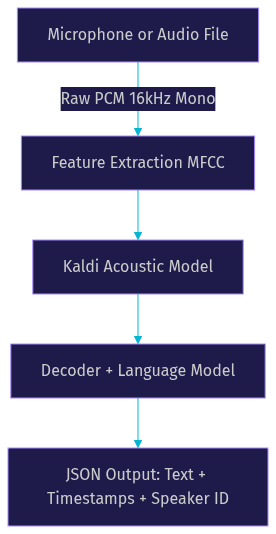
The output JSON contains the recognized text, confidence scores, word-level timestamps, and speaker labels when a speaker identification model is loaded. This structured output makes it straightforward to build downstream features like live captioning, command parsing, or conversation analytics.
Offline vs Cloud Speech-to-Text
Offline speech recognition fundamentally changes the trade-offs developers face when building voice-enabled applications. Cloud-based services like Google Speech-to-Text, Amazon Transcribe, and Azure Speech send audio to remote servers, process it on powerful hardware, and return results over the network. This model offers high accuracy and large vocabulary coverage but introduces latency from network round-trips, requires consistent bandwidth, and creates privacy concerns since audio data leaves the device.
Vosk eliminates the network dependency entirely. Audio is processed locally, results are returned with sub-second latency, and no audio data ever leaves the device. This makes Vosk the right choice for applications running in secure environments, on devices with unreliable connectivity, or in scenarios where privacy is non-negotiable. The trade-off is that local models have smaller vocabularies and may achieve lower accuracy than cloud services on complex audio, particularly with heavy accents or domain-specific terminology.
Cost is another differentiator. Cloud services charge per minute of audio processed, which scales linearly with usage. Vosk has no per-minute cost since processing happens on your own hardware. For high-volume transcription workloads, the hardware cost of running Vosk can be significantly lower than the cumulative API charges of a cloud service. For developers who need both offline processing and managed real-time transcription within communication apps, VideoSDK's transcription capabilities offer a hybrid approach worth evaluating.
Language Models and Accuracy
Vosk language models are pre-trained bundles that contain the acoustic model, language model, phoneme dictionary, and optional speaker identification data needed for transcription. Model sizes range from approximately 50 MB for lightweight models designed for mobile and embedded use, to over 1 GB for large models that maximize accuracy on complex audio. The small English model weighs in around 50 MB and works well for command-and-control applications, while the large English model at roughly 1.8 GB approaches cloud-level accuracy for general dictation.
Accuracy varies significantly by language. English models benefit from extensive training data and generally achieve word error rates competitive with cloud alternatives on clean audio. According to independent benchmarks published on the Artificial Analysis Speech Arena, Vosk's English models typically achieve word error rates in the 10 to 15 percent range on conversational audio, compared to 5 to 10 percent for top-tier cloud services. Languages with less training data available, such as smaller regional languages, may see higher error rates.
Selecting the right model depends on your deployment target and accuracy requirements. For a Raspberry Pi project with limited RAM, the small model is the practical choice. For a server-based batch transcription pipeline processing recorded meetings, the large model delivers better accuracy and is worth the memory overhead. For mobile applications, the small or medium models balance accuracy against storage and battery constraints. Vosk also supports custom grammar definitions that restrict recognition to a specific set of phrases, dramatically improving accuracy for command-driven interfaces.
The Recognizer Component
The Recognizer is the central processing unit in Vosk's API surface, accepting audio data, managing internal decoding state, and emitting recognition results as JSON objects. Every Vosk binding, regardless of programming language, follows the same recognizer workflow: instantiate a model, create a recognizer bound to that model, feed audio chunks into the recognizer, and parse the JSON results that come back.
Configuration options give developers control over how the recognizer behaves. The maximum alternatives setting controls how many candidate transcriptions are returned per result, useful when you need to choose among ambiguous interpretations. Word-level timestamps can be enabled to get precise timing information for each recognized word, which is essential for subtitle generation and audio analytics. Partial results can be toggled to receive incremental updates as the user is still speaking, enabling real-time captioning experiences. A grammar or vocabulary constraint can be applied to limit recognition to a predefined set of phrases, which dramatically improves accuracy for voice command systems. When a speaker identification model is loaded, the recognizer attaches speaker labels to each segment, enabling diarization without a separate processing step.
Endpoint detection is a critical feature of the recognizer. It automatically identifies when a speaker has finished an utterance based on silence duration and acoustic patterns, triggering a final result without requiring the developer to manually segment audio. This is what enables Vosk to work in streaming mode, where audio flows in continuously and the recognizer emits partial results during speech and final results at natural pause points.
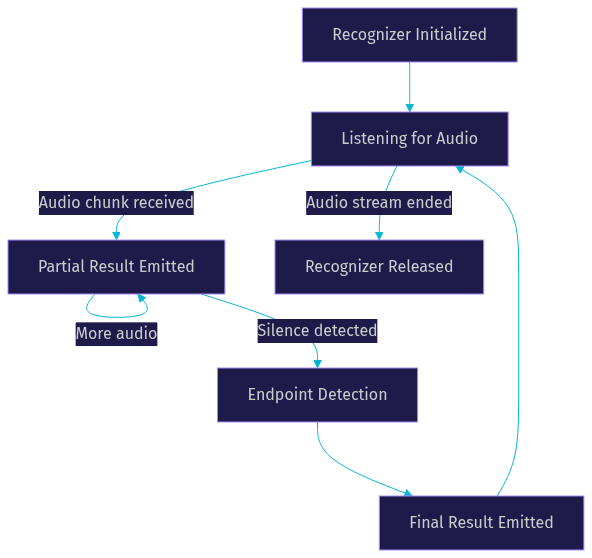
The recognizer maintains internal state across audio chunks, so it can handle long streaming sessions without restarting. However, if you need to reset context between speakers or between distinct audio segments, the recognizer can be cleared to start fresh without reloading the model.
Integration Options
Vosk provides language bindings for Python, Java, Node.js, C#, Rust, React Native, and .NET, covering virtually every major development platform. Each binding follows the same conceptual workflow: load a model from a local directory, create a recognizer with a specified sample rate, feed audio data in chunks, and parse JSON results. The API surface is intentionally consistent across languages, so developers who understand the Python workflow can apply the same mental model to Java, C#, or Rust without relearning the architecture.
Platform-specific considerations matter when deploying Vosk on mobile and embedded targets. On Android, model files must be bundled as assets within the application package, and the model path passed to the Vosk initializer points to the extracted asset directory. On iOS, models are typically added to the app bundle as resources and accessed through the bundle path. On Raspberry Pi and other Linux-based embedded systems, models are stored on the filesystem and loaded directly by path. React Native bindings bridge the native Vosk library through JavaScript, requiring model files to be accessible from the native side of the bridge.
For developers building real-time communication applications that need speech recognition alongside video or audio calling, VideoSDK's Python SDK can serve as the media transport layer while Vosk handles local transcription. This combination is particularly useful for privacy-sensitive telehealth or legal applications where audio must not leave the local device for transcription purposes.
Practical Implementation Guide
Building a Vosk speech recognition pipeline involves five sequential steps that apply regardless of your chosen programming language.
First, acquire a language model from the Vosk models repository. Download the model archive, extract it to a local directory, and note the path. The model directory contains the acoustic model, language model, and pronunciation dictionary that Vosk needs to function.
Second, load the model into memory by passing the model directory path to the Vosk model initializer. This step reads the model files into RAM and prepares the internal Kaldi structures for decoding. Model load time depends on model size and disk speed, ranging from under a second for small models to several seconds for large models on slower hardware.
Third, create a recognizer instance bound to the loaded model. Specify the audio sample rate at this stage, which must match the sample rate of the audio you plan to feed in. The most common configuration is 16 kHz mono, which is the standard for speech recognition. Mismatched sample rates are the single most common cause of poor accuracy and garbled output.
Fourth, feed audio data into the recognizer in chunks. For microphone input, use a producer-consumer pattern where an audio capture thread reads samples from the microphone and pushes them into a queue, while a processing thread pulls chunks from the queue and passes them to the recognizer. For batch file processing, read the audio file in fixed-size chunks and pass each chunk sequentially. The recognizer accepts raw PCM data, so ensure your audio source is decompressed and in the correct format before feeding it in.
Fifth, handle the JSON results returned by the recognizer. Partial results arrive while the user is still speaking and contain the best-guess transcription so far. Final results arrive when the recognizer detects an endpoint, containing the completed utterance with optional timestamps and speaker labels. Parse these results to update your UI, trigger commands, or store transcripts.
Audio format requirements are strict and non-negotiable. Vosk expects mono, 16-bit PCM audio at either 16 kHz or 8 kHz sample rate. Stereo audio, compressed formats like MP3, or mismatched sample rates will produce incorrect results or crash the recognizer. If your audio source produces a different format, convert it before passing it to Vosk.
Common errors include model load failure, which typically indicates an incorrect path or corrupted model archive, and sample rate mismatch, which produces output that looks like random words unrelated to the actual audio. Always verify your audio format before debugging recognizer logic.
Performance and Hardware Considerations
Vosk is designed to run efficiently on a wide range of hardware, from single-board computers to multi-core servers. On CPU, Vosk uses optimized Kaldi routines that leverage SIMD instructions where available, making real-time transcription feasible on modern processors with modest clock speeds. A Raspberry Pi 4 can run the small English model in real-time with approximately 30 to 40 percent CPU utilization, leaving headroom for other application logic.
GPU acceleration is available through CUDA support in Kaldi, which can significantly speed up processing for large models or batch transcription workloads. On server-class hardware with NVIDIA GPUs, the large English model can process audio faster than real-time, making it practical for transcribing large archives of recorded audio. However, for most real-time streaming use cases, CPU performance is sufficient, and the added complexity of GPU setup is not justified.
Memory usage scales with model size. The small model requires approximately 200 MB of RAM, while the large model can consume over 2 GB. On memory-constrained devices like Raspberry Pi, stick with small or medium models and avoid loading multiple models simultaneously. On servers, memory is rarely the bottleneck, but be aware that each recognizer instance holds its own state, so concurrent recognition sessions multiply memory usage.
For mobile platforms, battery life is a consideration. Continuous microphone capture and audio processing consume significant power, so design your application to activate recognition only when needed rather than running it continuously in the background.
Vosk Compared to Popular Cloud Services
Choosing between Vosk and cloud-based speech recognition services depends on your priorities around latency, privacy, cost, and accuracy. Here is a practical comparison across the most popular alternatives.
| Feature | Vosk | Google Speech-to-Text | OpenAI Whisper | Deepgram |
|---|---|---|---|---|
| Deployment | Offline, on-device | Cloud API | Local or cloud | Cloud API |
| Latency | Sub-second | 200-500ms round-trip | Varies by model size | Sub-second streaming |
| Privacy | Audio never leaves device | Audio sent to Google | Local option available | Audio sent to Deepgram |
| Pricing | Free, open-source | Per-minute billing | Free if self-hosted | Per-minute billing |
| Language support | 20+ languages | 125+ languages | 90+ languages | 30+ languages |
| Speaker ID | Built-in | Separate API call | Not built-in | Built-in diarization |
| Best for | Edge, embedded, privacy | Large-scale cloud ASR | Open-source flexibility | High-speed streaming |
Vosk wins on privacy, offline capability, and zero per-minute cost. Google Speech-to-Text wins on language coverage and accuracy for complex audio. OpenAI Whisper offers a compelling open-source alternative with broader language coverage but typically requires more compute resources than Vosk for real-time use. Deepgram excels at low-latency streaming transcription in cloud environments and offers competitive accuracy, particularly for English.
For developers who need speech recognition integrated into real-time video or audio calling applications, VideoSDK's AI Voice Agent pipeline supports multiple STT providers including Deepgram and OpenAI Whisper, offering a managed alternative to building a custom Vosk integration from scratch.
Best Practices and Troubleshooting
Getting good results from Vosk requires attention to model selection, audio quality, and recognizer configuration. Start with the right model for your use case. Command-and-control applications benefit from small models with grammar constraints, while dictation and transcription tasks need larger models with broader vocabulary. Test multiple models on representative audio samples before committing to one.
Audio quality is the biggest factor in recognition accuracy. Use a decent microphone, minimize background noise, and ensure your audio capture pipeline produces clean PCM at the correct sample rate. A high-quality microphone with the small model often outperforms a poor microphone with the large model.
Common pitfalls include feeding stereo audio to a recognizer configured for mono, using a sample rate that does not match the recognizer configuration, and forgetting to load a speaker model when speaker identification is needed. Another frequent issue is feeding audio chunks that are too small or too large. Chunks of approximately 100 to 200 milliseconds work well for real-time streaming, while batch processing can use larger chunks for efficiency.
To improve accuracy, consider defining a grammar that limits recognition to your expected vocabulary. This is particularly effective for voice command systems where the set of possible phrases is known in advance. For domain-specific terminology not covered by the default model, custom vocabulary and language model adaptation can help, though this requires more advanced Kaldi knowledge. Speaker adaptation, where the acoustic model is fine-tuned for a specific speaker's voice, can also improve accuracy for dedicated user devices.
Definitions Glossary
Vosk: An open-source speech recognition toolkit built on the Kaldi ASR engine that provides offline, real-time transcription with multilingual support and speaker identification.
Kaldi: A widely used open-source speech recognition framework developed at Johns Hopkins University, serving as the acoustic modeling and decoding foundation beneath Vosk.
Recognizer: The core Vosk component that accepts audio chunks, manages decoding state, and emits JSON-formatted transcription results including partial and final outputs.
Language Model: A pre-trained bundle containing acoustic models, phoneme dictionaries, and vocabulary data that Vosk loads to perform speech recognition for a specific language.
Endpoint Detection: The recognizer's ability to automatically identify when a speaker has finished an utterance based on silence patterns, triggering a final result without manual audio segmentation.
MFCC (Mel-Frequency Cepstral Coefficients): The acoustic feature representation extracted from raw audio that Vosk's Kaldi decoder processes to identify phoneme probabilities.
Partial Result: An incremental transcription output emitted by the recognizer while the user is still speaking, enabling real-time captioning and live feedback.
Key Takeaways
- Vosk speech recognition provides fully offline, on-device transcription using the Kaldi ASR engine, eliminating cloud latency and privacy concerns for voice-enabled applications.
- Language models range from 50 MB for embedded deployments to over 1 GB for maximum accuracy, with support for 20+ languages and custom grammar constraints.
- The Recognizer component manages streaming audio input, endpoint detection, and JSON output with word timestamps and speaker labels, following a consistent API across all language bindings.
- Audio format requirements are strict: mono, 16-bit PCM at 16 kHz or 8 kHz, and mismatched formats are the most common cause of poor recognition results.
- Vosk excels for privacy-first, embedded, and low-latency use cases, while cloud services like Deepgram and Google Speech-to-Text offer broader language coverage and higher accuracy on complex audio.
- Developers building real-time communication apps can pair Vosk with platforms like VideoSDK for local transcription within video and audio calling sessions, or use VideoSDK's built-in transcription for a managed alternative.
Conclusion
Vosk speech recognition fills a critical gap in the speech-to-text landscape by offering a mature, open-source, offline ASR engine that runs on hardware ranging from Raspberry Pi to server clusters. Its Kaldi foundation, multilingual model library, and consistent cross-language API make it accessible to developers who need privacy-first transcription without cloud dependencies. The trade-offs are real: smaller vocabularies and potentially lower accuracy than top-tier cloud services. But for embedded systems, secure environments, and cost-sensitive high-volume workloads, Vosk delivers where cloud APIs cannot.
Download a model from the Vosk models repository, try the Python demo to get a feel for the recognizer workflow, and explore the Vosk documentation for advanced configuration options. If you are building real-time communication applications and want managed transcription alongside video or audio calling, check out VideoSDK's real-time transcription features or sign up at app.videosdk.live/login to get started.
What are you building with Vosk speech recognition? Drop a comment and share what kind of offline ASR use case you are working on, whether it is a smart home device, a transcription pipeline, or something entirely different.
Free $20 Balance for AI Voice Agents & Video Calls
FAQ