


ASR speech recognition is the process of converting spoken audio into text using machine learning models that analyze acoustic features and linguistic patterns. Modern systems combine acoustic models, language models, and decoders to achieve high accuracy across multiple languages and noisy environments. Developers can integrate these capabilities through open-source models or cloud APIs, with VideoSDK offering real-time transcription built directly into its video calling SDKs.
Building applications that understand human speech has shifted from a research luxury to a production necessity. Whether you are transcribing customer support calls, generating live captions for a video calling app, or building a voice agent that responds in real time, accurate speech-to-text conversion sits at the core of the experience. The technology landscape has evolved rapidly, with open-source models now rivaling proprietary cloud services in both accuracy and latency.
For developers, the challenge is no longer whether ASR works but how to choose the right model, architect the pipeline, and deploy it at scale. This guide breaks down the core components of modern ASR speech recognition systems, compares leading open-source models, and walks through implementation best practices so you can ship a transcription pipeline that meets your accuracy and latency requirements.
What is ASR Speech Recognition?
ASR speech recognition, short for automatic speech recognition, is defined as the technology that converts spoken language into written text by analyzing audio signals through computational models. Unlike simple audio transcription, which a human performs manually, ASR systems use machine learning to process audio waveforms, identify phonetic patterns, and map them to linguistic representations.
ASR works by breaking down an audio stream into small frames, extracting acoustic features such as mel-frequency cepstral coefficients, and passing those features through a neural network that predicts the most likely phonemes or characters. A language model then refines those predictions by considering the probability of word sequences, ensuring the final output is coherent and grammatically plausible.
The distinction between ASR and basic transcription matters for developers. A basic transcription pipeline might record audio and send it to a human reviewer. An ASR pipeline automates the entire process, enabling real-time transcription, speaker diarization, and integration with downstream systems like large language models for summarization or sentiment analysis. VideoSDK provides real-time transcription as a built-in feature of its video calling SDK, allowing developers to add live captions without managing a separate ASR infrastructure.
Core Components of Modern ASR Systems
Modern ASR speech recognition systems rely on several interconnected components, each handling a specific stage of the audio-to-text pipeline. Understanding these components helps developers diagnose accuracy issues, optimize latency, and choose models that fit their deployment constraints.
Acoustic Model
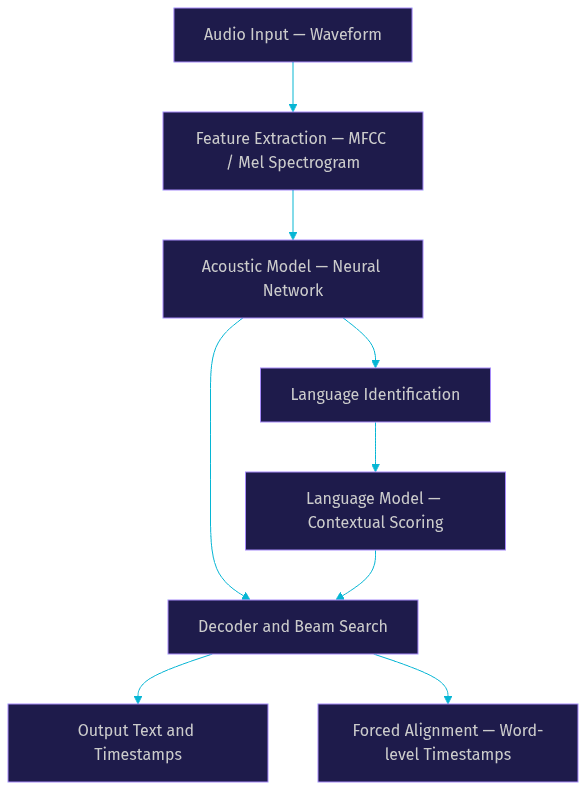
The acoustic model is the neural network responsible for mapping raw audio waveforms to phonetic representations. It learns to identify patterns in speech signals, such as formants and spectral features, and converts them into probability distributions over phonemes or subword units. Modern acoustic models use architectures like convolutional neural networks, transformers, or conformers, which combine self-attention with convolution to capture both local and global audio context. The quality of the acoustic model directly determines how well the system handles accents, background noise, and varied speaking styles.
Language Model
The language model improves transcription coherence by evaluating the likelihood of word sequences. Statistical n-gram models calculate probabilities based on historical word frequencies, while neural language models use deep learning to capture longer-range dependencies and contextual nuances. When the acoustic model produces ambiguous predictions, the language model helps disambiguate by favoring word sequences that make linguistic sense. For domain-specific applications like medical or legal transcription, developers often fine-tune the language model on specialized vocabulary to reduce errors.
Decoder and Beam Search
The decoder combines outputs from the acoustic and language models to generate the final text hypothesis. Beam search is the most common decoding strategy, maintaining a set of top candidate sequences and expanding them iteratively. At each step, the decoder scores candidates using a combination of acoustic and language model probabilities, prunes low-scoring paths, and retains the most promising hypotheses. Wider beam sizes improve accuracy but increase computational cost and latency, creating a tunable trade-off for developers.
Language Identification
Language identification, or LID, detects the spoken language within an audio stream before routing it to the appropriate ASR model. In multilingual pipelines, LID acts as a traffic controller, ensuring that a Spanish audio clip does not get processed by an English-only model. Modern LID systems use neural classifiers trained on diverse speech corpora and can identify languages from short audio segments, sometimes under three seconds. This component is critical for applications serving global user bases where callers may switch languages mid-conversation.
Forced Alignment
Forced alignment is the process of generating precise timestamps for words and phonemes within an audio recording, given a known transcript. Unlike standard ASR, which produces text from audio, forced alignment works in the opposite direction by matching existing text to audio frames. Developers use forced alignment to build subtitle tracks, synchronize audio with visual content, and create training data for new ASR models. Several open-source models now include built-in forced aligners, reducing the need for separate tooling.
The following diagram illustrates how audio flows through these components in a standard ASR pipeline:
Popular Open-Source ASR Models
The open-source ASR landscape has expanded significantly, with several models achieving state-of-the-art performance on public benchmarks. Each model targets different use cases, from massive multilingual coverage to compact edge deployment.
Qwen3-ASR (Alibaba)
Qwen3-ASR, developed by Alibaba, is a versatile automatic speech recognition model designed for broad language coverage and high-accuracy transcription. It supports multiple languages and includes a built-in forced aligner, which simplifies timestamp generation for subtitle and caption workflows. The model leverages transformer-based architecture and is trained on large-scale multilingual speech corpora. Developers building applications that serve Asian languages often find Qwen3-ASR particularly strong due to its training data distribution.
Omnilingual ASR (Meta)
Meta's Omnilingual ASR project pushes the boundaries of multilingual coverage, supporting over 1,600 languages through zero-shot and few-shot learning. Rather than training separate models per language, the system uses a unified architecture that generalizes across language families. This approach makes it suitable for applications targeting low-resource languages where dedicated training data is scarce. The trade-off is that zero-shot accuracy for some languages may lag behind models trained specifically on those languages.
FireRedASR2S
FireRedASR2S is an industrial-grade ASR system that bundles several production-ready modules into a single package. It includes voice activity detection to segment speech from silence, language identification for multilingual routing, automatic punctuation insertion, and the core ASR model. This all-in-one design reduces the integration effort for developers who need a complete pipeline rather than individual components. FireRedASR2S targets state-of-the-art performance on standard benchmarks and is optimized for real-world audio conditions.
GLM-ASR-Nano (ZAI)
GLM-ASR-Nano, developed by ZAI, focuses on compact deployment scenarios where computational resources are limited. The model supports dialect recognition and is trained to handle low-volume speech, making it suitable for edge devices and mobile applications. Its small footprint allows inference on CPUs without requiring dedicated GPU hardware. Developers building on-device transcription features or offline-first applications often consider this model due to its efficiency.
Comparison of Open-Source ASR Models
The table below compares these models across key dimensions developers evaluate during selection. [LINKABLE ASSET — comparison table]
| Model | Languages | Model Size | Latency Profile | Licensing | Best For |
|---|---|---|---|---|---|
| Qwen3-ASR | Multilingual, strong Asian languages | Medium | Moderate | Open-source | Applications needing built-in forced alignment |
| Omnilingual ASR | 1,600+ | Large | Higher due to scale | Open-source | Low-resource and rare language coverage |
| FireRedASR2S | Multilingual | Medium-large | Optimized for production | Open-source | Industrial pipelines needing VAD, LID, and punctuation |
| GLM-ASR-Nano | Select languages and dialects | Small | Low | Open-source | Edge deployment and on-device inference |
FireRedASR2S stands out for developers who want a complete pipeline out of the box, while GLM-ASR-Nano is the clear choice when hardware constraints demand a compact model.
Choosing the Right ASR for Your Project
Selecting an ASR speech recognition model requires balancing accuracy, latency, language coverage, and deployment constraints. No single model wins on every dimension, so developers must prioritize based on their application's specific requirements.
Accuracy vs. Latency Trade-off
High-accuracy models typically use larger architectures with wider beam search settings, which increases inference time. For batch transcription of recorded meetings, this trade-off favors accuracy because users wait for the final transcript rather than expecting instant results. For real-time transcription in a live video call, latency becomes the dominant concern. A delay of more than 500 milliseconds between speech and on-screen text degrades the user experience noticeably. Developers should benchmark candidate models on representative audio samples and measure both word error rate and end-to-end latency before committing.
Multilingual Requirements
If your application serves users in a single language, a specialized monolingual model often outperforms multilingual alternatives on that language. However, products with global audiences need models that handle multiple languages and can switch between them seamlessly. In these cases, evaluate models on their language coverage, dialect support, and code-switching ability, which is the capacity to handle conversations where speakers alternate between languages mid-sentence.
Real-Time vs. Batch Processing
Streaming ASR processes audio in small chunks as it arrives, producing partial transcripts that update continuously. This approach is essential for live captions, voice agents, and interactive applications. Batch ASR processes complete audio files after recording, which allows for more accurate models and post-processing steps like speaker diarization and punctuation restoration. Developers should match the processing mode to the use case, and consider that some models are optimized specifically for streaming while others perform best in batch mode.
Deployment Considerations
Cloud ASR services offer the fastest path to production, handling infrastructure, scaling, and model updates. The trade-off is ongoing API costs and data privacy considerations. On-premise deployment gives developers full control over data and eliminates per-call pricing but requires GPU infrastructure and model maintenance expertise. Edge ASR inference runs models directly on user devices, offering privacy and offline capability at the cost of model size constraints and device performance variability. VideoSDK's real-time transcription feature provides a middle ground, handling the ASR infrastructure while keeping transcription tightly integrated with the video calling experience.
Implementation Best Practices
Building a production-grade ASR speech recognition pipeline involves more than selecting a model. Data preparation, pre-processing, fine-tuning, and evaluation all contribute to the final accuracy and reliability users experience.
Data Preparation and Augmentation
Clean training data is the foundation of any ASR system. Start by removing audio segments with excessive background noise, clipping, or silence. Balance the dataset across speakers, genders, accents, and recording conditions to prevent the model from overfitting to a single voice profile. Data augmentation techniques, such as adding background noise, varying playback speed, and applying pitch shifts, artificially expand the dataset and improve robustness to real-world conditions. For domain-specific applications, include vocabulary and phrases common to that domain so the model learns the relevant terminology.
Noise Robustness and Pre-processing
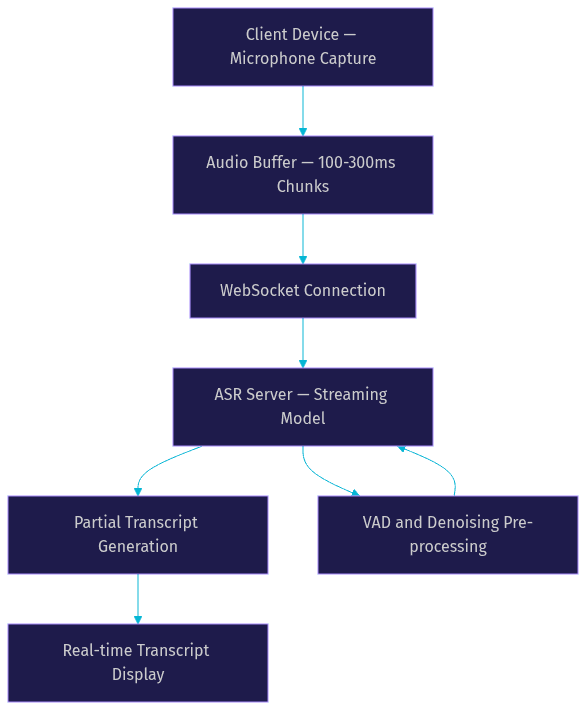
Real-world audio is messy. Users speak in cars, cafes, and open offices where background noise competes with speech. Pre-processing steps improve ASR accuracy before the audio reaches the model. Voice activity detection segments the audio stream into speech and non-speech regions, allowing the system to skip silence and reduce computational load. Denoising algorithms filter out steady background sounds like fans or traffic. Volume normalization ensures consistent audio levels across different input devices. These steps are particularly important for streaming ASR, where the system cannot rely on having the complete audio file for context.
Model Fine-Tuning
Open-source ASR models are trained on general speech corpora, which may not match your target domain. Fine-tuning adapts a pre-trained model to your specific use case by continuing training on a smaller, domain-specific dataset. For example, a medical transcription application might fine-tune on doctor-patient conversations to improve recognition of clinical terminology. Fine-tuning requires labeled audio-text pairs and typically needs less data than training from scratch. Monitor validation loss carefully to avoid overfitting, and always evaluate the fine-tuned model on a held-out test set.
Streaming Inference Architecture
Low-latency streaming ASR requires careful architectural design. The client captures audio in small chunks, typically 100 to 300 milliseconds, and sends them to the ASR server over a persistent connection. The server processes each chunk, updates the running transcript, and sends partial results back to the client. Buffering strategies matter: too small a buffer increases network overhead, while too large a buffer adds latency. Chunking must align with the model's expected input length to avoid splitting words across frames. The diagram below shows a typical streaming inference architecture:
Evaluating Performance
Rigorous evaluation separates a working prototype from a production system. Word error rate (WER) measures the percentage of words that are substituted, deleted, or inserted relative to the reference transcript. Character error rate (CER) is preferred for languages without clear word boundaries, such as Chinese or Japanese. Use established benchmark datasets like LibriSpeech, Common Voice, or domain-specific corpora to ensure reproducibility. Run evaluations on audio that reflects real deployment conditions, including noise, accents, and varied speaking rates. Track metrics over time as models are updated and compare against baseline cloud services to validate that your open-source deployment delivers competitive quality.
Future Trends in ASR
The ASR speech recognition field is evolving rapidly, driven by advances in large language models, multimodal learning, and edge computing.
LLM-Driven Speech-Text Models
Large language models are increasingly integrated with ASR pipelines, either as powerful language models that refine decoder output or as end-to-end speech-text models that process audio directly. These models bring contextual understanding that traditional ASR lacks, enabling features like automatic punctuation, speaker attribution, and real-time summarization. The trend toward end-to-end models reduces the need for separate acoustic and language model components, simplifying deployment at the cost of increased model size. VideoSDK's AI voice agent architecture exemplifies this trend, connecting ASR output directly to LLMs and TTS providers in a unified pipeline.
Multimodal Speech Understanding
Combining audio with visual and textual context improves recognition accuracy in challenging scenarios. A multimodal model can use lip movements from video to disambiguate speech in noisy environments, or combine screen content with spoken commands to better understand user intent. As video calling platforms like VideoSDK already transmit both audio and video streams, integrating multimodal ASR into these platforms is a natural evolution that can significantly improve transcription quality for video-based conversations.
Edge and On-Device Deployment
Advances in model quantization, pruning, and hardware acceleration are making it feasible to run capable ASR models on mobile devices and embedded hardware. Quantization reduces model precision from 32-bit floating point to 8-bit integers, cutting memory usage and inference time with minimal accuracy loss. Hardware accelerators like Apple's Neural Engine and Android's NNAPI provide dedicated compute paths for neural network inference. Edge deployment offers privacy benefits, offline capability, and zero per-call API costs, making it attractive for applications where cloud connectivity is unreliable or where data residency rules prohibit cloud processing.
Definitions Glossary
Acoustic Model: The neural network component that maps audio features to phonetic or subword representations. In modern ASR systems, it typically uses transformer or conformer architectures to process mel spectrograms.
Word Error Rate (WER): The primary metric for evaluating ASR accuracy, calculated as the sum of substitutions, deletions, and insertions divided by the total words in the reference transcript. Lower WER indicates better recognition accuracy.
Voice Activity Detection (VAD): A pre-processing technique that identifies speech segments within an audio stream, separating them from silence and noise. VAD reduces computational load and improves transcription focus.
Forced Alignment: The process of generating word-level or phoneme-level timestamps by aligning a known transcript with audio. It is used for subtitle generation, dataset creation, and audio-text synchronization.
Beam Search: A decoding strategy that maintains multiple candidate text hypotheses during ASR inference, expanding and pruning them at each step to find the most likely transcription.
Streaming ASR: A speech recognition mode that processes audio in real-time chunks, producing partial transcripts that update as more audio arrives. It is essential for live captioning and interactive voice applications.
Key Takeaways
- ASR speech recognition systems combine acoustic models, language models, and decoders to convert audio into text, with each component tunable for accuracy or latency optimization.
- Open-source models like Qwen3-ASR, Omnilingual ASR, FireRedASR2S, and GLM-ASR-Nano cover use cases from massive multilingual coverage to compact edge deployment.
- Choosing the right ASR requires evaluating the accuracy-latency trade-off, language coverage, processing mode, and deployment environment specific to your application.
- Production-grade pipelines require attention to data preparation, noise robustness, model fine-tuning, and rigorous evaluation using WER and CER metrics.
- VideoSDK integrates real-time transcription directly into its video calling SDKs, letting developers add live captions without managing separate ASR infrastructure.
Conclusion
ASR speech recognition has reached a point where open-source models deliver production-quality transcription across hundreds of languages. The key to success lies in understanding your pipeline components, selecting a model that matches your accuracy and latency requirements, and investing in pre-processing and evaluation. Whether you deploy on the cloud, on-premise, or at the edge, the practices outlined here will help you build a transcription system that holds up under real-world conditions. If you want to skip the infrastructure work and add live transcription to a video calling app today, explore VideoSDK's transcription features or sign up at app.videosdk.live/login. What are you building with ASR? Drop a comment, I'd love to hear what kind of speech recognition use case you're working on.
Free $20 Balance for AI Voice Agents & Video Calls
FAQ