



An API key is a long-lived static identifier that proves which application is calling an API, while an API token is a short-lived, dynamically generated credential that proves who is calling and what they are allowed to do. In the api key vs api token debate, tokens win for user-facing and high-security flows because they support scopes, expiration, and revocation. Keys remain a pragmatic choice for trusted server-to-server integrations. VideoSDK, for example, uses token-based authentication so that room access is granted per participant rather than per application.
Every developer has shipped an integration where the credentials question got hand-waved. You sign up for a service, the dashboard hands you a long random string, and you paste it into a header. Six months later, a security review asks why a static key with full account access is embedded in a mobile app, and nobody has a good answer.
That string might have been an API key. It might have been a token. The distinction matters more than most teams realize, because the two credentials behave completely differently under attack, scale differently across users, and fail differently in production. This article breaks down the api key vs api token question across purpose, lifespan, scope, and security, then gives you a decision framework you can apply to your own APIs today.
API Key vs API Token: Core Differences
The api key vs api token comparison comes down to four dimensions: purpose, lifespan, scope, and security model. An API key identifies an application or project. An API token represents an authenticated session, a delegated user, or a narrowly scoped grant. Keys are typically static until someone rotates them manually. Tokens are minted dynamically, carry an expiration, and can encode fine-grained permissions.
Security posture diverges sharply. A leaked API key is a standing credential: whoever holds it holds it forever, or until an admin notices. A leaked token is a burning credential: it decays on its own, and a well-designed system can revoke it instantly. That single difference drives most of the guidance in this article.
What an API Key Is
An API key is defined as a static, long-lived credential issued by a provider to identify the calling application. It is usually generated once from an admin dashboard or developer portal, stored by the client, and sent with every request, commonly in a custom header. Many providers pair a public key with a secret, and some support HMAC-style request signing to prove possession without transmitting the secret.
Typical use cases include server-to-server integrations, billing-metered third-party APIs, analytics pipelines, and internal microservices where the caller is a trusted machine rather than a human. The key answers one question: which registered project is making this call?
What an API Token Is
An API token is defined as a dynamically generated credential that authenticates a specific session, user, or delegated action. The most common form is the bearer token: whoever presents it is assumed to be its rightful owner, which is why transport security and short lifetimes are critical. OAuth 2.0 access tokens, JWTs, and session tokens all fall into this family.
Tokens are minted through an authentication flow, such as the OAuth client-credentials flow for machine clients or an authorization-code flow for users. They typically carry scopes, an expiry timestamp, and sometimes an audience or issuer claim. Use cases include user-centric web and mobile apps, single sign-on, delegated third-party access, and any scenario where permissions must vary per caller.
How They Are Created and Managed
Credential lifecycle management is where keys and tokens diverge operationally. Keys follow a manual, administrator-driven workflow: generate, distribute, store, rotate on a schedule, revoke on compromise. Tokens follow an automated, protocol-driven workflow: authenticate, mint, use, refresh, expire. Teams that treat tokens like keys, hardcoding them into config files, lose most of the security benefit.
Rotation strategy differs accordingly. Key rotation is a planned operational event, often quarterly, requiring coordination between issuer and consumer. Token rotation is continuous and built into the protocol, with refresh tokens exchanging for new access tokens on a defined cadence.
Creation Process for API Keys
API keys are created through a provider's admin portal or developer dashboard. An administrator or project owner initiates generation, the provider produces a random identifier (and often a paired secret), and the portal displays it once with a warning to store it immediately. Some platforms let you attach metadata: allowed IP ranges, environment tags, or coarse permission tiers. The key then lives until it is manually rotated or revoked. Because issuance is manual, key sprawl is a real risk; teams accumulate dozens of forgotten keys across environments.
Creation Process for API Tokens
API tokens are created through an authentication exchange rather than a dashboard. In the OAuth 2.0 client-credentials flow, a trusted client authenticates directly against the token endpoint and receives an access token. In user-centric flows, the user logs in, authorizes the client, and the client exchanges an authorization grant for a token. The response includes the token, its type (commonly bearer), its expiry, and often a refresh token. Each token can encode scopes and claims specific to that session, which is why the same application can hold different tokens with different permissions at different times.
Security Implications
Security is the dimension where the api key vs api token decision has real consequences. The OWASP API Security Top 10 repeatedly flags broken authentication and excessive token exposure as leading causes of API breaches, and both credential types appear in those failure modes. Understanding the attack vectors for each helps you choose controls that actually match the threat.
Threat Landscape for API Keys
API keys face four primary threats. First, leakage: keys end up in public repositories, mobile app binaries, browser bundles, and CI logs. Because keys lack expiration, a key leaked in 2023 can still be valid in 2026 unless someone rotated it. Second, replay: a stolen key works from anywhere, so an attacker in another country can impersonate your application indefinitely. Third, brute force: weak or short keys can be guessed, though modern providers generate high-entropy values that resist this. Fourth, over-permission: coarse key scopes mean a leaked key often grants far more access than the compromised component needed. Mitigation centers on IP allowlisting, request signing, environment separation, and aggressive rotation schedules.
Threat Landscape for API Tokens
Tokens face a different set of threats. Token replay is the classic one: a bearer token intercepted in transit or stolen from storage can be reused until it expires, which is why short TTLs and TLS everywhere are non-negotiable. Token theft from browser storage or mobile devices remains common. Scope escalation appears when authorization servers issue broader scopes than the flow requested, or when clients fail to validate scope on their side. Refresh token abuse extends an attacker's window indefinitely if refresh tokens are long-lived and unbound. Mitigations include sender-constrained tokens (such as DPoP or mTLS-bound tokens), refresh token rotation, token introspection at the resource server, and audience-restricted claims.
Best-Practice Security Controls
Apply IP restrictions to keys, keep token TTLs short, automate rotation for both, and store every secret in a managed vault rather than source control or environment files committed to repositories.
Practical Use-Case Scenarios
Theory is fine, but the api key vs api token question is usually answered by looking at who is calling and how much you trust them. These four scenarios cover most real-world decisions.
Server-to-Server Integration
When two trusted backend services communicate, an API key (or the OAuth client-credentials flow, which produces a machine token) is often sufficient. The caller is a machine you control, the network path is private, and there is no user context to preserve. A static key with IP restrictions and scheduled rotation is a pragmatic, low-overhead choice here. Many teams prefer client-credentials tokens anyway, because they get expiration and scope for free.
User-Centric Applications
Any application acting on behalf of a human needs tokens. A web app calling your API, a mobile client fetching user data, a third-party tool requesting delegated access: all of these require per-user, per-session credentials. A shared API key would collapse every user into one identity, destroying audit trails and access control. OAuth 2.0 with scoped access tokens is the standard answer, and OpenID Connect adds identity on top.
Hybrid Approaches
Mature systems combine both. An API key identifies the application at the gateway, enabling rate limiting, billing, and coarse access control. A token then authenticates the specific user and authorizes the specific action. This two-layer model is how most large platforms work: the key answers "which integration is this," the token answers "which user, doing what, until when."
Edge Cases
Public APIs exposed to browsers cannot safely hold any secret, so they rely on short-lived tokens minted server-side. Mobile apps should never embed static keys; use token flows with device-bound storage. IoT devices often use key-based device identity at manufacturing time, then exchange that key for short-lived session tokens at runtime.
Managing Credentials in Production
Choosing the right credential type is half the job; operating it safely is the other half. Production credential management covers storage, rotation automation, monitoring, and audit trails.
Secret Management Tools
Static keys and long-lived secrets belong in a dedicated secret manager: HashiCorp Vault, AWS Secrets Manager, or Google Cloud Secret Manager. These tools provide encrypted storage, access policies, automatic audit logging, and in some cases dynamic secret generation, where a short-lived credential is minted on demand instead of reused. The rule is simple: no credential lives in source control, and no credential is pasted into a chat thread.
Automated Rotation Pipelines
Rotation should be a pipeline event, not a calendar reminder. Integrate key rotation into CI/CD so that deployments fetch the current credential from the vault at runtime rather than baking it into artifacts. Webhook triggers from your secret manager can notify dependent services when a key changes. For tokens, rotation is protocol-native: refresh flows run automatically, and your job is to ensure refresh tokens themselves are rotated and stored safely.
Monitoring and Revocation
Every credential use should be observable. Alert on anomalous patterns: a key suddenly calling from a new region, a token used after its expected session ended, or request volume spiking against a quiet integration. Maintain a revocation runbook: know, before an incident, exactly which dashboard or endpoint revokes which credential, who has permission to do it, and how quickly consumers pick up the replacement. Audit logs of credential issuance, use, and revocation are also a compliance requirement under frameworks like SOC 2.
Diagram: Credential Flow Comparison
The two authentication paths differ structurally, not just in credential format. The diagram below shows the parallel flows: the key path authenticates in a single request, while the token path adds an issuance step that binds the credential to a scope and an expiry.
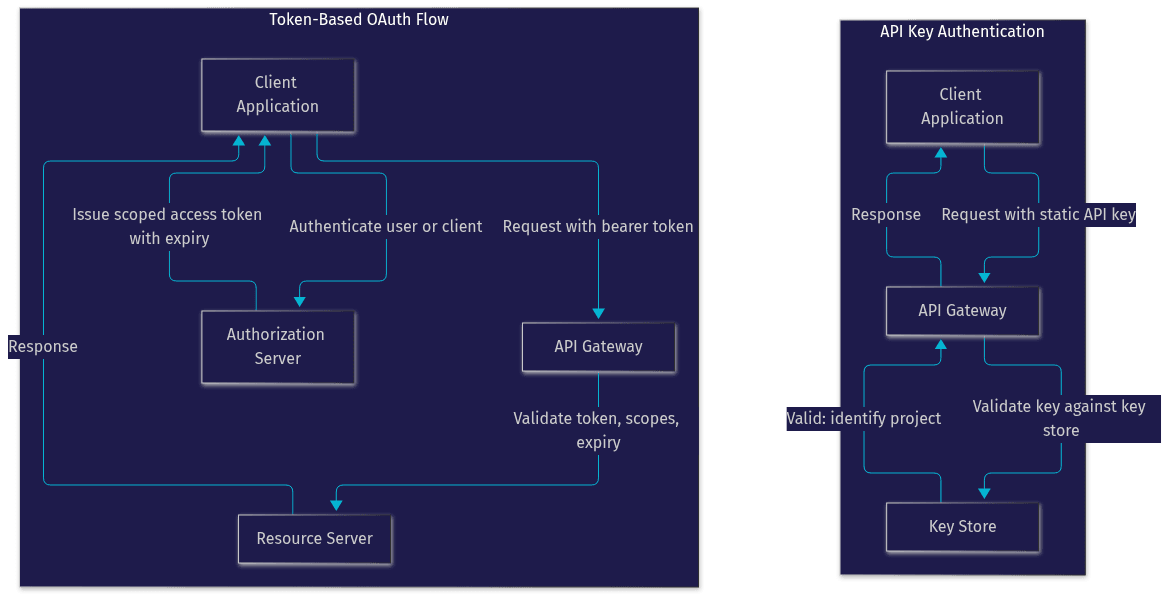
The key flow is one step shorter, which is exactly its appeal and its weakness: there is no issuance step to bind the credential to a context, so the credential is only as trustworthy as its storage.
Choosing the Right Approach: Decision Framework
Use this framework when you cannot decide between a key and a token. Ask three questions in order. First: is the caller a machine you fully control, or a user or third party you do not? Machines you control can use keys; everyone else needs tokens. Second: does the permission set need to vary per caller or per session? If yes, only tokens deliver that. Third: what is the blast radius if the credential leaks? If the answer is "full account access," you need expiration and revocation, which means tokens, or keys wrapped in aggressive rotation and IP restrictions.
Decision Checklist
- Project type: internal service, public API, or user-facing app
- User context: machine-only, or acting on behalf of a human
- Security requirements: blast radius, compliance, expiry needs
- Lifecycle management: can you automate rotation and revocation
Future Trends in API Authentication
API authentication is consolidating around tokens, and the tokens themselves are getting harder to steal. OAuth 2.1, the emerging consolidation of the 2.0 specification family, removes deprecated flows and makes PKCE mandatory for all clients, public and confidential. Sender-constrained tokens, particularly DPoP (Demonstrating Proof of Possession), bind a token to a specific key holder so a stolen bearer token becomes useless. Mutual TLS adds the same binding at the transport layer for high-assurance machine APIs.
At the infrastructure layer, zero-trust API gateways increasingly handle token issuance, introspection, and revocation centrally, so individual services never validate credentials themselves. Meanwhile, static API keys are being pushed toward the edges: acceptable for identifying integrations at the gateway, but rarely trusted deeper into the system. If you are designing authentication in 2026, assume tokens are the default and keys are a deliberate, scoped exception.
Definitions Glossary
API Key: A static, long-lived credential issued by a provider to identify a calling application or project, typically generated once from a dashboard and sent with every request.
API Token: A dynamically generated, usually short-lived credential that authenticates a session, user, or delegated action, often carrying scopes and an expiry. VideoSDK uses token-based authentication so each participant's room access is granted individually.
Bearer Token: A token type where possession alone grants access; whoever presents it is assumed to be its owner, making transport security and short lifetimes essential.
OAuth 2.0: The authorization framework that defines how clients obtain scoped access tokens through defined flows such as client-credentials and authorization-code.
Token Introspection: The process by which a resource server checks with the authorization server whether a token is active, what scopes it carries, and who it belongs to.
Scope: A named permission attached to a token that limits what actions the holder can perform, enabling least-privilege access control.
Key Takeaways
- API keys identify applications and are static; API tokens authenticate sessions or users and expire, which makes them safer under leakage.
- Server-to-server integrations between trusted services can use keys with IP restrictions and rotation; anything user-facing needs scoped tokens.
- Hybrid architectures use keys for integration identity at the gateway and tokens for per-user authorization behind it.
- Production safety depends on vault storage, automated rotation, misuse monitoring, and a rehearsed revocation runbook, regardless of credential type.
- Trends point toward tokens as the default, with OAuth 2.1, DPoP, and zero-trust gateways making static keys a deliberate exception rather than the norm.
Conclusion
The api key vs api token question resolves cleanly once you separate identity from authorization. Keys answer "which application is calling" and suit trusted machine integrations. Tokens answer "which user, doing what, until when" and suit everything else. Audit your own APIs against the decision framework above: check for static keys in mobile or browser clients, confirm every token has a scope and an expiry, and verify you can revoke any credential within minutes. If you are building real-time applications, VideoSDK's token-based room authentication handles the hard part for you; start with the VideoSDK quickstart or explore the authentication and token guide. What are you building? Drop a comment, I'd love to hear how you are handling credentials in your stack.
Choosing the Right One
Deciding whether to use an API key or a token depends largely on the specific requirements of your application and the level of security you need:
Use API Keys When
- You need a simple identifier for accessing APIs that do not contain sensitive or personal information.
- Your application interacts with less critical external services where complex authentication is unnecessary.
- You require a method for quick and simple rate limiting or access monitoring without detailed user-level controls.
Use Tokens When
- User authentication is crucial, and you need to securely manage individual user sessions across requests.
- Your application demands detailed access control based on user roles or permissions, especially when dealing with sensitive or personal information.
- You require a system that can dynamically adjust permissions and access rights based on real-time analysis of user actions or attributes.
Conclusion
Understanding the differences between API keys and tokens is fundamental for developers and IT security professionals tasked with safeguarding digital interactions. While API keys offer a straightforward solution for identifying applications, they fall short in environments where user-specific authentication and fine-grained access controls are necessary. API tokens, with their dynamic and detailed approach to user permissions, are better suited for these more complex scenarios.
By employing the appropriate authentication method—be it API keys for basic access control or tokens for advanced user-specific permissions—organizations can enhance the security and functionality of their digital platforms. As technology evolves and security demands intensify, the strategic implementation of these tools will continue to play a critical role in the development of secure and efficient software ecosystems.
Free $20 Balance for AI Voice Agents & Video Calls
FAQ