


The best Synthflow alternatives in 2026 are QuickVoice for regulated enterprises, Dapta for no-code bilingual workflows, Voiceflow for conversation design, Air AI for autonomous outbound calls, Thoughtly for quick setup, Retell AI for developer-centric control, and Vapi for fine-grained telephony. Each platform wins in a different scenario, and matching your compliance, scale, and workflow needs to the right one matters more than any single feature. If you need full programmatic control over voice pipelines, VideoSDK's open-source AI Agent SDK is also worth evaluating alongside these tools.
Synthflow built its reputation on a no-code AI voice agent builder that lets non-technical teams launch inbound and outbound call automation quickly. That convenience explains why thousands of businesses adopted it for lead qualification, appointment booking, and customer service. But convenience has a ceiling.
As voice AI matured through 2025 and into 2026, teams started hitting real constraints: compliance certifications that lag behind regulated-industry requirements, pricing that scales unpredictably with call volume, limited control over conversation logic, and analytics that stop at surface-level call summaries. If you are searching for Synthflow alternatives, you are probably not unhappy with the concept of no-code voice AI. You are unhappy with the fit.
This guide compares seven platforms that each solve a different slice of the problem, from HIPAA-compliant enterprise deployments to fully programmable telephony pipelines for engineering teams.
Why Look for Synthflow Alternatives?
Teams switch away from Synthflow for predictable, well-documented reasons. Understanding them helps you avoid landing in the same trap with a different vendor.
Compliance gaps come up first for healthcare, finance, and insurance teams. If a platform cannot sign a business associate agreement for HIPAA or show SOC 2 Type II attestation, regulated workloads simply cannot move onto it, no matter how good the voice quality is.
Scalability limits appear once outbound campaigns grow. Some platforms throttle concurrent calls or degrade latency under load, which turns a 10,000-call campaign into a two-week slog.
Customization constraints frustrate product teams. No-code builders are fast until you need conditional branching, custom data extraction, or deterministic step ordering. At that point, drag-and-drop becomes a bottleneck instead of an accelerator.
Pricing surprises are the most common complaint in voice AI. Per-minute models look cheap in a demo and get expensive at production volume, especially when failed calls, voicemails, and retries are billed the same as successful conversations.
Language coverage and analytics depth round out the list. A platform that handles 20 languages cannot serve a global support operation, and call analytics that stop at transcripts give operations teams nothing to optimize against.
The right move is matching platform capabilities to your actual workload, not to the most impressive demo.
Decision-Making Checklist for Synthflow Alternatives
Before comparing platforms, score each candidate against these seven criteria. Weight them by your business model: a healthcare clinic should weight compliance heavily, while an outbound sales team should weight concurrency and pricing.
- No-code vs API-first builder: Non-technical teams need visual builders; engineering teams need SDKs, webhooks, and version control. Some platforms offer both, but the depth differs enormously.
- Compliance certifications: HIPAA, SOC 2, ISO 27001, and PCI DSS coverage. Ask for the actual attestation documents, not a marketing claim.
- Language support and multilingual accuracy: Count languages, but also test accent handling and code-switching, where a caller mixes two languages mid-sentence.
- Scalability and call volume handling: Ask about concurrent call limits, queue behavior under burst traffic, and latency at peak load.
- Pricing model: Per-minute, flat-rate, or tiered. Model your real call volume including retries and voicemails before comparing sticker prices.
- Integration ecosystem: CRM connectors, calendar booking, telephony number provisioning, and webhooks for custom systems.
- Analytics and reporting: Transcripts, sentiment, intent classification, conversion attribution, and export options for your data warehouse.
Quick Comparison Overview
The table below summarizes how the seven Synthflow alternatives stack up on the criteria that matter most. Treat it as a shortlist generator, then read the in-depth reviews for your top two or three candidates.
| Platform | Best For | Compliance | Languages | Pricing Model |
|---|---|---|---|---|
| QuickVoice | Regulated enterprises | HIPAA, SOC 2 | 100+ | Tiered, free tier |
| Dapta | No-code bilingual workflows | Standard | English, Spanish | Tiered |
| Voiceflow | Conversation design | Standard | Multilingual | Per-usage |
| Air AI | Autonomous outbound calls | Standard | Multi-language catalog | Per-minute |
| Thoughtly | Quick setup | Standard | Limited | Cost-effective tiers |
| Retell AI | Developer-centric control | Standard | Multilingual | Transparent per-minute |
| Vapi | Fine-grained telephony | Standard | Multilingual | Flexible per-minute |
The feature categories interact: compliance requirements constrain language options, and call volume shapes which pricing model is economical. The flowchart below shows how these categories chain together when you evaluate a platform.

In-Depth Reviews of the Top 7 Synthflow Alternatives
1. QuickVoice – Best for Regulated Enterprises
QuickVoice wins where compliance is non-negotiable. The platform carries HIPAA compliance with signed business associate agreements and SOC 2 attestation, which puts it on the shortlist for healthcare providers, financial services firms, and large BPO operations handling sensitive caller data.
Language coverage is the second differentiator: support for more than 100 languages makes it viable for global support desks and multinational BPOs where a single campaign must handle callers across regions. A free tier lets teams validate voice quality and conversation flow before committing spend, which shortens procurement cycles in enterprises that require a proof of concept.
Deployment speed is the third strength. In practice, regulated enterprises often find that the gap between signing and first live call is weeks, not months, because the platform handles telephony provisioning and compliance documentation as part of onboarding.
Ideal use cases: healthcare appointment reminders and patient follow-ups, insurance claims intake, financial services outbound verification, and large BPOs that need auditable call handling at scale. If your workload involves protected health information or payment data, QuickVoice is the safest starting point on this list.
2. Dapta – Best No-Code Bilingual Workflow
Dapta targets a specific and underserved segment: sales and service teams operating in English and Spanish markets who need true no-code automation. The visual builder handles conversation logic, data capture, and handoff rules without any engineering involvement, which makes it a natural landing spot for teams that liked Synthflow's approach but need deeper workflow control.
The integration ecosystem is the standout feature. With more than 1,000 integrations, Dapta connects to the CRMs, calendars, and booking systems that bilingual sales teams already run on. A lead qualified in Spanish can be routed to the right CRM record, booked onto a rep's calendar, and handed off with full conversation context, all without a developer writing glue logic.
Booking and lead handoff are first-class primitives rather than afterthoughts. The platform is designed around the moment a caller says yes, capturing the appointment or routing the lead immediately.
Ideal use cases: bilingual outbound sales, Spanish-language customer service for US-based businesses, real estate and home services lead qualification, and appointment-driven businesses targeting Latin American or US Hispanic markets.
3. Voiceflow – Best for Conversation Design
Voiceflow approaches voice AI from the conversation design discipline rather than the telephony stack. Its visual canvas lets product teams map every branch of a conversation, prototype across channels, and iterate on dialogue logic before anything goes live.
The strength here is control over conversational structure. Where most no-code builders abstract the flow into simple trigger-response pairs, Voiceflow lets designers build genuinely complex dialogue trees with context carryover, fallback strategies, and escalation rules. Cross-channel prototyping means the same conversation design can be tested for voice, chat, and messaging surfaces, which matters for support teams running omnichannel operations.
Low-code extensions fill the gap when visual design runs out of room. Developers can extend flows with custom logic while designers keep ownership of the conversation structure, a division of labor that product teams consistently appreciate.
Ideal use cases: product teams designing support and sales conversations, agencies building voice experiences for clients, and organizations that need rigorous conversation testing before launch. It is less suited to teams that just want to fire up an outbound campaign this afternoon.
4. Air AI – Best for Autonomous Outbound Calls
Air AI specializes in long-form autonomous conversations. Where many voice agents are optimized for short, transactional exchanges, Air AI is built to sustain extended outbound calls that run ten minutes or longer without human intervention, handling objections, follow-up questions, and multi-topic discussions.
Low-code customization lets sales operations teams tune the agent's pitch, objection handling, and qualification criteria without engineering support. The multi-language catalog supports outbound campaigns across regions, though teams targeting regulated industries should verify compliance coverage separately, as it is not the platform's primary focus.
The autonomy is the value proposition: campaigns run with minimal human supervision, and the agent is designed to complete the full call objective rather than handing off at the first complication.
Ideal use cases: outbound sales campaigns with long consideration cycles, survey and research calls, lead nurturing sequences, and any workload where the goal is a completed conversation rather than a quick transfer to a human.
5. Thoughtly – Best for Quick Setup
Thoughtly optimizes for time-to-first-call. The interface is simple, the launch path is short, and a working voice agent can go from signup to live calls in a single afternoon. For small teams and startups, that speed is often the deciding factor.
The trade-off is depth. Analytics cover the basics, call transcripts and outcomes, but stop short of the granular conversion attribution that larger operations use for optimization. Customization options are correspondingly lighter, which is acceptable if your conversations are straightforward and your volume is modest.
Pricing is cost-effective for small-scale deployments, which makes Thoughtly a low-risk way to test whether voice AI works for your business at all before graduating to a heavier platform.
Ideal use cases: startups validating voice AI with limited budget, small businesses automating appointment confirmation or FAQ handling, and teams running a first pilot before committing to an enterprise contract.
6. Retell AI – Best for Developer-Centric Control
Retell AI takes the opposite approach from the no-code platforms: it is API-first, built for engineering teams that want programmatic control over every part of the call pipeline. Conversation logic, telephony configuration, and data handling are all accessible through well-documented interfaces rather than locked behind a visual builder.
Granular telephony control is the differentiator. Teams can manage call routing, transfer logic, and session state at a level of detail that no-code platforms deliberately hide. That control comes with responsibility: someone on your team has to build and maintain the integration, so factor in engineering time when comparing costs.
Pricing is transparent per-minute billing, which developers consistently prefer because it makes cost modeling straightforward. You can predict exactly what a campaign will spend before running it.
Ideal use cases: tech companies building voice AI into their own products, teams with custom CRM or data infrastructure, and engineering-led organizations that treat voice agents as part of their application stack rather than a standalone tool.
7. Vapi – Best for Fine-Grained Telephony
Vapi sits closest to the raw telephony layer among the platforms on this list. It targets developers building high-performance voice pipelines where latency, call flow programmability, and infrastructure flexibility are the primary requirements.
Low latency is the headline capability. In voice AI, response delay is the single biggest destroyer of conversational realism, and Vapi's architecture is engineered around minimizing the gap between caller speech and agent response. Programmable call flows mean developers define exactly how a call progresses, including barge-in handling, function execution, and mid-call context updates.
Flexible pricing accommodates different usage patterns, which matters for teams whose call volume is spiky or seasonal. The platform also composes well with other infrastructure: teams building fully custom stacks often pair a programmable voice layer like Vapi with a media and agent orchestration layer such as VideoSDK's AI Agent SDK, which handles room management, agent sessions, and the speech-to-text, LLM, and text-to-speech pipeline around the call.
Ideal use cases: engineering teams building voice products where latency budgets are tight, high-volume automated calling systems, and organizations that need voice pipelines to integrate with their existing real-time communication infrastructure.
How to Choose the Right Alternative for Your Business
Map your priorities to the checklist from earlier, then walk this decision path.
If you operate in a regulated industry, start and likely end with QuickVoice, since compliance eliminates most other options. If your team is non-technical and bilingual, Dapta is the natural fit. If product and design ownership of conversations matters more than speed to launch, evaluate Voiceflow.
For outbound-heavy workloads, choose Air AI for long autonomous calls or Thoughtly for quick, low-cost pilots. If engineering owns the project, the choice narrows to Retell AI for API-first control or Vapi for latency-critical telephony, with VideoSDK's open-source agent framework as a strong option when you also need the broader real-time communication layer around your agents.
The decision tree from the comparison section applies directly: compliance first, then languages, then volume, then builder type. Run your top two candidates through a two-week pilot with real call recordings before signing anything.
Migration Tips: Switching from Synthflow Without Dropping Calls
Migrating a live voice operation is a solvable engineering problem if you sequence it correctly.
Export your data first. Pull all conversation transcripts, agent configurations, phone numbers, and integration settings from Synthflow before anything changes. Transcripts are especially valuable because they become your test corpus for validating the new platform's conversation quality.
Port phone numbers early. Number porting is the longest lead-time item in most migrations. Start the porting request with your new provider weeks before the planned cutover, and confirm regulatory requirements for the numbers involved, since some jurisdictions restrict porting timelines.
Run in parallel. Route a small percentage of traffic, start with 5 to 10 percent, to the new platform while Synthflow handles the rest. Compare transcripts, call outcomes, and conversion metrics side by side for at least a week before shifting more volume.
Test against real recordings. Replay your exported Synthflow transcripts as test scenarios against the new agents. Verify that booking flows, CRM writes, and escalation rules all fire correctly before the new platform touches a live caller.
Only when parallel metrics match or beat the old baseline should you complete the cutover and decommission the old configuration.
The Architecture Behind a Modern Voice AI Stack
Understanding how these platforms differ requires knowing what sits underneath them. Every platform on this list, including Synthflow, is a composition of the same core layers: telephony ingress, speech-to-text, an LLM for reasoning, text-to-speech, and orchestration logic that ties them together. The differences are in which layers each platform exposes to you.
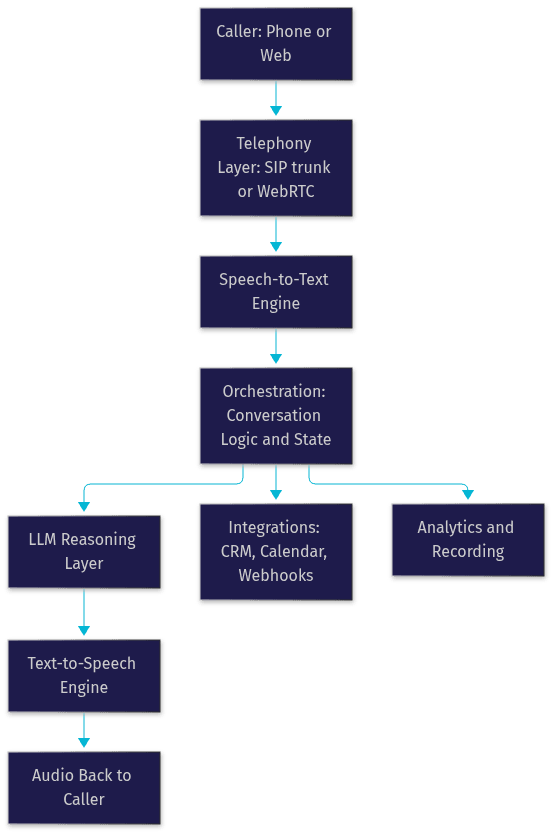
No-code platforms like Synthflow, Dapta, and Thoughtly hide layers B through F behind a visual builder. API-first platforms like Retell AI, Vapi, and VideoSDK's agent framework expose each layer individually, letting you swap the speech engine, choose your LLM provider, and control turn detection yourself. That architectural difference is the real reason developer teams outgrow no-code tools, and it is the core criterion behind the checklist in this guide.
Definitions Glossary
AI Voice Agent: A software system that conducts spoken conversations with callers, combining speech recognition, language reasoning, and synthesized speech to handle calls autonomously.
Inbound vs Outbound Voice AI: Inbound agents answer incoming calls for support and qualification; outbound agents initiate calls for sales, reminders, and follow-ups.
HIPAA Compliance: US healthcare data privacy regulation. A voice AI platform serving healthcare must sign a business associate agreement before handling patient-related calls.
SOC 2: An auditing standard that verifies a service provider's controls around security, availability, and confidentiality. Type II attestation covers controls operating over time.
Per-Minute Pricing: A billing model charging by call duration. It requires careful volume modeling because failed calls and voicemails are often billed the same as successful conversations.
Agent Worker: In VideoSDK's architecture, the Python process that runs an AI voice agent and manages its session lifecycle inside a real-time communication room.
Key Takeaways
- The best Synthflow alternative depends on your constraint: compliance points to QuickVoice, bilingual no-code workflows point to Dapta, and engineering control points to Retell AI or Vapi.
- Compliance certifications, language coverage, and pricing model eliminate candidates faster than feature lists do, so score those first.
- No-code platforms and API-first platforms differ architecturally: the former hide the speech, reasoning, and telephony layers, while the latter expose each one for custom control.
- Migrate safely by exporting data, porting numbers early, and running both platforms in parallel until the new one matches your conversion baseline.
- For teams that need voice agents embedded inside a broader real-time application, VideoSDK's open-source AI Agent SDK provides the agent pipeline and room infrastructure alongside video and audio calling.
Conclusion
Choosing among Synthflow alternatives in 2026 is less about finding a better platform and more about finding the right constraint match. Regulated teams need certifications, bilingual sales teams need workflow depth, and engineering teams need programmatic control over the full voice pipeline. Run the checklist, pilot your top two candidates with real call recordings, and let parallel metrics make the final call. If your roadmap includes voice agents inside a larger real-time product, explore VideoSDK's AI Agent SDK and the quickstart guides on GitHub. What are you building with voice AI? Drop a comment, I'd love to hear which use case you're automating.
Free $20 Balance for AI Voice Agents & Video Calls
FAQ