


Introduction to AI Voice Agents in Word Error Rate (WER)
What is an AI Voice Agent?
AI Voice Agents are sophisticated software entities designed to interact with users through voice commands. They leverage technologies like speech recognition, natural language processing, and text-to-speech to understand and respond to user queries. These agents are increasingly prevalent in various industries, offering seamless interaction and automation.
Why are they important for the Word Error Rate (WER) industry?
In the realm of speech recognition, Word Error Rate (WER) is a crucial metric. It measures the accuracy of transcriptions by comparing the number of errors in a recognized sentence to the total number of words. AI Voice Agents can provide real-time insights and analysis of WER, helping developers and businesses optimize their speech recognition systems.
Core Components of a Voice Agent
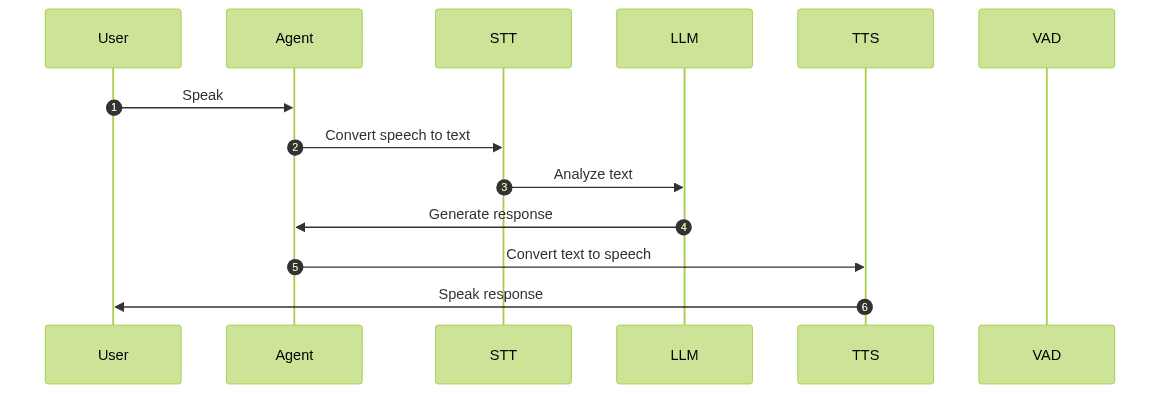
A typical AI Voice Agent consists of components like Speech-to-Text (STT) engines, Language Models (LLM), Text-to-Speech (TTS) systems, and Voice Activity Detection (VAD). These components work together to process audio input, understand user intent, and generate appropriate responses.
What You'll Build in This Tutorial
In this tutorial, you will learn how to build an AI Voice Agent using the VideoSDK framework. This agent will specialize in providing information and insights about Word Error Rate (WER).
Architecture and Core Concepts
High-Level Architecture Overview
The architecture of an AI Voice Agent involves several key components working in unison. The agent listens to user input, processes it through a series of pipelines, and responds intelligently.
Understanding Key Concepts in the VideoSDK Framework
Agent
The
Agent class is the core representation of your AI Voice Agent. It defines the agent's behavior and interactions.Cascading Pipeline in AI Voice Agents
The
CascadingPipeline manages the flow of audio processing, from Speech-to-Text (STT) to Language Model (LLM) to Text-to-Speech (TTS).VAD & Turn Detector for AI Voice Agents
Voice Activity Detection (VAD) and Turn Detection are crucial for determining when the agent should listen and respond. They help in managing the conversation flow effectively.
Setting Up the Development Environment
Prerequisites
Ensure you have Python 3.11+ installed and a VideoSDK account. Sign up at app.videosdk.live to obtain necessary API credentials.
Step 1: Create a Virtual Environment
To manage dependencies, create a virtual environment:
1python -m venv venv
2source venv/bin/activate  # On Windows use `venv\Scripts\activate`
3
Step 2: Install Required Packages
Install the VideoSDK and other necessary packages:
1pip install videosdk-agents videosdk-plugins
2
Step 3: Configure API Keys in a .env file
Create a
.env file in your project directory and add your VideoSDK API keys:1VIDEOSDK_API_KEY=your_api_key_here
2VIDEOSDK_SECRET_KEY=your_secret_key_here
3Building the AI Voice Agent: A Step-by-Step Guide
Step 4.1: Generating a VideoSDK Meeting ID
To interact with the agent, you need a meeting ID. Use the VideoSDK API to generate one.
Step 4.2: Creating the Custom Agent Class
1class MyVoiceAgent(Agent):
2    def __init__(self):
3        super().__init__(instructions=agent_instructions)
4    async def on_enter(self): await self.session.say("Hello! How can I help?")
5    async def on_exit(self): await self.session.say("Goodbye!")
6
This class extends the
Agent class, setting up initial instructions and defining entry and exit behaviors.Step 4.3: Defining the Core Pipeline
1pipeline = CascadingPipeline(
2    stt=DeepgramSTT(model="nova-2", language="en"),
3    llm=OpenAILLM(model="gpt-4o"),
4    tts=ElevenLabsTTS(model="eleven_flash_v2_5"),
5    vad=SileroVAD(threshold=0.35),
6    turn_detector=TurnDetector(threshold=0.8)
7)
8
The
CascadingPipeline integrates various plugins to process audio input and generate responses.Step 4.4: Managing the Session and Startup Logic
1async def start_session(context: JobContext):
2    agent = MyVoiceAgent()
3    conversation_flow = ConversationFlow(agent)
4    session = [AI Voice Agent Sessions](https://docs.videosdk.live/ai_agents/core-components/agent-session)(
5        agent=agent,
6        pipeline=pipeline,
7        conversation_flow=conversation_flow
8    )
9    try:
10        await context.connect()
11        await session.start()
12        await asyncio.Event().wait()
13    finally:
14        await session.close()
15        await context.shutdown()
16
This function manages the agent session, ensuring it connects and starts correctly.
Running and Testing the Agent
Step 5.1: Running the Python Script
Execute the script using:
1python main.py
2
Step 5.2: Interacting with the Agent in the AI Agent Playground
Use the playground link provided in the console to interact with your agent and test its capabilities.
Advanced Features and Customizations
Extending Functionality with Custom Tools
Explore adding new capabilities to your agent by integrating custom plugins and tools.
Exploring Other Plugins
The VideoSDK framework supports various plugins for enhanced functionality. Experiment with different configurations to suit your needs.
Troubleshooting Common Issues
API Key and Authentication Errors
Ensure your API keys are correctly configured in the
.env file.Audio Input/Output Problems
Check your microphone and speaker settings if you encounter audio issues.
Dependency and Version Conflicts
Ensure all dependencies are compatible with Python 3.11+ and the VideoSDK framework.
Conclusion
Summary of What You've Built
You've successfully built an AI Voice Agent capable of analyzing Word Error Rate (WER) using the VideoSDK framework.
Next Steps and Further Learning
Consider exploring additional features and customizations to enhance your agent's capabilities further.
FAQ