


Python real time voice AI refers to the development of low-latency conversational agents using Python libraries for speech recognition, language modeling, and text-to-speech. Unlike batch processing, these pipelines process audio streams on the fly to achieve sub-second response times. Developers typically use tools like faster-whisper for ASR, local or cloud LLMs, and streaming TTS engines, often orchestrated through frameworks like VideoSDK's AI Agent SDK for WebRTC transport.
The landscape of conversational AI has shifted dramatically from simple text-based chatbots to sophisticated voice agents that can listen, think, and speak in real time. For Python developers, this evolution presents a unique challenge: orchestrating multiple machine learning models into a seamless pipeline that responds in under a second. Achieving this requires a deep understanding of audio streaming, speech recognition, language model inference, and audio synthesis.
Building a python real time voice ai pipeline means moving away from batch processing, where an entire audio file is recorded and then transcribed, toward a streaming architecture where audio frames are processed the moment they arrive. This article explores the core components of a real-time voice pipeline, compares the best open-source Python libraries for each stage, and provides architectural patterns for deploying production-ready voice agents.
What is Python Real Time Voice AI?
Python real time voice AI is defined as the construction of conversational AI systems that process spoken language and generate spoken responses with minimal delay using the Python programming language. It works by continuously capturing audio from a user, detecting when they are speaking, transcribing that speech to text, generating a response with a language model, and converting that response back to speech, all within a single streaming session.
The critical distinction between real-time voice AI and traditional speech processing is latency. Batch-mode speech processing records an entire audio file, sends it to a transcription service, waits for the full text, processes it, and then generates a complete audio response. This workflow can take several seconds or even minutes. Real-time voice AI requires sub-second response times. The system must begin transcribing while the user is still speaking, start generating text before the user finishes, and begin synthesizing speech before the full text response is generated. This requires streaming architectures and careful orchestration of every component in the pipeline.
Core Components of a Real Time Voice Pipeline
A functional real-time voice AI pipeline relies on four core components working in sequence. Each component must be optimized for speed and capable of handling streaming data.
Voice Activity Detection (VAD)
Voice Activity Detection is the gatekeeper of the pipeline. VAD is a technique used to detect the presence or absence of human speech in an audio stream. In a real-time system, VAD serves two critical purposes. First, it prevents the pipeline from processing silence or background noise, saving computational resources. Second, it detects speech boundaries, signaling when a user has finished speaking and the system should begin generating a response. Accurate VAD is essential for low latency, as waiting too long to detect the end of speech adds unnecessary delay to the interaction.
Automatic Speech Recognition (ASR)
Automatic Speech Recognition, or streaming ASR, converts spoken audio into text in real time. Unlike batch transcription, streaming ASR outputs partial transcripts as the user speaks and finalizes them when speech ends. Python developers have access to several powerful streaming ASR options. Faster-whisper is a popular choice, offering a C++ implementation of OpenAI's Whisper model with lower memory usage and faster inference. Moonshine is another option, designed specifically for low-latency, CPU-friendly inference on edge devices. The choice of ASR backend heavily influences the pipeline's overall latency and hardware requirements.
Large Language Model (LLM) Integration
Once the user's speech is transcribed, the text is passed to a Large Language Model to generate a response. The LLM is the brain of the voice agent. Developers must choose between local inference and cloud-based APIs. Local LLMs, served using tools like Ollama or vLLM, offer complete data privacy and zero network latency, but require significant GPU resources. Cloud-based options, like the OpenAI Realtime API, handle the heavy compute off-site and often include built-in turn-taking logic, but introduce network latency and recurring costs.
Text to Speech (TTS)
The final step is converting the LLM's text response back into audible speech. For real-time voice AI, the TTS engine must support streaming output, meaning it should start generating audio chunks before the entire text response is received. Python developers can choose from several TTS solutions. Vui Nano offers a compact 300M parameter model suitable for fast inference. OpenMusicx provides Qwen3-TTS for high-quality synthesis. Vocals SDK includes streaming TTS capabilities designed specifically for conversational agents. Commercial services like ElevenLabs or Cartesia are also popular for their voice cloning and natural prosody.
Python Ecosystem for Real Time Voice AI
The Python ecosystem has rapidly adapted to the needs of real-time voice developers, offering a mix of end-to-end frameworks and specialized libraries.
Open source projects
Several open-source projects provide end-to-end solutions for building voice agents. Vui is a framework focused on providing lightweight, fast voice interactions. OpenMusicx offers tools for music and voice generation. Vocals SDK provides a comprehensive toolkit for building conversational interfaces with streaming TTS. AgentFlow allows developers to define complex conversational logic and orchestrate multiple models. These projects typically offer permissive licensing, making them suitable for commercial applications.
Key Python packages
Building a custom pipeline requires assembling several specialized Python packages. The essential libraries include faster-whisper for streaming ASR, torch for deep learning model inference, websockets for handling audio streaming over networks, and webrtc-vad for detecting speech boundaries. Developers should ensure they are using recent versions of these libraries to take advantage of performance optimizations and bug fixes.
| Package | Primary Use Case | Typical Role in Pipeline |
|---|---|---|
| faster-whisper | Streaming ASR | Transcribes incoming audio frames |
| torch | Model Inference | Runs neural network models locally |
| websockets | Network Transport | Streams audio between client and server |
| webrtc-vad | Voice Detection | Identifies speech start and end points |
Designing the End to End Architecture
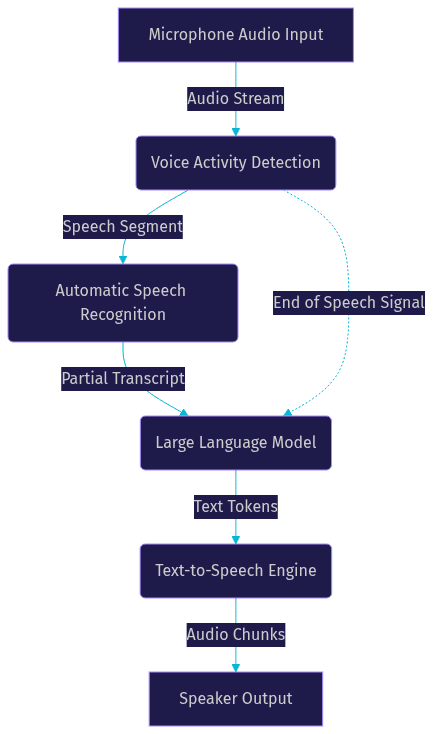
Designing a robust architecture for a python real time voice ai system requires careful consideration of data flow and component interaction. The standard flow begins at the user's microphone, where raw audio frames are captured and sent over a network connection to the backend pipeline. The backend first passes the audio through a VAD module to filter out silence. When speech is detected, the audio chunks are forwarded to the streaming ASR module. The ASR module outputs partial transcripts, which are fed into the LLM. The LLM generates text tokens, which are immediately sent to the TTS engine. The TTS engine synthesizes audio chunks and sends them back to the user's speaker.
This linear flow must be asynchronous to achieve low latency. Each component should run in its own thread or process, communicating via queues. If the ASR module waits for the LLM to finish before processing the next audio frame, the conversation will feel sluggish and robotic.
Choosing the Right ASR Backend
The ASR backend is often the largest source of latency in a voice AI pipeline. Choosing the right tool depends on your hardware constraints and accuracy requirements. Faster-whisper is the go-to choice for developers with access to a GPU. It leverages CTranslate2 to provide highly optimized inference, significantly reducing the time to first token. It supports various Whisper model sizes, allowing developers to trade accuracy for speed.
Moonshine is an alternative designed for situations where GPU resources are unavailable. It is a CPU-friendly model that maintains reasonable accuracy on conversational speech. While it may not match the transcription accuracy of a large Whisper model on noisy audio, its low latency on standard hardware makes it ideal for edge deployments and rapid prototyping.
Selecting an LLM Strategy
The LLM strategy dictates the intelligence and conversational flow of the voice agent. Local inference using Ollama or vLLM provides maximum control. You can choose any open-weight model, ensure data never leaves your server, and avoid per-token API costs. However, local inference requires powerful GPUs, often with large VRAM capacities, to generate text fast enough for real-time conversation.
Cloud-based strategies, particularly using the OpenAI Realtime API, offer a different value proposition. The Realtime API handles the entire voice pipeline, including ASR, LLM, and TTS, in a single streaming connection. It includes built-in turn-taking logic, meaning the API detects when the user interrupts the AI and stops the response automatically. This reduces the complexity of your Python code but introduces network latency and requires an internet connection. For a hybrid approach, developers can use VideoSDK's AI Voice Agents to handle the real-time transport and turn-taking while integrating their own custom LLM endpoints.
TTS Options and Voice Cloning
The TTS engine defines the personality and naturalness of the voice agent. Vui Nano is a 300M parameter model that excels at rapid synthesis, making it suitable for applications where latency is the absolute highest priority. OpenMusicx offers Qwen3-TTS, which provides high-quality, expressive speech suitable for more nuanced conversational agents. Vocals SDK focuses on streaming TTS, ensuring that audio playback begins before the full sentence is generated.
For applications requiring a unique brand voice, voice cloning is a critical feature. Commercial services like ElevenLabs allow developers to clone a voice from a short sample. While open-source TTS models are improving, commercial services still generally lead in natural prosody and emotional range. When integrating a TTS engine, ensure it supports chunked audio output to maintain the real-time feel of the conversation.
Integration Patterns: WebSocket vs WebRTC
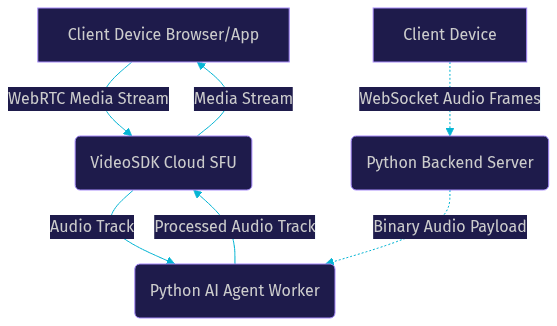
How audio travels between the user and the Python backend is a foundational architectural decision. Developers typically choose between WebSockets and WebRTC. A WebSocket connection is simpler to implement. The client captures audio, encodes it, and sends it as binary frames over a WebSocket connection to the Python server. The server processes the audio and sends synthesized speech back. This pattern works well for controlled environments and is compatible with APIs like the OpenAI Realtime API.
WebRTC is the standard for real-time media on the web. It handles audio encoding, network traversal (NAT and firewalls), and jitter buffering automatically. WebRTC is essential if your voice agent needs to operate directly within a web browser or mobile app under varying network conditions. Using a service like VideoSDK simplifies WebRTC implementation. VideoSDK provides a Python SDK that allows your AI agent to join a room as a participant, receiving and sending audio tracks directly without managing the underlying WebRTC peer connections.
Implementing Barge In and Turn Taking
Barge-in is the ability of a user to interrupt the AI while it is speaking. Without barge-in, a voice agent feels unnatural, forcing the user to wait until the AI finishes its entire response. Implementing barge-in requires continuous VAD monitoring. While the TTS engine is playing audio to the user, the pipeline must simultaneously listen to the user's microphone. If the VAD detects user speech, the system must immediately stop the TTS audio playback, cancel any pending LLM token generation, and reset the ASR module to capture the new input.
This turn-taking logic is complex to build from scratch. VAD-driven turn detection requires tuning thresholds to avoid false triggers from background noise. Frameworks like VideoSDK's Agent SDK include built-in turn detection and preemptive response capabilities, handling the cancellation logic for you. If you are building a custom pipeline, ensure your asynchronous architecture allows for rapid cancellation of streaming tasks.
Deployment Considerations
Deploying a python real time voice ai pipeline to production involves several infrastructure choices.
Hardware
The hardware requirements depend heavily on your model choices. A pipeline using faster-whisper and a local LLM will require one or more GPUs with significant VRAM. A pipeline relying on cloud APIs for ASR and LLM can run on a basic CPU-only server, as the Python backend acts mainly as an orchestrator.
Containerisation
Containerising the application ensures consistency across environments. A typical approach involves packaging the Python backend and the local LLM server as separate containerised services, with the Python service configured to wait for the model server to be ready before accepting connections. A reverse proxy can be placed in front to handle TLS termination and route traffic appropriately. This separation of concerns makes it easier to update individual components, scale the model server independently, and reproduce the same environment from development through to production.
Scaling with multiple concurrent sessions
Scaling a voice AI pipeline is challenging because each conversation requires persistent, stateful connections. You cannot simply throw the audio into a stateless REST API. Horizontal scaling requires a load balancer capable of handling WebSocket or WebRTC connections. Each Python worker process can handle a limited number of concurrent streams, dictated by the GIL and the computational load of the models. Using an orchestrator like Kubernetes allows you to spin up additional pods as connection volume increases.
Security
Security is paramount. All audio streams must be encrypted in transit using TLS. If using WebRTC, the protocol handles encryption via DTLS and SRTP. If using WebSockets, you must enforce WSS (WebSocket Secure). Authentication should be handled via short-lived tokens. For example, when using VideoSDK, your backend server generates a meeting token that the client uses to authenticate the session.
Performance Tuning and Monitoring
Once deployed, monitoring performance is critical to maintaining a quality user experience. The primary metric is end-to-end latency: the time from when the user stops speaking to when the AI begins responding. This should be measured on the client side to capture network delays. Profiling tools can help identify bottlenecks in the Python audio pipeline. Common bottlenecks include model loading times, queue processing delays, and inefficient audio encoding. Bitrate adaptation is also important for WebRTC streams, allowing the audio quality to scale down on poor network connections to maintain low latency.
Real World Use Cases
Python real time voice AI is enabling a new class of applications. In robotics, voice agents provide a natural interface for humans to command and interact with autonomous systems. For live webinars and events, real-time AI can provide instant live captioning and translation. In customer support, AI-driven call center agents can handle tier-one support calls, resolving issues or routing complex problems to human agents. Healthcare applications include voice-based diagnostic assistants that transcribe patient interactions and prompt clinicians with relevant questions.
Future Trends in Python Real Time Voice AI
The future of real-time voice AI points toward increased multimodality and edge inference. Models are evolving to process audio, text, and vision simultaneously, allowing agents to understand context like never before. Running these complex pipelines on edge devices, like local servers or even mobile phones, is becoming more feasible as models are quantized and optimized. Standards like the OpenAI Realtime API will continue to shape how developers structure these pipelines, pushing the ecosystem toward unified streaming interfaces.
Definitions Glossary
Voice Activity Detection (VAD): A technique used to detect the presence of human speech in an audio stream, essential for determining when a user starts and stops speaking.
Streaming ASR: Automatic Speech Recognition that processes audio in real time, providing partial transcripts as the user speaks rather than waiting for the full recording.
Barge-In: The ability of a user to interrupt an AI agent while it is speaking, requiring the system to immediately stop audio output and process the new input.
WebRTC: A web standard for real-time peer-to-peer communication, handling audio encoding, network traversal, and encryption for media streams.
Agent Worker: A Python process, often used in frameworks like VideoSDK, that runs the AI agent logic and manages the session lifecycle within a real-time communication room.
Key Takeaways
- Building a python real time voice ai pipeline requires orchestrating VAD, ASR, LLM, and TTS components in an asynchronous, streaming architecture to achieve sub-second latency.
- Developers must choose between local inference for privacy and control, or cloud-based APIs for reduced infrastructure complexity and built-in turn-taking.
- WebRTC is the preferred transport method for browser and mobile-based voice agents due to its built-in network traversal and media handling, easily integrated using VideoSDK.
- Implementing barge-in is critical for natural conversation, requiring continuous VAD monitoring and the ability to rapidly cancel ongoing TTS and LLM generation.
- Scaling a voice AI application requires stateful connection management and horizontal scaling of Python worker processes to handle concurrent sessions.
Conclusion
Building a python real time voice ai pipeline is a complex but rewarding challenge that sits at the intersection of speech processing, natural language generation, and real-time network engineering. By carefully selecting your ASR, LLM, and TTS components and leveraging robust transport layers like WebRTC, you can create conversational agents that feel instantaneous and natural. Whether you are building a local prototype with faster-whisper or a scalable production agent using VideoSDK's AI Voice Agents, the Python ecosystem provides the tools you need. What are you building with VideoSDK? Drop a comment below, I would love to hear what kind of voice AI use case you are working on. You can start building today by signing up at app.videosdk.live/login.
FAQ