


A lease renewal with an AI voice agent is an automated workflow where a voice-based AI assistant contacts tenants before their lease expires, negotiates renewal terms in real time, generates compliant renewal documents, and syncs everything with your property management system. VideoSDK provides the real-time communication infrastructure and AI agent SDK that makes this possible, connecting speech-to-text, large language models, and text-to-speech providers into a single pipeline that handles the entire renewal conversation.
Property managers lose thousands of hours every year chasing lease expirations, calling tenants to discuss renewals, and manually updating rent terms across disconnected systems. The process is repetitive, compliance-heavy, and prone to human error. A single missed renewal window can mean a vacant unit, lost revenue, and a rushed turnover that costs far more than a smooth renewal would have.
An AI voice agent changes this by automating the outreach, negotiation, and documentation phases of lease renewal. Instead of a property manager making 40 phone calls a week, a voice AI assistant calls each tenant 60 to 90 days before expiration, discusses renewal options within pre-approved policy bands, answers tenant questions, and produces a signed renewal notice. VideoSDK's AI Voice Agent SDK provides the real-time media infrastructure, pipeline orchestration, and telephony integration needed to build and deploy this kind of system at scale.
By the end of this guide, you will understand the full architecture of a lease renewal voice agent, how it integrates with existing property management systems, and the practical steps to implement one using VideoSDK's agent infrastructure.
What Is a Lease Renewal with AI Voice Agent?
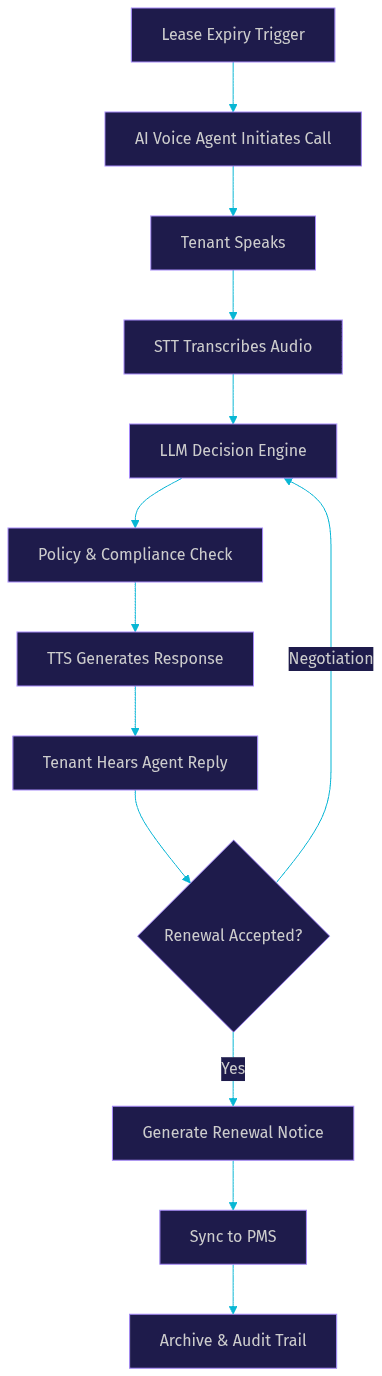
A lease renewal with an AI voice agent is a conversational AI workflow that automates tenant outreach, rent negotiation, and renewal document generation through real-time voice interaction. The agent calls tenants on a schedule, holds a natural conversation about renewal terms, applies business rules to rent increases and concessions, and writes the outcome back to the property management system.
The core components are speech-to-text (STT) for transcribing tenant speech, a large language model (LLM) for decision-making and response generation, text-to-speech (TTS) for producing natural-sounding agent speech, and integration points that connect the agent to your property management system and telephony provider. VideoSDK ties these together through its Agent Worker architecture, where a Python process manages the session inside a VideoSDK room and orchestrates the STT-to-LLM-to-TTS pipeline.
VideoSDK provides this capability through its open-source AI Agent SDK, which supports real-time models from OpenAI, Google Gemini, and AWS Nova Sonic, along with STT providers like Deepgram and OpenAI Whisper, and TTS providers like ElevenLabs and Cartesia. The Conversational Graph feature adds a deterministic flow layer on top, letting you define exact conversation steps for compliance-sensitive renewal discussions while the LLM handles natural language generation.
Here is how the end-to-end flow works:
Key Benefits for Property Managers
Automating lease renewals with a voice AI agent delivers measurable improvements across operational efficiency, revenue capture, and tenant satisfaction. Property managers who deploy these systems report significant time savings and fewer compliance errors compared to manual renewal workflows.
- Time savings: A single AI voice agent can handle hundreds of renewal calls per day, each lasting 3 to 7 minutes. This eliminates the bulk of outbound calling that property managers or leasing agents would otherwise do manually, freeing staff for higher-value tasks like move-in coordination and resident events.
- Compliance assurance: Every conversation follows pre-defined policy bands and compliance rules. The Conversational Graph ensures that rent increase caps, legally required disclosure language, and jurisdiction-specific renewal notice periods are enforced programmatically, not left to an agent's memory.
- Revenue optimization: The LLM analyzes market rent data, tenant payment history, and occupancy risk to recommend rent increases that maximize revenue without pushing tenants to vacate. This data-driven approach consistently captures more revenue than flat-percentage increases applied across the board.
- Tenant experience: Tenants receive proactive outreach in a conversational format that feels personal. The agent can answer questions about renewal terms, explain rent adjustments, and even offer concessions within approved limits, all without making the tenant wait for a callback.
- Multi-channel consistency: The same AI pipeline can power voice calls, SMS follow-ups, and email renewal notices. VideoSDK's telephony integration bridges SIP-based phone calls with WebRTC rooms, so the agent can reach tenants on their preferred channel while maintaining a single conversation state.
- Auditability: Every interaction is recorded, transcribed, and logged. Property managers get a complete audit trail showing what was said, what terms were offered, and what the tenant agreed to.
Core Workflow Steps
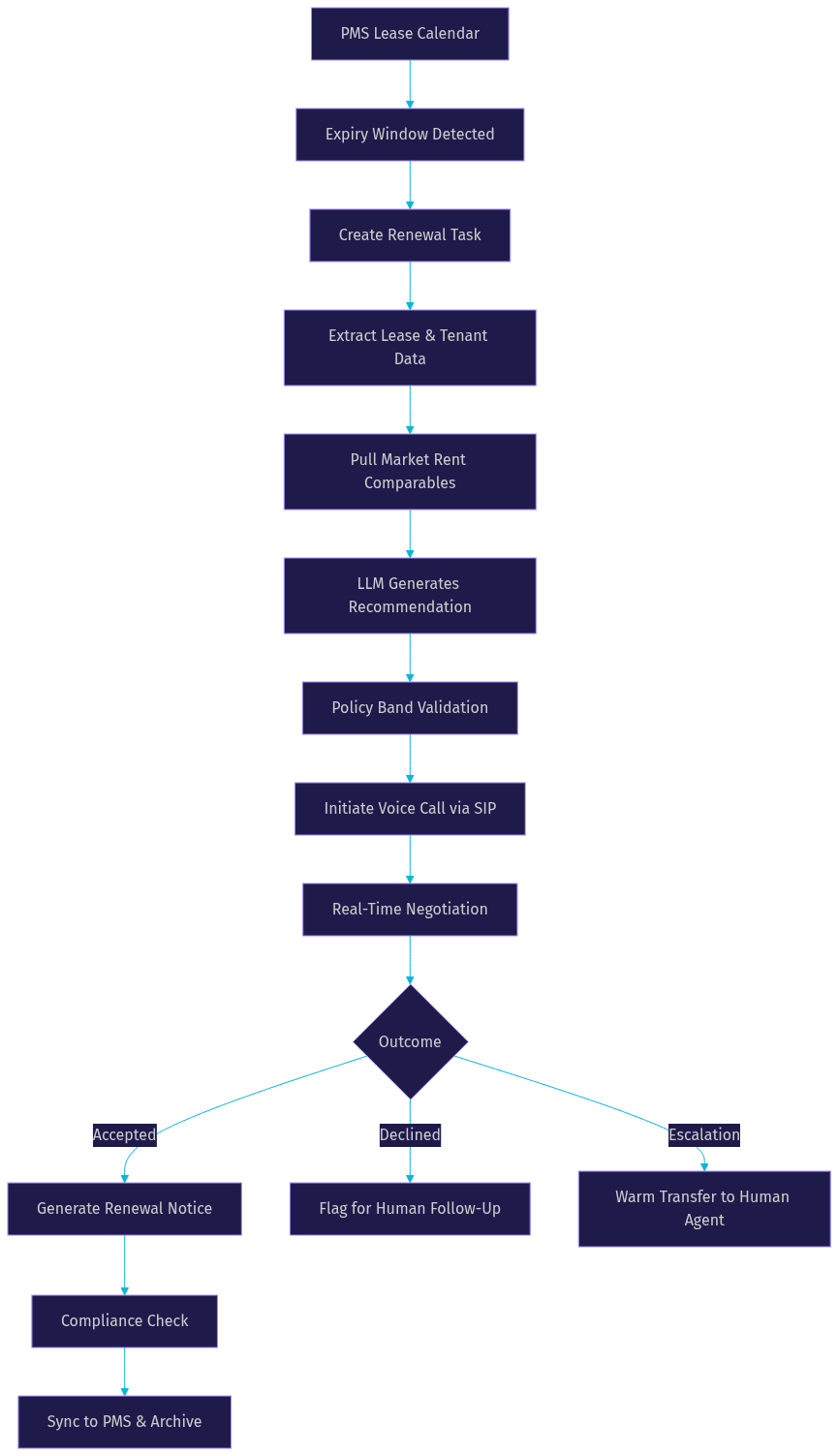
The lease renewal voice agent workflow consists of five sequential stages, each building on the previous one to move from passive monitoring to active negotiation and final documentation.
1. Expiry Monitoring and Trigger
The agent continuously monitors lease expiration dates from your property management system. When a lease enters the renewal window, typically 60 to 90 days before expiration, the system creates a renewal task and schedules an outbound call. The trigger logic can be customized per property or portfolio, accounting for local notice requirements and lease type. VideoSDK's REST APIs handle room creation and session scheduling, so each renewal call gets its own isolated VideoSDK room with a unique meeting token.
2. Data Extraction and Market Analysis
Before the call begins, the agent pulls relevant data from multiple sources. It extracts current lease terms, rent amount, tenant payment history, occupancy duration, and any prior maintenance requests from the PMS. It also queries market rent data for comparable units in the area to establish a competitive rent range. This data feeds into the LLM as context, giving the agent a complete picture of the tenant relationship and market conditions before it ever says hello.
3. Recommendation Generation
The LLM produces a structured renewal recommendation based on the extracted data and your policy configuration. This includes a suggested rent increase percentage, maximum concession allowance, and renewal term options. The recommendation is checked against policy bands defined in the Conversational Graph, ensuring the agent never offers terms outside approved limits. For example, if your policy caps rent increases at 5 percent for tenants with over two years of tenure, the agent enforces that constraint automatically.
4. Voice Interaction and Negotiation
The agent initiates the call and conducts a real-time conversation with the tenant. It explains the renewal offer, answers questions, and adjusts terms within the approved bands if the tenant negotiates. Sentiment detection helps the agent recognize when a tenant is hesitant or frustrated, triggering a softer approach or a transfer to a human agent. VideoSDK's turn detection and voice activity detection (VAD) ensure natural conversation pacing, preventing the agent from interrupting the tenant or speaking over them.
5. Documentation and System Update
Once the tenant accepts the renewal terms, the agent automatically generates a compliant renewal notice, runs a final compliance check against local regulations, and syncs the updated lease terms back to the PMS. The entire conversation recording, transcript, and renewal document are archived for audit purposes. If the tenant declines or requests changes outside the agent's authority, the system flags the case for human follow-up.
Integration Points with Existing Property Management Systems
A lease renewal voice agent is only useful if it connects cleanly to the property management system where lease data lives. The integration layer is what turns a conversational AI into a functional business tool.
Most modern PMS platforms, including Yardi, AppFolio, and Buildium, expose REST APIs that allow external systems to read lease records, tenant contact information, and payment history. The voice agent integration typically works through a middleware service that authenticates with the PMS API, pulls the required lease data before each call, and writes renewal outcomes back after the conversation concludes.
Authentication is handled through OAuth tokens or API keys, depending on the PMS. The middleware caches lease data to reduce API calls and maintains a mapping between PMS lease IDs and VideoSDK room IDs so every conversation is traceable back to the original lease record.
Audit trails are critical. Every data read, every renewal term generated, and every PMS update should be logged with timestamps, agent version, and the conversation transcript reference. This creates a defensible record showing that renewal terms were generated within policy and that the tenant explicitly agreed to the terms discussed.
For custom PMS implementations or legacy systems without modern APIs, the integration can use database-level connectors or scheduled data exports. VideoSDK's Python SDK is well-suited for building these custom pipelines, as it can connect to any data source and feed the extracted context directly into the agent pipeline.
Practical Implementation Tips
Building a production-grade lease renewal voice agent requires careful decisions across speech processing, policy configuration, conversation design, and testing. Here are the practical considerations that separate a working prototype from a deployed system.
Choose STT and TTS providers carefully. For lease renewal conversations, transcription accuracy directly impacts negotiation quality. Deepgram's Nova-3 model consistently achieves low word-error-rates on conversational audio, according to Artificial Analysis's Speech Arena benchmark. For TTS, ElevenLabs and Cartesia Sonic produce natural-sounding speech that tenants find less robotic. Test multiple providers with real tenant audio samples before committing.
Set policy bands explicitly. Define rent increase caps, concession limits, and renewal term options as structured data in the Conversational Graph. Never rely on prompt engineering alone to enforce business rules. The LLM should generate natural language, but the graph should control what terms are offerable. This separation prevents the agent from promising terms that violate policy.
Handle edge cases proactively. Tenants may ask about repairs, parking, or lease breaks during a renewal call. Build fallback nodes in the Conversational Graph that acknowledge these topics and route to a human agent when needed. Voicemail detection should pause the agent and leave a callback message rather than talking to an answering machine.
Train the LLM with lease-specific context. Provide the LLM with the current lease terms, local renewal regulations, and common tenant objections as system context. VideoSDK's agent pipeline supports RAG (retrieval-augmented generation), so you can pull relevant lease clauses and regulatory requirements into the conversation context dynamically.
Test voice quality thoroughly. Record sample calls and review them with property management staff. Pay attention to pacing, interruption handling, and tone during negotiation moments. VideoSDK's pipeline observability features let you inspect each stage of the STT-to-LLM-to-TTS chain, making it easier to diagnose where a conversation went wrong.
Scale incrementally. Start with a single property or a small portfolio. Monitor renewal acceptance rates and tenant feedback for 30 to 60 days before expanding. VideoSDK's Agent Cloud handles deployment and scaling, so you can add properties without re-architecting the system.
Common Pitfalls and How to Avoid Them
Even well-designed lease renewal voice agents can fail in predictable ways. Recognizing these pitfalls early saves significant rework.
Mis-aligned rent caps: If the policy bands in the Conversational Graph do not match the actual rent cap rules in your PMS, the agent may offer terms that the PMS rejects on sync. Always validate policy bands against PMS configuration before deploying. Run a dry-run mode where the agent simulates calls without making PMS updates.
Poor VAD sensitivity: If voice activity detection is too aggressive, the agent interrupts tenants mid-sentence. If too passive, the agent waits too long and the conversation feels unnatural. Tune VAD thresholds based on call recordings and adjust per language or accent if your portfolio is diverse.
Compliance blind spots: Renewal regulations vary by jurisdiction. A rent stabilization rule in New York City differs from rent control rules in San Francisco. Build jurisdiction-specific compliance nodes in the Conversational Graph and update them whenever regulations change. Never assume a single compliance configuration works across markets.
Over-reliance on AI without human-in-the-loop: Some renewal scenarios require human judgment. A tenant who has had three maintenance complaints in the last month may need a personal call from the property manager. Configure escalation triggers in the Conversational Graph that warm-transfer to a human agent when sentiment drops below a threshold or when the tenant explicitly requests a human.
Data privacy concerns: Lease data contains personally identifiable information. Ensure that all PMS API calls use encrypted connections, that conversation recordings are stored in compliant regions, and that access to transcripts is restricted. VideoSDK supports end-to-end encryption for real-time media, and the agent pipeline should be configured to minimize data retention where possible.
Measuring Success: KPI Dashboard
A lease renewal voice agent should be measured against concrete operational metrics. Track these KPIs from day one to quantify impact and identify improvement areas.
- Renewal acceptance rate: Percentage of agent-handled renewals where the tenant accepted the terms offered. Benchmark against your historical manual renewal rate.
- Average time per renewal: Total minutes from call initiation to document generation. A well-tuned agent completes this in under 7 minutes.
- Rent-increase capture: The actual rent increase achieved as a percentage of the recommended increase. This measures whether the agent is negotiating effectively or leaving money on the table.
- Compliance error rate: Percentage of renewals flagged for compliance issues after agent processing. Target zero. Any non-zero rate indicates a policy band or jurisdiction configuration gap.
- Tenant satisfaction score: Post-call survey or sentiment analysis score. Tenants should rate the experience as good or better than a human-managed renewal call.
- Human escalation rate: Percentage of calls transferred to a human agent. A high rate may indicate overly narrow policy bands or insufficient LLM context.
Future Trends in AI Voice-Driven Lease Management
The intersection of voice AI and property management is evolving rapidly. Several emerging trends will shape the next generation of lease renewal agents.
Multimodal agents that combine voice with visual interfaces are on the horizon. A tenant on a video call could see their renewal terms displayed on screen while discussing them with the agent. VideoSDK's video calling SDK and AI agent infrastructure already support this combination, making multimodal renewal conversations a natural extension of the current architecture.
Generative contract clauses will allow agents to draft customized lease addenda during the renewal conversation itself. If a tenant requests a pet clause modification, the agent could generate compliant addendum language in real time, subject to human review before signing.
Real-time market feed integration will make rent recommendations more dynamic. Instead of pulling market data before the call, agents could query live rent indices during the conversation, adjusting offers based on current market conditions.
Regulatory AI auditors will review every renewal conversation for compliance in real time, flagging potential violations before the renewal document is finalized. This adds a second layer of compliance assurance on top of the Conversational Graph's deterministic rules.
Definitions Glossary
AI Voice Agent: A software system that conducts real-time voice conversations with users, combining speech-to-text, large language models, and text-to-speech to handle tasks like lease renewal negotiation autonomously.
Conversational Graph: VideoSDK's deterministic flow engine that defines conversation steps as a directed graph, ensuring compliance-sensitive renewal discussions follow business rules rather than relying on LLM judgment alone.
Agent Worker: The Python process that runs a VideoSDK AI agent session, managing the STT-to-LLM-to-TTS pipeline and the connection between the tenant and the property management system.
Policy Bands: Pre-defined ranges for rent increases, concessions, and renewal terms that constrain what the AI voice agent can offer during a lease renewal conversation.
Voice Activity Detection (VAD): The mechanism that determines when a tenant has started or stopped speaking, enabling the AI agent to respond at the right moment without interrupting.
Warm Transfer: A call transfer method where the AI agent briefly conferences in a human agent, provides context, and then hands off the conversation seamlessly.
Key Takeaways
- A lease renewal with an AI voice agent automates the entire renewal lifecycle from expiry monitoring through tenant negotiation to compliant document generation and PMS sync.
- VideoSDK's AI Voice Agent SDK and Conversational Graph provide the real-time communication infrastructure and deterministic flow control needed for compliance-sensitive lease renewal conversations.
- Integration with existing PMS platforms like Yardi, AppFolio, and Buildium is essential, and VideoSDK's REST APIs and Python SDK make this integration straightforward.
- Policy bands must be enforced through the Conversational Graph, not through prompt engineering, to prevent the agent from offering non-compliant renewal terms.
- Start with a single property, measure KPIs like renewal acceptance rate and compliance error rate, and scale incrementally using VideoSDK Agent Cloud.
Conclusion
Lease renewal with an AI voice agent is one of the highest-ROI applications of conversational AI in property management. It eliminates repetitive manual calls, enforces compliance programmatically, optimizes rent increases with data-driven recommendations, and delivers a tenant experience that feels personal and responsive. VideoSDK's AI Voice Agent SDK, Conversational Graph, and telephony integration provide everything you need to build and deploy this system. Start with a pilot on a single property, configure your policy bands in the Conversational Graph, and measure results against your current manual renewal process. Explore the AI Voice Agent documentation and the Conversational Graph guide to begin building. You can sign up for a free account at app.videosdk.live/login and join the VideoSDK Discord community to connect with other developers building AI voice applications. What are you building with VideoSDK? Drop a comment below, I would love to hear what kind of AI voice agent use case you are working on.
FAQ