


Introduction to AI Voice Agents in connect voice agent to API
AI Voice Agents are sophisticated systems designed to interact with users through voice commands, providing a seamless interface between humans and machines. These agents use advanced technologies such as Speech-to-Text (STT), Text-to-Speech (TTS), and Language Models (LLM) to understand and respond to user queries.
What is an AI Voice Agent?
An AI Voice Agent is a software application that uses natural language processing (NLP) to interpret spoken language and generate appropriate responses. These agents are capable of performing tasks, answering questions, and even controlling smart devices through voice commands.
Why are they important for the connect voice agent to API industry?
AI Voice Agents are crucial in industries where hands-free operation and quick information retrieval are essential. They are widely used in customer service, home automation, and healthcare, providing users with an efficient way to interact with technology.
Core Components of a Voice Agent
- Speech-to-Text (STT): Converts spoken language into text.
- Language Model (LLM): Processes text to understand context and intent.
- Text-to-Speech (TTS): Converts text responses back into spoken language.
What You'll Build in This Tutorial
In this tutorial, you will learn how to build an AI Voice Agent that connects to APIs using the VideoSDK framework. We will guide you through setting up the development environment, building the agent, and testing it in a playground environment.
Architecture and Core Concepts
High-Level Architecture Overview
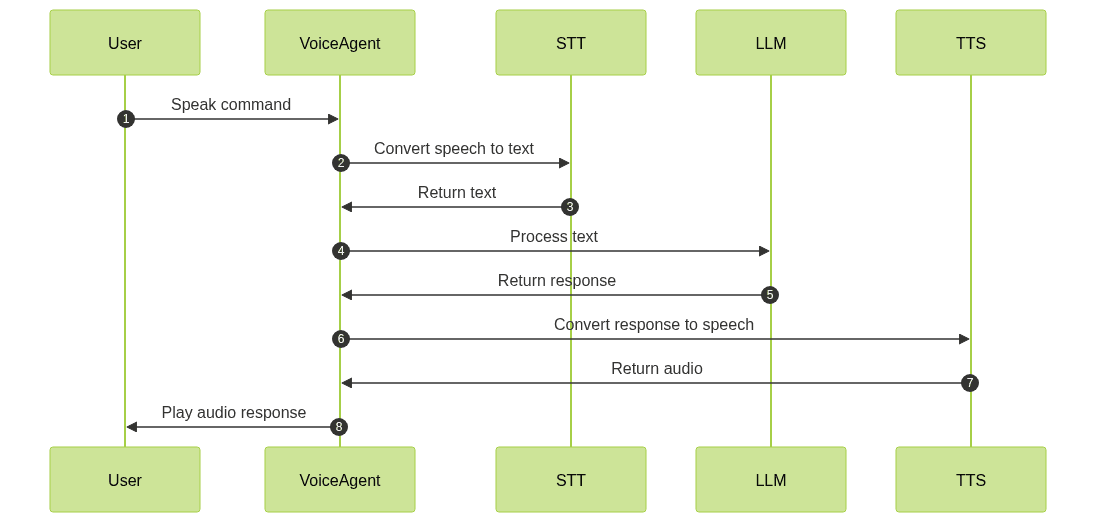
The architecture of an AI Voice Agent involves several stages of data processing. When a user speaks, the audio is captured and processed through STT to convert it into text. The text is then analyzed by an LLM to determine the appropriate response, which is converted back to speech using TTS.
Understanding Key Concepts in the VideoSDK Framework
- Agent: Represents the core logic of your voice bot, handling interactions and responses.
- CascadingPipeline: Manages the flow of audio data through various processing stages, including STT, LLM, and TTS. Learn more about the Cascading pipeline in AI voice Agents.
- VAD & TurnDetector: These components help the agent determine when to start and stop listening, ensuring smooth interactions.
Setting Up the Development Environment
Prerequisites
Before you begin, ensure you have Python 3.11+ installed and a VideoSDK account. You can sign up at app.videosdk.live.
Step 1: Create a Virtual Environment
Create a virtual environment to manage dependencies:
1python3 -m venv myenv
2source myenv/bin/activate
Step 2: Install Required Packages
Install the necessary packages using pip:
1pip install videosdk
2pip install asyncio
Step 3: Configure API Keys in a .env file
Create a
.env file in your project directory and add your VideoSDK API keys:1VIDEOSDK_API_KEY=your_api_key_hereBuilding the AI Voice Agent: A Step-by-Step Guide
Below is the complete code for the AI Voice Agent. We will break it down into smaller parts to explain each component.
1import asyncio, os
2from videosdk.agents import Agent, AgentSession, CascadingPipeline, JobContext, RoomOptions, WorkerJob, ConversationFlow
3from videosdk.plugins.silero import SileroVAD
4from videosdk.plugins.turn_detector import TurnDetector, pre_download_model
5from videosdk.plugins.deepgram import DeepgramSTT
6from videosdk.plugins.openai import OpenAILLM
7from videosdk.plugins.elevenlabs import ElevenLabsTTS
8from typing import AsyncIterator
9
10# Pre-downloading the Turn Detector model
11pre_download_model()
12
13agent_instructions = "You are a knowledgeable technical assistant specializing in integrating voice agents with APIs. Your primary role is to guide users through the process of connecting their AI Voice Agent to various APIs. You can provide step-by-step instructions, troubleshoot common issues, and suggest best practices for API integration. However, you are not a developer and cannot write or debug code. Always remind users to refer to official API documentation for detailed technical specifications. Your responses should be concise, informative, and focused on the integration process."
14
15class MyVoiceAgent(Agent):
16    def __init__(self):
17        super().__init__(instructions=agent_instructions)
18    async def on_enter(self): await self.session.say("Hello! How can I help?")
19    async def on_exit(self): await self.session.say("Goodbye!")
20
21async def start_session(context: JobContext):
22    # Create agent and conversation flow
23    agent = MyVoiceAgent()
24    conversation_flow = ConversationFlow(agent)
25
26    # Create pipeline
27    pipeline = CascadingPipeline(
28        stt=DeepgramSTT(model="nova-2", language="en"),
29        llm=OpenAILLM(model="gpt-4o"),
30        tts=ElevenLabsTTS(model="eleven_flash_v2_5"),
31        vad=SileroVAD(threshold=0.35),
32        turn_detector=TurnDetector(threshold=0.8)
33    )
34
35    session = AgentSession(
36        agent=agent,
37        pipeline=pipeline,
38        conversation_flow=conversation_flow
39    )
40
41    try:
42        await context.connect()
43        await session.start()
44        # Keep the session running until manually terminated
45        await asyncio.Event().wait()
46    finally:
47        # Clean up resources when done
48        await session.close()
49        await context.shutdown()
50
51def make_context() -> JobContext:
52    room_options = RoomOptions(
53    #  room_id="YOUR_MEETING_ID",  # Set to join a pre-created room; omit to auto-create
54        name="VideoSDK Cascaded Agent",
55        playground=True
56    )
57
58    return JobContext(room_options=room_options)
59
60if __name__ == "__main__":
61    job = WorkerJob(entrypoint=start_session, jobctx=make_context)
62    job.start()
Step 4.1: Generating a VideoSDK Meeting ID
To generate a meeting ID, use the following
curl command:1curl -X POST "https://api.videosdk.live/v1/meetings" \
2-H "Authorization: Bearer YOUR_API_TOKEN" \
3-H "Content-Type: application/json"Step 4.2: Creating the Custom Agent Class
The
MyVoiceAgent class defines the behavior of the voice agent. It inherits from the Agent class and specifies instructions that guide the agent's interactions.1class MyVoiceAgent(Agent):
2 def __init__(self):
3 super().__init__(instructions=agent_instructions)
4 async def on_enter(self): await self.session.say("Hello! How can I help?")
5 async def on_exit(self): await self.session.say("Goodbye!")Step 4.3: Defining the Core Pipeline
The
CascadingPipeline is responsible for processing audio data through various stages:- STT: Uses Deepgram STT Plugin for voice agent to convert speech to text.
- LLM: Uses OpenAI LLM Plugin for voice agent to process the text and generate a response.
- TTS: Uses ElevenLabs TTS Plugin for voice agent to convert the response back to speech.
- VAD: Uses Silero Voice Activity Detection to detect when the user is speaking.
- TurnDetector: Helps manage conversation flow by detecting when to listen and respond.
1pipeline = CascadingPipeline(
2    stt=DeepgramSTT(model="nova-2", language="en"),
3    llm=OpenAILLM(model="gpt-4o"),
4    tts=ElevenLabsTTS(model="eleven_flash_v2_5"),
5    vad=SileroVAD(threshold=0.35),
6    turn_detector=TurnDetector(threshold=0.8)
7)
Step 4.4: Managing the Session and Startup Logic
The
start_session function manages the session lifecycle, connecting the agent and starting the conversation flow. The make_context function sets up the room options for the session.1def make_context() -> JobContext:
2 room_options = RoomOptions(
3 # room_id="YOUR_MEETING_ID", # Set to join a pre-created room; omit to auto-create
4 name="VideoSDK Cascaded Agent",
5 playground=True
6 )
7
8 return JobContext(room_options=room_options)Running and Testing the Agent
Step 5.1: Running the Python Script
To run the agent, execute the following command in your terminal:
1python main.pyStep 5.2: Interacting with the Agent in the Playground
After running the script, you will see a playground link in the console. Open this link in your browser to interact with the agent. Speak into your microphone and observe how the agent processes and responds to your input.
Advanced Features and Customizations
Extending Functionality with Custom Tools
The VideoSDK framework allows you to extend your agent's functionality by integrating custom tools. These tools can be used to perform specific tasks or provide additional data processing capabilities.
Exploring Other Plugins
While this tutorial uses specific plugins, the VideoSDK framework supports various STT, LLM, and TTS plugins. Explore these options to customize your agent's capabilities further.
Troubleshooting Common Issues
API Key and Authentication Errors
Ensure your API keys are correctly configured in the
.env file. Double-check the keys for any typos or missing characters.Audio Input/Output Problems
Verify that your microphone and speakers are working correctly. Check your system settings to ensure they are configured as the default audio devices.
Dependency and Version Conflicts
Ensure all dependencies are installed with compatible versions. Use a virtual environment to manage dependencies and avoid conflicts.
Conclusion
Summary of What You've Built
In this tutorial, you've built a functional AI Voice Agent capable of connecting to APIs and interacting with users through voice commands. You've learned to set up the development environment, build the agent, and test it in a playground environment.
Next Steps and Further Learning
Continue exploring the VideoSDK framework to enhance your agent's capabilities. Experiment with different plugins and custom tools to create more sophisticated voice interactions. For a head start, refer to the Voice Agent Quick Start Guide to streamline your development process.
Free $20 Balance for AI Voice Agents & Video Calls
FAQ