


An AI voice agent for telecom is a voice-based AI system that connects directly to telephony infrastructure via SIP or WebRTC, processes caller speech in real time through a speech-to-text, LLM reasoning, and text-to-speech pipeline, and integrates with carrier BSS/OSS and CRM systems to resolve subscriber requests autonomously. VideoSDK provides a Python-based AI Voice Agent SDK with built-in SIP integration and a Conversational Graph engine for deterministic, compliance-ready call flows. Start with the VideoSDK AI Agents documentation to deploy your first telecom agent.
Telecom operators lose millions annually to missed calls, average hold times exceeding six minutes, and agent turnover rates that consistently climb above 30 percent in contact centers. Every dropped call is a churn risk. Every long hold is a satisfaction penalty. The traditional IVR tree, with its rigid menu prompts and forced keypad navigation, has been testing subscriber patience for decades.
An AI voice agent for telecom changes this equation. Instead of routing callers through static menus, the agent listens, understands intent, pulls real-time subscriber data from BSS/OSS systems, and resolves requests conversationally. Whether a subscriber wants to dispute a billing charge, upgrade a data plan, or report a service outage, the agent handles the interaction end to end.
This guide covers what a telecom-specific AI voice agent is, how its architecture works, deployment options, implementation best practices, real-world use cases, ROI calculations, and emerging trends for 2026. By the end, you will understand how to architect and deploy a production-grade voice AI system using VideoSDK's AI Voice Agent SDK and telephony integration.
What Is an AI Voice Agent for Telecom?
An AI voice agent for telecom is defined as a real-time voice AI system that operates natively on telephony infrastructure, processing inbound and outbound calls through SIP trunks or WebRTC bridges while integrating with carrier-grade business support systems. Unlike a generic chatbot or smart speaker assistant, a telecom AI voice agent handles subscriber-specific transactions: billing lookups, plan modifications, service activations, and technical troubleshooting.
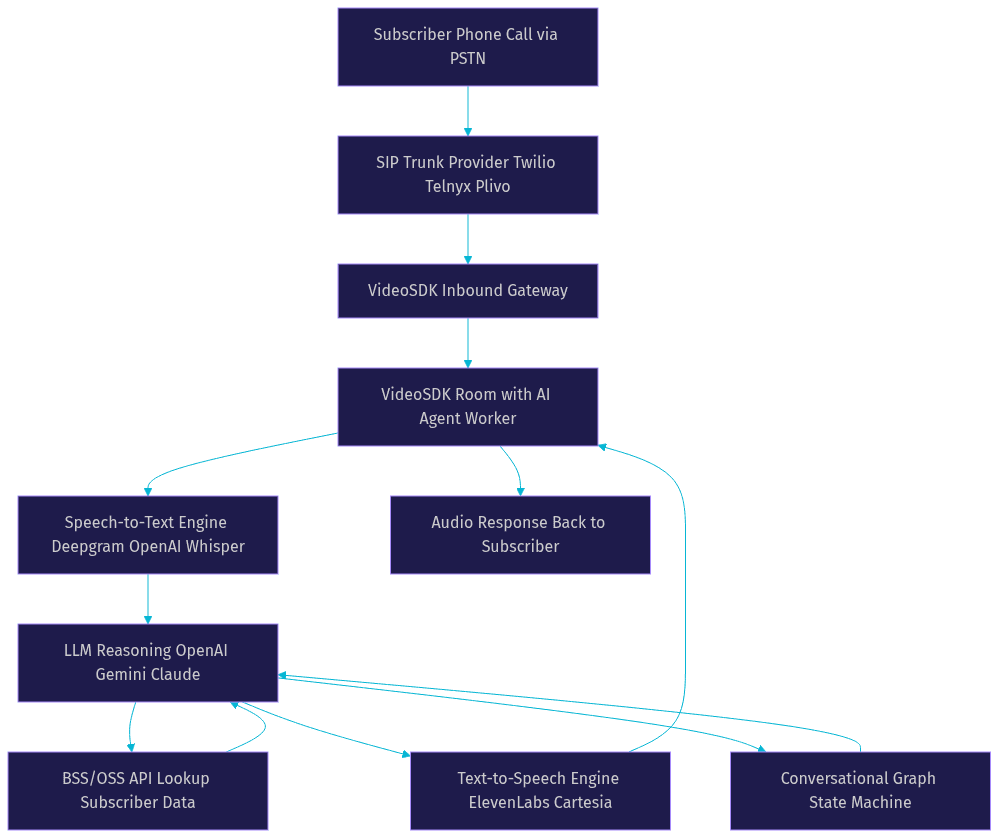
The agent works by bridging traditional telephony (SIP, PSTN) with modern AI pipelines. When a subscriber calls, the telephony layer routes the audio stream into a speech-to-text engine that transcribes the caller's words in real time. A large language model then processes that transcription, detects intent, queries backend systems for subscriber context, and determines the appropriate response. A text-to-speech engine converts the response back to natural-sounding audio, which flows back through the telephony layer to the caller.
VideoSDK provides a telecom-ready AI voice agent through its Python-based Agent SDK, which connects LLM, STT, and TTS providers to VideoSDK rooms that bridge SIP telephony and WebRTC. The Conversational Graph layer lets telecom operators define deterministic call flows for compliance-sensitive processes like payment collection and plan changes, where every step must happen in a specific order and business rules, not LLM judgment, control branching.
The key differentiator from generic AI assistants is telecom-native integration. A general-purpose voice AI can answer questions and hold conversations. A telecom AI voice agent can pull a subscriber's current plan from the BSS, verify their identity using account-level data, process a payment through the billing system, push a service activation command to the OSS, and confirm the change back to the caller, all within a single call.
Core Benefits for Telecom Operators
Telecom operators deploying AI voice agents see measurable improvements across first-call resolution, operational cost, and subscriber retention. The benefits extend beyond call deflection to fundamentally reshaping how contact centers operate.
Faster first-call resolution. An AI voice agent retrieves subscriber data from BSS/OSS and CRM systems in milliseconds, eliminating the hold time a human agent spends looking up account details. According to industry contact center benchmarks, AI-assisted resolution can reduce average handle time by 40 to 60 percent for routine transactions.
Reduced churn and operational cost. Subscribers who experience fast, accurate resolution are significantly less likely to switch carriers. AI agents handle peak call volumes without scaling headcount, turning a variable cost center into a predictable infrastructure cost.
24/7 multilingual support. A telecom AI voice agent operates around the clock and can switch languages mid-call based on the caller's preference. This is particularly valuable for operators serving multilingual regions where staffing human agents for every language and shift is economically impractical.
Seamless BSS/OSS integration. The agent connects directly to business support systems for billing, plan management, and subscriber data, and to operational support systems for service activation, fault management, and network status. This integration is what separates a telecom voice agent from a generic conversational AI.
Compliance and security. Telecom operators operate under strict regulatory frameworks including GDPR, HIPAA (for health-adjacent services), and SOC 2. VideoSDK's agent architecture supports encryption, role-based access control, and data residency requirements that telecom compliance teams demand.
Architecture Overview
A production-grade AI voice agent for telecom consists of five interconnected layers: telephony integration, speech-to-text processing, LLM reasoning, text-to-speech generation, and BSS/OSS connectors. Each layer must meet strict latency targets to maintain conversational naturalness.
The diagram below shows how a subscriber call flows through the system, from SIP trunk ingress through the AI pipeline to backend system queries and back.
Speech-to-Text (STT)
The STT layer transcribes the subscriber's spoken audio into text in real time. For telecom use cases, latency targets are aggressive: transcription must complete within 100 to 150 milliseconds to keep the conversation feeling live. Providers like Deepgram and OpenAI Whisper are commonly used, with Deepgram's Nova series consistently ranking well on the Artificial Analysis Speech Arena benchmark for conversational audio accuracy. VideoSDK's Agent SDK supports pluggable STT providers, so telecom operators can choose the engine that best matches their language coverage and latency requirements.
Large Language Model (LLM) Reasoning
The LLM layer is the cognitive core of the agent. It receives the transcribed text, detects subscriber intent, queries the knowledge base, and decides what action to take. For telecom-specific tasks, the LLM needs access to function tools that call BSS/OSS APIs: look up a subscriber's current plan, check an invoice status, process a payment, or trigger a service activation. VideoSDK's Agent SDK supports function tools and MCP integration, letting the LLM invoke external systems securely. The Conversational Graph layer sits above the LLM to enforce deterministic flow for compliance-sensitive transactions, ensuring the agent always verifies identity before accessing billing data.
Text-to-Speech (TTS)
The TTS layer converts the agent's text response back into natural-sounding audio. For telecom, voice quality directly impacts subscriber trust. Providers like ElevenLabs, Cartesia Sonic, and AWS Polly deliver human-like speech with multi-language support. VideoSDK's Agent SDK includes TTS caching, which pre-generates common responses (greetings, standard confirmations, compliance disclaimers) to eliminate TTS latency for repeated phrases. De-noise processing cleans up the audio output before it reaches the subscriber.
Telephony Integration
The telephony layer bridges traditional phone networks with the AI agent's WebRTC-based processing environment. VideoSDK's SIP integration supports inbound calls through an Inbound Gateway, outbound calls through an Outbound Gateway, and a Routing Rules engine that directs calls to the right agent or queue. The system supports DTMF events for callers who use keypad input, call transfer for escalation to human agents, and warm transfer for seamless handoff with context. SIP trunk providers like Twilio, Telnyx, Plivo, and Vonage are all supported.
BSS/OSS and CRM Connectors
The BSS/OSS connector layer is what makes the agent telecom-specific rather than generic. During a call, the agent queries business support systems for subscriber profile data, billing history, plan details, and payment status. It queries operational support systems for network status, service activation, and fault management. CRM connectors pull interaction history and preference data. VideoSDK's REST APIs provide the server-side orchestration layer for managing these integrations, creating rooms before calls, managing agent sessions, and pulling post-call analytics.
Deployment Options
Telecom operators can deploy AI voice agents in three primary configurations, each with distinct tradeoffs around latency, data residency, and operational overhead.
Cloud-managed AI Agent service. VideoSDK Agent Cloud provides a fully managed deployment where VideoSDK handles infrastructure, scaling, and monitoring. The operator's team focuses on agent logic, conversation flows, and BSS/OSS integration. This is the fastest path to production and works well for operators who want to pilot AI voice without provisioning infrastructure. Scaling is automatic, and the managed service handles failover and redundancy.
Self-hosted Docker or Kubernetes. Operators with strict data residency requirements or existing infrastructure investments can self-host the Agent SDK using Docker containers or Kubernetes clusters. This gives full control over data routing, network configuration, and compliance boundaries. Self-hosted deployments require the operator's team to manage scaling, monitoring, and updates, but they eliminate data egress concerns for jurisdictions with strict telecom data sovereignty laws.
Hybrid on-premises plus edge. For ultra-low-latency requirements, operators can deploy agent workers at edge locations close to regional SIP gateways while keeping the LLM and BSS/OSS integration layers in a central cloud. This architecture reduces round-trip latency for STT and TTS processing, which is critical for operators targeting sub-300-millisecond end-to-end response times. The tradeoff is increased operational complexity in managing distributed agent workers.
Key considerations across all deployment models include data residency compliance (especially for operators in the EU or regions with data localization laws), horizontal scaling strategy for peak call volumes, and monitoring coverage for latency, call quality, and agent accuracy.
Implementation Best Practices
Building a production-grade AI voice agent for telecom requires attention to authentication, network handling, latency monitoring, security, and testing workflows. These are the areas where pilot deployments most commonly fail.
Token-based authentication and role-based access. VideoSDK uses token-based authentication for all agent sessions. Tokens are generated server-side using your API key and secret, then passed to the Agent Worker. Never expose API secrets in client-side code or agent configuration files. Role-based access control ensures that agents can only invoke the BSS/OSS functions they are authorized for, preventing a billing inquiry agent from accidentally triggering service deactivation.
Network-adaptive streaming and bandwidth handling. Telecom calls originate from diverse network conditions: fiber, 4G, 5G, rural copper, and everything in between. VideoSDK's network-adaptive streaming automatically adjusts bitrate and audio quality based on real-time bandwidth detection. For AI voice agents, this means the STT engine receives clean audio even on poor connections, and the TTS output degrades gracefully rather than dropping entirely.
Monitoring latency and call quality metrics. The target end-to-end latency for a conversational AI voice agent is under 300 milliseconds from the moment the subscriber stops speaking to the moment the agent begins responding. VideoSDK's Pipeline Observability layer provides real-time metrics on STT latency, LLM inference time, TTS generation time, and total round-trip latency. Operators should set alerting thresholds and review latency distributions, not just averages, because tail latency (the slowest 5 percent of calls) is what subscribers notice.
Security and compliance. Telecom operators handling payment data must comply with PCI DSS. Those operating in healthcare-adjacent markets must meet HIPAA requirements. All operators in the EU face GDPR obligations. VideoSDK supports encryption in transit and at rest, and the Conversational Graph's checkpointing feature lets operators pause a call flow for human-in-the-loop verification before processing sensitive transactions. According to the W3C WebRTC security specification, all media flows should use DTLS-SRTP encryption, which VideoSDK enforces by default.
Testing workflow. Before routing live subscriber calls to an AI agent, run sandbox calls that simulate real scenarios: billing disputes, plan upgrades, outage reports, and edge cases like callers speaking over the agent or using unfamiliar terminology. A/B routing lets operators send a percentage of calls to the AI agent while the rest go to human agents, providing a controlled comparison of resolution rates and subscriber satisfaction scores.
Real-World Use Cases
AI voice agents for telecom excel in high-volume, structured interactions where the subscriber's intent can be determined quickly and resolved through BSS/OSS integration.
Billing inquiries and payment processing. A subscriber calls to question a charge on their monthly bill. The AI agent retrieves the invoice from the BSS, walks the subscriber through each line item, and if the subscriber agrees to pay, processes the payment through the billing system. The Conversational Graph ensures payment flows follow compliance-mandated steps: identity verification, amount confirmation, payment method capture, and transaction receipt.
Plan changes and service activation. A subscriber wants to upgrade from a 5GB data plan to an unlimited plan. The agent queries the BSS for available plans, presents the options with pricing, confirms the change, and pushes the activation command to the OSS. The entire transaction completes in under two minutes, compared to the eight to twelve minutes a human agent typically spends on the same call.
Technical troubleshooting. A subscriber reports slow internet speeds. The agent queries the OSS for network status in the subscriber's area, checks for known outages, and if no outage exists, guides the subscriber through basic troubleshooting steps like router restart procedures. If the issue requires a technician dispatch, the agent books the appointment through the CRM and sends confirmation via SMS.
Retention and win-back campaigns. For outbound calls, the AI agent contacts subscribers who have shown churn signals (recent downgrades, support complaints, competitor plan inquiries). The agent offers targeted retention deals based on the subscriber's usage patterns and account history, pulling offer eligibility from the BSS in real time.
Consider a concrete scenario: a subscriber calls their mobile carrier to upgrade to a family plan. The AI agent answers immediately, verifies the subscriber's identity using account-level data from the BSS, retrieves available family plan options with pricing, confirms the selection, processes the plan change through the OSS, and sends a confirmation SMS. Total call time: 90 seconds. No hold music. No agent transfer. No repeated identity verification.
ROI and Cost Considerations
The economics of AI voice agents for telecom are compelling when measured against the fully loaded cost of human contact center agents.
AI voice agent pricing typically follows a per-minute model, ranging from $0.05 to $0.15 per minute depending on the STT, LLM, and TTS providers selected. VideoSDK's pricing includes a free tier with credits for initial testing. Human contact center agents cost $15 to $25 per hour in most markets, plus infrastructure, training, and management overhead.
For a telecom operator handling 50,000 calls per month with an average handle time of 6 minutes, human agent costs run approximately $75,000 to $125,000 per month. An AI voice agent handling the same volume at $0.10 per minute costs $30,000 per month, a 60 to 76 percent reduction. Even accounting for the 20 to 30 percent of calls that still require human escalation, the net savings remain substantial.
Churn reduction adds a second ROI layer. If AI-driven faster resolution reduces monthly churn by 0.5 percentage points for a carrier with 2 million subscribers, the retained revenue impact far exceeds the agent infrastructure cost.
Future Trends in Telecom AI Voice
The telecom AI voice landscape is evolving rapidly, with several trends shaping 2026 and beyond.
Multimodal agents. Voice-only interactions are expanding to include visual elements. A subscriber on a video-capable device could see their bill breakdown on screen while the AI agent explains it verbally. VideoSDK's vision and multi-modality support, including avatar integration, positions operators to deliver these combined experiences.
Edge AI inference. Deploying STT and LLM inference at edge locations closer to regional SIP gateways is pushing response times toward sub-100-millisecond targets. This is particularly relevant for 5G-era services where latency expectations are tightening.
5G network slicing integration. AI voice agents are beginning to interact with 5G network slicing APIs, allowing the agent to prioritize call quality on a dedicated slice during sensitive interactions like payment processing or emergency troubleshooting.
Emerging standards for AI-enabled SIP. Industry bodies are developing standards for how AI agents signal their presence on SIP calls, including capabilities disclosure and handoff protocols. VideoSDK's open-source Agent SDK on GitHub tracks these developments and integrates emerging specifications as they stabilize.
Definitions Glossary
AI Voice Agent: A real-time voice AI system that processes spoken language, reasons about intent, and generates natural speech responses, operating within a telephony or WebRTC session.
SIP (Session Initiation Protocol): The signaling protocol that establishes, manages, and terminates voice calls over IP networks, bridging traditional telephony with WebRTC-based AI processing. VideoSDK's telephony integration uses SIP to connect PSTN calls to AI agent rooms.
BSS/OSS: Business Support Systems and Operational Support Systems. BSS handles billing, plan management, and subscriber data. OSS handles service activation, fault management, and network operations. AI voice agents query both during live calls.
Conversational Graph: VideoSDK's deterministic flow engine that defines conversation steps as a directed graph, ensuring compliance-sensitive telecom transactions follow mandated sequences regardless of LLM behavior.
Agent Worker: The Python process that runs a VideoSDK AI agent, managing the session lifecycle, pipeline execution, and tool invocations within a VideoSDK room.
DTMF (Dual-Tone Multi-Frequency): The keypad tone signals generated when a caller presses numbers on their phone. VideoSDK's telephony layer captures DTMF events for callers who prefer keypad input over voice.
Key Takeaways
- An AI voice agent for telecom bridges SIP telephony with real-time STT, LLM reasoning, and TTS pipelines, integrating directly with BSS/OSS and CRM systems to resolve subscriber requests autonomously.
- VideoSDK's Python-based Agent SDK provides SIP-native telephony integration, pluggable STT/TTS providers, and a Conversational Graph for deterministic, compliance-ready call flows.
- Deployment options range from fully managed VideoSDK Agent Cloud to self-hosted Docker or Kubernetes, with hybrid edge configurations for sub-300-millisecond latency targets.
- ROI calculations show 60 to 76 percent cost reduction compared to human agent handling at scale, with additional revenue retention from reduced churn.
- Production success depends on token-based authentication, network-adaptive streaming, latency monitoring, security compliance, and structured sandbox testing before live call routing.
Conclusion
An AI voice agent for telecom is no longer a futuristic concept. It is a deployable system that reduces operational costs, improves first-call resolution, and scales to handle peak call volumes without proportional headcount increases. VideoSDK's AI Voice Agent SDK, with its SIP-native telephony integration, Conversational Graph for deterministic flows, and pluggable STT, LLM, and TTS providers, gives telecom operators the building blocks to ship a production pilot in weeks, not quarters. Start by exploring the VideoSDK AI Agents documentation and the telephony integration guide, then join the VideoSDK Discord community to connect with other developers building telecom voice AI. Sign up at app.videosdk.live/login to claim your free credits and begin your pilot. What telecom challenge are you tackling with AI voice? Drop a comment below, I would love to hear what use case you are building.
Free $20 Balance for AI Voice Agents & Video Calls
FAQ