


An AI voice agent for logistics is a voice-based AI system that automates phone interactions for dispatch, shipment tracking, and carrier coordination by connecting speech-to-text, LLMs, and transport-management systems in real time. VideoSDK provides the telephony infrastructure, Python agent SDK, and SIP integration to deploy these agents into production phone workflows.
A typical mid-sized freight brokerage handles between 500 and 2,000 inbound and outbound calls per day. Drivers call in to confirm pickup times, customers ask where their shipments are, and dispatchers spend hours relaying load details between systems that do not talk to each other. Every one of those calls is a manual touchpoint that scales linearly with headcount.
An AI voice agent for logistics changes that equation by automating the repetitive voice interactions that consume dispatcher and call-center capacity. Instead of hiring more operators, logistics companies deploy a voice AI layer that answers calls, understands intent, pulls data from the transport-management system, and responds in natural language. This article walks through what these agents are, how they work technically, and how to build one using VideoSDK's AI agent infrastructure.
What Is an AI Voice Agent for Logistics?
An AI voice agent for logistics is defined as a specialized voice AI system that handles inbound and outbound phone calls specific to freight, shipping, and supply-chain operations. Unlike a generic voice assistant that answers general questions, a logistics voice agent is wired directly into operational systems like a transport-management system (TMS), enterprise resource planning (ERP) platform, or warehouse management system (WMS).
A logistics voice agent works by receiving a phone call through a SIP trunk or PSTN gateway, converting the caller's speech to text using a speech-to-text engine, passing that text to a large language model that understands logistics-specific intent, generating a response, converting that response back to speech using a text-to-speech engine, and speaking it back to the caller in real time. The entire round-trip happens in under a second when architected correctly.
VideoSDK provides the foundational infrastructure for building these agents through its AI Voice Agent SDK, which connects LLMs, STT providers, and TTS providers to real-time communication rooms. The agent runs as a Python process that joins a VideoSDK room alongside the human caller, processing audio streams and executing logistics workflows. For phone-based interactions, VideoSDK's telephony and SIP integration bridges traditional phone networks to these WebRTC-based rooms, enabling both inbound and outbound call flows.
The core capabilities that distinguish a logistics-specific voice agent include real-time shipment tracking queries, automated dispatch coordination, multilingual support for cross-border operations, and write-back integration with TMS platforms to update shipment statuses without human intervention.
Key Business Benefits
Logistics companies deploy voice agents to solve four measurable problems: slow dispatch, overwhelming call volume, language barriers, and rising labor costs.
Faster Dispatch and Load Booking
Speed is the single most valuable asset in freight brokerage. When a carrier calls about an available load, the broker who confirms the booking first wins the business. An AI voice agent captures load details, equipment requirements, pickup windows, and rate negotiations the moment the call connects, then posts that data directly into the TMS without a dispatcher typing it in.
In practice, freight brokers deploying voice agents for load booking report cutting average call-handling time from four minutes to under 90 seconds. The agent never puts a caller on hold, never loses a detail to misheard information, and can handle 50 concurrent conversations while a human dispatcher manages one.
WISMO Call Deflection
"Where is my order?" (WISMO) calls account for up to 70% of inbound contact volume for many logistics and e-commerce companies. Each WISMO call follows the same pattern: the customer asks for a status update, the agent looks up the tracking number, and the agent reads back the current location and estimated delivery time.
A voice AI agent handles this entirely autonomously. It extracts the tracking number or order reference from the caller's speech, queries the TMS or tracking API, and responds with the shipment status in natural language. According to industry contact-center benchmarks, automated WISMO handling deflects 60 to 80% of status inquiry calls away from human agents, freeing staff for exception handling and revenue-generating activities.
Multilingual Communication
Cross-border freight involves drivers, customs brokers, and customers who speak different languages. A logistics voice agent configured with multilingual STT and TTS providers can converse in English, Spanish, Mandarin, Hindi, Arabic, and dozens of other languages without routing calls to specialized agents.
VideoSDK's agent SDK supports multiple STT and TTS providers, including Deepgram, OpenAI Whisper, Google Speech-to-Text, ElevenLabs, and AWS Polly, giving developers the flexibility to pair the best language-specific models for each regional market. According to the Artificial Analysis Speech Arena benchmark, provider performance varies significantly by language, so selecting the right STT and TTS combination per region directly impacts caller experience.
Cost Savings and ROI
The ROI framework for a logistics voice agent rests on three measurable reductions: labor hours, error rates, and missed opportunities. A single voice agent handling 1,000 calls per day replaces roughly 10 to 15 full-time call-center agents at peak load. Error rates drop because the agent pulls data directly from system APIs rather than transcribing it manually. Missed load opportunities decrease because the agent answers every call instantly, 24 hours a day.
For a freight brokerage spending $500,000 annually on dispatcher and call-center labor, a voice agent deployment typically costs between $2,000 and $8,000 per month in platform and telephony fees, delivering payback within 60 to 90 days.
Core Technical Architecture
A production logistics voice agent is a pipeline of connected components that transform a phone call into a structured TMS transaction.
Voice Capture and Speech-to-Text Pipeline
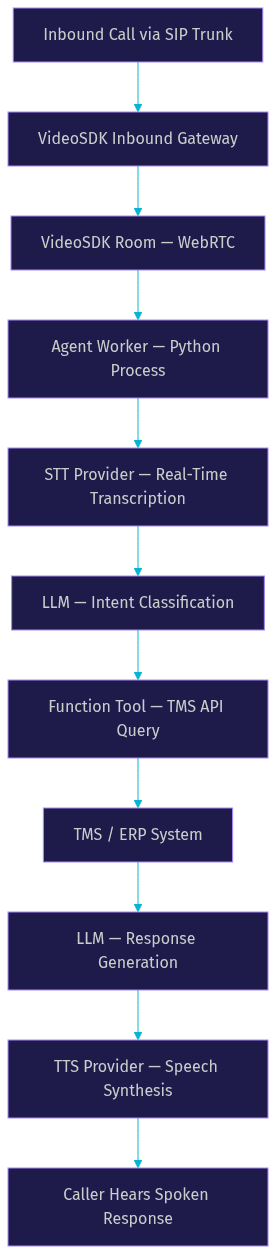
Every logistics voice agent interaction begins with audio capture. When a caller dials the logistics company's phone number, the call arrives through a SIP trunk connected to VideoSDK's inbound gateway. The gateway bridges the traditional phone call into a VideoSDK room using WebRTC, where the AI agent is already connected as a participant.
The agent's pipeline picks up the caller's audio stream and passes it to the STT provider for real-time transcription. VideoSDK's agent architecture supports streaming STT, meaning partial transcripts appear as the caller speaks rather than waiting for a pause. This reduces perceived latency and allows the agent to begin processing intent before the caller finishes their sentence. The W3C WebRTC specification governs the underlying media transport that makes this real-time audio exchange possible.
Natural-Language Understanding and Intent Routing
Once the STT layer produces text, the LLM processes it to determine intent. In a logistics context, common intents include shipment status inquiry, load booking, pickup scheduling, delivery confirmation, rate negotiation, and customs documentation request.
The LLM does not operate in a vacuum. VideoSDK's Conversational Graph lets developers define a deterministic flow for compliance-driven conversations. Instead of relying on the LLM to decide what comes next, the graph enforces a structured sequence: collect the tracking number, validate it against the TMS, retrieve the status, then respond. The LLM handles natural language generation, but the business logic controls branching.
Integration with TMS and ERP Systems
The voice agent becomes operationally valuable only when it can read from and write back to the TMS. This integration typically uses REST APIs exposed by the TMS platform, with the agent calling endpoints to fetch shipment details, update delivery statuses, or create new load records.
VideoSDK's agent SDK supports function tools, which are callable functions the LLM can invoke during a conversation. When a caller asks about a shipment, the LLM triggers a function tool that queries the TMS API, receives the response, and incorporates the data into its spoken reply. Webhooks can also be configured to push real-time updates from the TMS back into the agent session, enabling proactive outbound calls when a shipment status changes.
Outbound Call Automation
Inbound handling is only half the equation. Logistics voice agents also initiate outbound calls for carrier check-ins, delivery confirmation calls, and customer notification sequences. The agent dials out through VideoSDK's outbound gateway, connects to the recipient's phone number, and conducts the conversation using the same STT, LLM, and TTS pipeline.
The architecture below shows how a typical logistics voice agent call flows from inbound reception through to TMS update and caller confirmation:
How Do You Build an AI Voice Agent for Logistics with VideoSDK?
Building a production-ready logistics voice agent requires five sequential phases, each with specific technical decisions that determine call quality, integration depth, and operational reliability.
1. Choose the Right Platform
The first decision is deployment topology. VideoSDK offers two paths: Agent Cloud, a fully managed hosting environment where the agent worker runs on VideoSDK's infrastructure, and self-hosted deployment using Docker or Kubernetes on your own cloud provider.
Agent Cloud is the faster path for teams that want to ship without managing infrastructure. You configure the agent pipeline, connect your telephony provider, and VideoSDK handles scaling, monitoring, and worker lifecycle. Self-hosting gives you full control over network routing, data residency, and compliance boundaries, which matters for logistics companies operating under strict data sovereignty requirements.
2. Set Up Secure Telephony
Logistics voice agents need to receive and make real phone calls. VideoSDK's telephony integration supports SIP trunk connections from providers like Twilio, Telnyx, Vonage, and Plivo. The inbound gateway receives calls and routes them into VideoSDK rooms, while the outbound gateway initiates calls to external numbers.
Security considerations include IP whitelisting for SIP traffic, secure SIP with TLS encryption, DTMF event handling for IVR menu navigation, and geo-fencing to restrict call origins to specific regions. VideoSDK also supports call transfer and warm transfer, which are critical when a voice agent needs to escalate a complex issue to a human dispatcher mid-conversation.
3. Configure TMS Connectivity
The voice agent needs authenticated access to your TMS. This involves storing API credentials securely, mapping TMS data fields to the agent's function tools, and defining the specific endpoints the agent can call.
For example, a function tool designed to retrieve shipment status would accept a tracking number parameter, call the TMS REST API, and return the current location, estimated delivery time, and any exception flags. Another tool designed to confirm deliveries would write a delivery timestamp back to the TMS after the agent confirms a successful drop-off with a driver.
VideoSDK uses token-based authentication for all SDK interactions. You generate a token server-side using your VideoSDK API key and secret, then pass it to the agent worker when initializing a session. Never expose your API secret in client-side code or agent configurations that could be intercepted. The VideoSDK REST API reference documents the full set of endpoints for room creation, token validation, and session management.
4. Define Conversational Flows
For structured logistics workflows like load booking or customs documentation, free-form LLM conversations introduce risk. A driver might provide partial information, change details mid-conversation, or ask questions that pull the agent off track.
VideoSDK's Conversational Graph solves this by letting you define the conversation as a directed graph with explicit nodes, transitions, and state. Each node represents a conversation step, such as collecting the pickup address or confirming the equipment type. Transitions enforce the required sequence. Extractors pull structured data from the caller's responses and validate it before moving to the next node.
For a load booking flow, the graph might proceed as follows: greet the caller, collect origin and destination, collect equipment type, collect pickup window, query available loads from the TMS, present options, confirm selection, write booking back to TMS, and confirm with a booking number. The LLM generates natural language at each step, but the graph guarantees every required field is captured.
5. Test, Deploy, and Monitor
Before going live, test the agent with simulated calls covering common intents, edge cases, and accent variations. VideoSDK provides pre-call device testing capabilities to verify audio quality. In production, ensure TURN and STUN servers are configured for reliable media traversal across firewalls, which is especially important when drivers call from mobile networks with restrictive NAT policies.
The deployment pipeline below illustrates the progression from development through staging to production, with monitoring hooks at each stage:
VideoSDK's pipeline observability features provide real-time metrics on STT latency, LLM response time, TTS generation speed, and end-to-end conversational latency. These metrics are essential for maintaining sub-second response times, which are the difference between a voice agent that feels natural and one that feels broken. The open-source VideoSDK agents repository on GitHub includes reference implementations and observability configurations that developers can adapt for logistics workflows.
Real-World Use Cases
Three operational scenarios illustrate how logistics companies deploy voice agents to solve distinct communication bottlenecks.
E-commerce Last-Mile Delivery
A regional e-commerce carrier deploys an AI voice agent to handle delivery confirmation and rescheduling. When a driver completes a drop-off, the agent automatically calls the recipient to confirm receipt. If the recipient is unavailable, the agent offers rescheduling options, captures the preferred time window, and writes the updated delivery slot back to the carrier's dispatch system.
For customers who prefer messaging, the same agent logic can be extended to WhatsApp through VideoSDK's AI WhatsApp Agent integration, sending delivery confirmation messages and handling reschedule requests through text interaction.
Freight Brokerage Load Booking
A freight brokerage processing 800 loads per week uses a voice agent as the first point of contact for inbound carrier calls. When a driver calls about a load, the agent greets them, asks for their MC number and preferred lanes, queries the brokerage's load board through a TMS API, and presents available matches.
The agent captures the carrier's rate expectation, compares it to the broker's margin threshold, and either confirms the booking or routes the call to a human broker for rate negotiation. Bookings confirmed by the agent are written directly to the TMS with all required fields populated, eliminating manual data entry.
Cross-Border Carrier Coordination
A logistics company operating between the US and Mexico deploys a bilingual voice agent that handles customs documentation queries in both English and Spanish. Drivers approaching the border call the agent to confirm paperwork requirements, report customs clearance status, and receive instructions for the next checkpoint.
The agent queries the customs management system, retrieves the required document list for the specific shipment and border crossing, and communicates it in the driver's preferred language. This reduces border dwell time by ensuring drivers arrive with the correct documentation, avoiding costly delays and detention fees.
Challenges and Best-Practice Tips
Speech recognition accuracy in noisy environments is the most common technical challenge. Truck cabs, warehouse floors, and loading docks produce background noise that degrades STT quality. Mitigate this by selecting STT providers with strong noise-robust models, enabling VideoSDK's built-in de-noise feature on the agent pipeline, and configuring voice activity detection thresholds to filter out non-speech audio.
Token expiry causes silent agent failures. VideoSDK meeting tokens have a finite lifespan, and an agent session that outlives its token will disconnect without warning. Generate tokens with appropriate expiry windows for long-haul tracking calls, and implement server-side refresh logic that reissues tokens before they lapse.
Escalation to human agents must be seamless. When the voice agent encounters an intent it cannot handle, a rate negotiation that exceeds its threshold, or a customer who requests a human, it should transfer the call using VideoSDK's warm transfer capability. The agent introduces the transfer, connects the human dispatcher, and drops off the call without the caller needing to redial.
Future Trends in Logistics Voice AI
Real-time multimodal models like OpenAI Realtime, Google Gemini Live, and AWS Nova Sonic are converging voice, text, and image understanding into single inference passes. For logistics, this means a voice agent could soon analyze a photo of a bill of lading while discussing it on a call, extracting structured data without a separate OCR step.
Edge-deployed speech processing is emerging as a solution for environments with unreliable connectivity. Running STT and VAD on the device reduces round-trip latency and keeps sensitive shipment data local, which matters for defense logistics and pharmaceutical cold-chain operations.
AI-driven predictive dispatch represents the next evolution. Instead of reacting to incoming calls, voice agents will proactively contact carriers based on predicted load availability, historical lane preferences, and real-time traffic data, turning the voice channel from a cost center into a revenue engine.
Definitions Glossary
AI Voice Agent for Logistics: A specialized voice AI system that automates phone-based interactions for freight, shipping, and supply-chain operations by connecting STT, LLM, and TTS providers to transport-management systems through real-time telephony infrastructure.
Conversational Graph: VideoSDK's deterministic flow engine that defines multi-turn voice conversations as a directed graph with nodes, transitions, state, and extractors, ensuring compliance-driven logistics workflows follow a required sequence.
SIP Trunk: A Session Initiation Protocol connection that bridges traditional phone networks to VideoSDK WebRTC rooms, enabling inbound and outbound voice calls between PSTN callers and AI agent workers.
WISMO: "Where is my order?" calls that represent the majority of inbound contact volume for logistics and e-commerce companies, typically deflected by AI voice agents through automated shipment status lookups.
Agent Worker: The Python process that runs a VideoSDK AI agent, managing its session lifecycle inside a VideoSDK room and orchestrating the STT, LLM, and TTS pipeline for each conversation turn.
Key Takeaways
- An AI voice agent for logistics automates dispatch, WISMO, and carrier coordination calls by connecting speech-to-text, LLMs, and TMS platforms through real-time telephony infrastructure.
- VideoSDK provides the complete stack: Python agent SDK, SIP telephony integration, Conversational Graph for deterministic flows, and Agent Cloud for managed deployment.
- WISMO call deflection of 60 to 80% is achievable with a well-configured voice agent, dramatically reducing call-center labor costs.
- Conversational Graph is essential for compliance-driven logistics workflows like load booking and customs documentation, where every step must happen in order.
- Production deployment requires attention to STT noise robustness, token lifecycle management, and seamless human escalation through warm transfer.
Conclusion
Deploying an AI voice agent for logistics transforms the most labor-intensive communication workflows into automated, scalable processes. From WISMO deflection to load booking and cross-border coordination, the technology is mature enough for production use today. VideoSDK's open-source agent SDK, SIP telephony integration, and Conversational Graph give developers the building blocks to ship a logistics voice agent without stitching together half a dozen vendor APIs. Start by exploring the AI Voice Agent documentation or sign up at app.videosdk.live/login to test with free credits. What are you building with VideoSDK? Drop a comment below, I'd love to hear what kind of logistics voice AI use case you're working on.
FAQ