


An AI voice agent for banking is a real-time, speech-driven AI system that understands spoken customer requests, authenticates identity, executes transactions, and delivers compliant responses over phone or digital channels. VideoSDK provides the telephony, SIP integration, and AI agent pipeline infrastructure to deploy these agents with sub-second latency and full audit trails. Start with a pilot use case like balance inquiry, then expand to transfers and collections.
Banks handle millions of inbound calls daily, and the pressure is mounting from every direction. Regulatory bodies demand stricter compliance and auditability. Customers expect instant, frictionless service comparable to what they get from consumer tech platforms. And operations teams are stretched thin trying to manage call center costs that keep climbing year over year.
An AI voice agent for banking addresses all three pressures simultaneously. It answers calls in under a second, operates around the clock, follows compliance rules deterministically, and scales without proportional headcount increases. This guide walks you through what these agents are, how they work, how to architect them, and how to deploy one in a production banking environment.
What is an AI Voice Agent for Banking?
Definition
An AI voice agent for banking is defined as a real-time conversational AI system that interacts with bank customers through spoken language over telephony or digital voice channels. Unlike a simple interactive voice response system that routes callers through rigid menus, an AI voice agent understands natural language, extracts intent, verifies identity, and can execute actual banking transactions. It connects directly to core banking systems and CRM platforms through secure APIs, making it a functional extension of the bank's digital infrastructure rather than just a front-end deflection tool.
How It Works
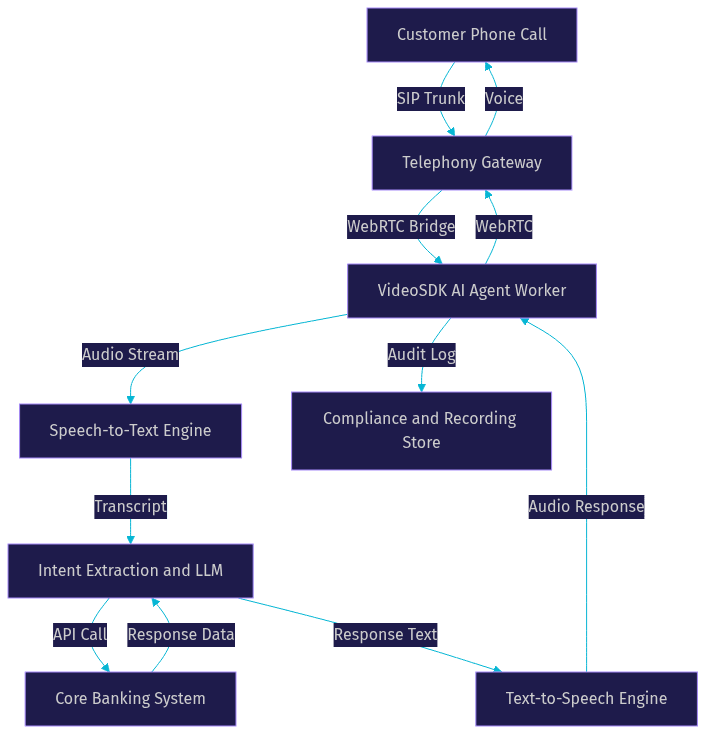
The AI voice agent for banking works by processing customer speech through a multi-stage pipeline. First, speech-to-text converts the caller's audio into text in real time. Next, an intent extraction layer identifies what the customer wants, whether that is checking a balance, reporting a lost card, or initiating a transfer. A large language model or deterministic logic engine then generates the appropriate response or triggers an API call to the core banking system. Finally, text-to-speech converts the response back into natural-sounding audio and delivers it to the caller. VideoSDK's AI agent pipeline manages this entire flow with built-in turn detection and voice activity detection.
Key Benefits for Banks
24/7 Availability and Reduced Wait Times
Banks lose customers to long hold times. An AI voice agent answers every call instantly, with sub-300-millisecond response times that feel natural in conversation. Call abandonment rates drop sharply when wait times approach zero. Customers can check balances, report fraud, or reset passwords at 2 AM on a Sunday without waiting for business hours. This always-on availability directly improves net promoter scores and reduces the load on human agents during peak hours.
Cost Reduction and ROI
The economics are straightforward. A human agent costs a bank between fifteen and twenty-five dollars per hour including benefits, training, and infrastructure. An AI voice agent handles the same volume of routine inquiries at a fraction of that cost. Banks that deploy voice agents for collections see faster recovery cycles because the AI can make thousands of outbound calls simultaneously. Training costs drop because updating a workflow or script does not require retraining a workforce. Most banks report positive ROI within the first three to six months of deployment.
Improved Compliance and Auditability
Every interaction with an AI voice agent is recorded, transcribed, and logged with timestamps. Consent capture is built into the conversation flow, so compliance teams have proof that disclosures were read and acknowledged. Real-time guardrails prevent the agent from sharing sensitive information with unverified callers. Audit trails satisfy PCI-DSS requirements for payment data, GDPR requirements for data handling, and regional regulations like RBI guidelines for Indian banks. The deterministic nature of the agent means that every call follows the same compliance path, eliminating the variability that human agents introduce.
Core Capabilities and Features
Natural Language Understanding and Multilingual Support
A banking AI voice agent must understand customers as they actually speak, not as a script expects them to. Natural language understanding allows the agent to detect intent from open-ended phrases like "I need help with my card" without forcing the caller through a menu. Modern language models handle regional dialects, code-switching between languages, and colloquial expressions that are common in multilingual markets. For banks serving diverse populations, the agent's ability to switch between English, Spanish, Hindi, Arabic, or regional dialects mid-conversation is a significant differentiator. VideoSDK supports integration with multiple STT and LLM providers, including OpenAI, Google Gemini, and Sarvam AI for hyper-local language coverage.
Secure KYC and Identity Verification
Before any transactional action, the agent must verify who is calling. Voice-based identity verification uses biometric voiceprints or knowledge-based authentication questions combined with one-time passwords sent to the customer's registered phone. The agent can also perform AML screening by checking the caller's details against watchlists in real time. This layer of verification happens within the first thirty seconds of the call, and the agent will not proceed to transactional actions until verification is complete. All verification steps are logged for regulatory review.
Transactional Actions: Balance, Transfers, Card Services
Once identity is verified, the AI voice agent for banking can execute real transactions. Balance inquiries are the simplest and most common use case. Fund transfers require additional confirmation steps, where the agent reads back the recipient details and amount before executing. Card services include blocking a lost card, requesting a replacement, or activating a new card. Each transactional action triggers a secure API call to the core banking system, and the agent confirms the outcome to the caller. VideoSDK's telephony integration ensures these interactions happen over secure SIP connections with full DTMF support for keypad inputs.
Integration Architecture
The architecture of a banking AI voice agent connects telephony infrastructure, AI processing pipelines, and core banking systems through secure, encrypted channels. Understanding this architecture is essential before deployment because each layer has specific compliance and performance requirements.
Telephony and SIP Bridge
Inbound and outbound calls enter the system through a telephony gateway that bridges traditional SIP trunk connections to the AI processing layer. The bank's existing PBX or SIP trunk provider routes calls to this gateway, which converts SIP audio into WebRTC streams that the AI agent can process. For outbound campaigns like collections or payment reminders, the gateway initiates calls through the SIP trunk and connects the recipient to the AI agent. VideoSDK's SIP integration supports inbound and outbound flows with providers like Twilio, Telnyx, and Plivo, including DTMF event handling for keypad navigation and call transfer capabilities for escalation to human agents.
Core-Banking and CRM Connectors
The AI agent needs real-time access to customer data to be useful. Core-banking connectors use REST APIs to fetch account balances, transaction history, and customer profiles. CRM connectors pull interaction history, previous complaints, and customer segmentation data so the agent can personalize the conversation. When a customer asks about a recent transaction, the agent queries the core banking API, retrieves the transaction details, and reads them back in natural language. These connectors must use token-based authentication and encrypted connections to protect financial data in transit.
Data Flow and Security Layers
Every layer of the pipeline must be secured. Audio streams between the telephony gateway and the AI agent are encrypted using WebRTC's built-in SRTP. API calls to core banking systems use HTTPS with mutual TLS where available. Token-based authentication ensures that only authorized agents can access banking APIs. All conversations are recorded and transcribed, with transcripts stored in an encrypted compliance repository. Audit logs capture every API call, every intent extraction, and every transactional action with timestamps and correlation IDs. Data residency requirements can be met by deploying the agent worker in specific geographic regions, either through cloud region selection or self-hosted deployment using Docker or Kubernetes.
Implementation Roadmap
Deploying an AI voice agent for banking requires a structured approach that balances speed of delivery with regulatory and security requirements. The following roadmap breaks the process into four phases.
Planning and Compliance Checklist
Before writing a single line of configuration, your compliance team must sign off on several items. Verify PCI-DSS scope for any call that involves card data. Confirm GDPR data handling requirements for EU customers, including right-to-erasure for call recordings. Check regional regulations like RBI guidelines for Indian banks or OCC guidance for US institutions. Define data residency requirements and confirm where call recordings and transcripts will be stored. Establish a consent capture script that meets legal disclosure requirements in every market you serve.
Selecting a Vendor or Platform
Choose a platform based on four criteria. First, latency SLA: the platform must guarantee sub-500-millisecond end-to-end response time, including STT, LLM, and TTS processing. Second, deployment model: determine whether your compliance team requires on-premises or self-hosted deployment, or whether a cloud-hosted solution with regional data residency is acceptable. Third, language coverage: verify that the platform supports every language and dialect your customer base speaks, including regional variants. Fourth, integration ease: confirm that the platform connects to your existing SIP trunk provider and core banking APIs without requiring custom middleware. VideoSDK offers both managed Agent Cloud deployment and self-hosted options, with broad STT, LLM, and TTS provider support.
Deployment Steps
The deployment follows four phases. In phase one, connect your telephony infrastructure to the AI agent platform by configuring SIP trunk routing and testing inbound and outbound call flows. In phase two, integrate core banking APIs by establishing authenticated connections to your balance, transaction, and customer profile endpoints, then map each API response to conversational language. In phase three, configure conversation workflows for your initial use cases, starting with balance inquiry and card blocking, then adding fund transfers and loan inquiries. Define guardrails, escalation triggers, and consent scripts for each workflow. In phase four, go live with a limited pilot, routing a small percentage of inbound calls to the AI agent while monitoring performance, accuracy, and customer satisfaction. Gradually increase call volume as confidence builds.
Monitoring and Continuous Improvement
Track three categories of metrics. Operational metrics include call containment rate, which measures the percentage of calls resolved without human escalation, and average handle time. Quality metrics include CSAT scores, intent detection accuracy, and transaction success rates. Performance metrics include end-to-end latency, STT word error rate, and TTS naturalness scores. Review these metrics weekly during the first month, then monthly. Use call transcripts to identify common failure patterns and refine the conversation workflows accordingly.
Challenges and Best Practices
Latency and Network Considerations
Sub-500-millisecond response time is the threshold for natural conversation. Beyond that, callers perceive awkward pauses and may assume the system is broken. To achieve this, deploy the STT, LLM, and TTS components in regions geographically close to your call center infrastructure. Use streaming STT that processes audio in chunks rather than waiting for the caller to finish speaking. Enable TTS caching for common responses like balance announcements and confirmation messages. VideoSDK's agent pipeline supports streaming STT and TTS caching natively, which reduces round-trip latency for repetitive banking interactions.
Guardrails to Prevent Hallucinations
Financial information is not a place for creative AI output. Hallucinations in a banking context can mean quoting the wrong balance, authorizing an incorrect transfer, or giving inaccurate regulatory information. Prevent this with a deterministic response layer that constrains the LLM to verified data from core banking APIs. Use policy filters that block the agent from discussing topics outside its scope, such as investment advice or loan approval decisions. Implement a Conversational Graph for structured flows like loan applications and KYC verification, where every step must happen in a specific order and the LLM only generates the natural language wrapping around deterministic logic.
Handling Edge Cases and Escalation
No AI agent handles every scenario. The system must recognize when it cannot help and transfer the call to a human agent without losing context. Define explicit escalation triggers: unrecognized intent after two attempts, failed identity verification, suspected fraud reports, and customer requests for a human. When escalation occurs, the agent transfers the call through a warm transfer that includes the conversation transcript and any data already collected, so the human agent does not ask the customer to repeat information. Handle API failures gracefully by informing the customer that the system is temporarily unavailable and offering a callback option.
Future Trends
The next generation of AI voice agents for banking will move beyond voice-only interactions. Multimodal agents that combine voice with visual interfaces are emerging, where a customer on a mobile banking app can speak to the agent while viewing transaction details on screen. Deterministic Conversational Graphs will become the standard for compliance-heavy flows, replacing prompt-engineered LLM systems that cannot guarantee step-by-step regulatory compliance. AI governance frameworks will tighten, with regulators requiring explainability reports for every automated financial decision. Banks that build their voice agent infrastructure on flexible, API-driven platforms today will be positioned to adopt these capabilities without re-architecting their systems.
Definitions Glossary
AI Voice Agent: A real-time conversational AI system that understands spoken language, extracts intent, and executes actions through API connections to backend systems.
SIP Trunk: A telephony protocol that bridges traditional phone networks to internet-based communication systems, enabling inbound and outbound calls to reach AI agents.
Conversational Graph: A deterministic, graph-based conversation orchestration layer where developers define conversation flow as nodes and transitions, ensuring compliance-driven steps happen in exact order.
Call Containment Rate: The percentage of customer calls resolved by the AI agent without requiring escalation to a human agent, a primary ROI metric for banking voice deployments.
DTMF: Dual-Tone Multi-Frequency signaling, the technical standard for telephone keypad inputs that AI voice agents use to capture numeric responses like account numbers and PINs.
Key Takeaways
- An AI voice agent for banking combines real-time speech processing with secure core-banking API integration to handle customer calls end-to-end, from balance inquiries to fund transfers.
- Sub-300-millisecond response times and 24/7 availability directly reduce call abandonment rates and improve customer satisfaction scores.
- Compliance is built into the architecture through call recording, consent capture, audit trails, and deterministic guardrails that satisfy PCI-DSS, GDPR, and regional banking regulations.
- A Conversational Graph approach is essential for structured flows like KYC verification and loan applications where every step must follow a specific regulatory sequence.
- VideoSDK provides the telephony SIP integration, AI agent pipeline, and deployment flexibility needed to build and scale banking voice agents, with both managed cloud and self-hosted options.
Conclusion
AI voice agents for banking are no longer experimental. They are a proven response to the triple pressure of rising call volumes, regulatory demands, and customer expectations. The banks that deploy them gain measurable cost savings, improved compliance posture, and a customer experience that matches the speed of modern digital life. The technology is mature, the integration patterns are well understood, and platforms like VideoSDK provide the infrastructure to get started without building from scratch. If you are ready to explore a pilot, sign up for a free VideoSDK account and review the AI agents documentation to see how the pipeline fits your banking use case. What are you building with VideoSDK? Drop a comment below, I would love to hear what kind of voice agent use case you are working on.
FAQ