
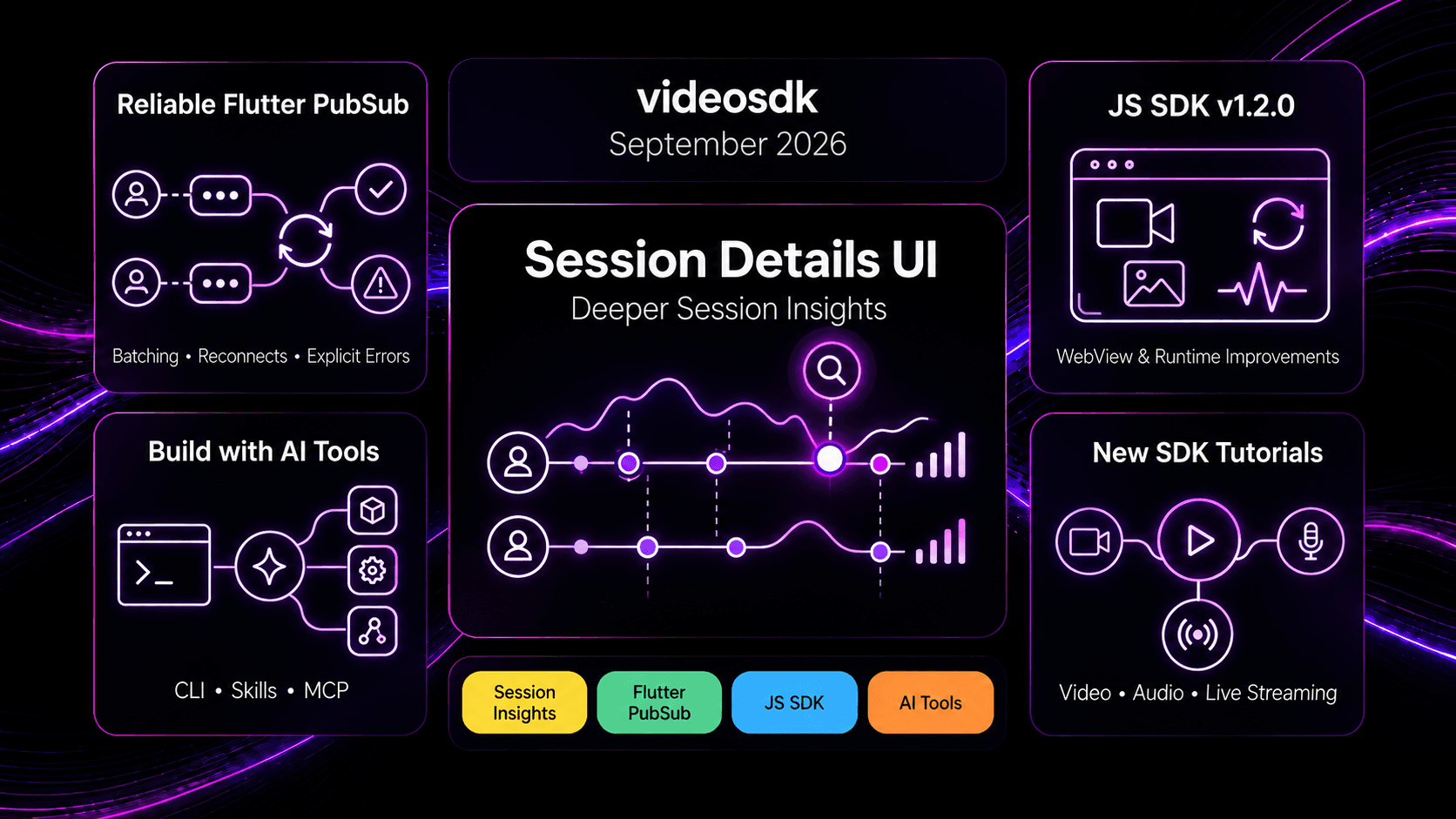


September 2026 Updates: Deeper session visibility, more predictable messaging, and practical improvements across the developer workflow.
September's updates focus on a practical part of running real-time applications in production: understanding what happened during a session and making application behavior more predictable when conditions are not ideal.
The Dashboard now provides a richer Session Details experience for investigating participant activity, network conditions, and media quality. Flutter SDK v4.0.0 and v4.0.1 strengthen PubSub delivery and failure handling, while JS SDK v1.2.0 improves WebView behavior and runtime observability. We have also expanded our resources for AI-assisted development and added new implementation tutorials across multiple SDKs.
A New Session Details UI
When one participant reports poor video quality or a session behaves differently than expected, the first problem is often not fixing it. It is figuring out what actually happened.
The redesigned Session Details UI gives developers a clearer way to inspect a session from start to finish. The updated experience brings session-level information, participant activity, network events, and media statistics into a more useful debugging workflow.
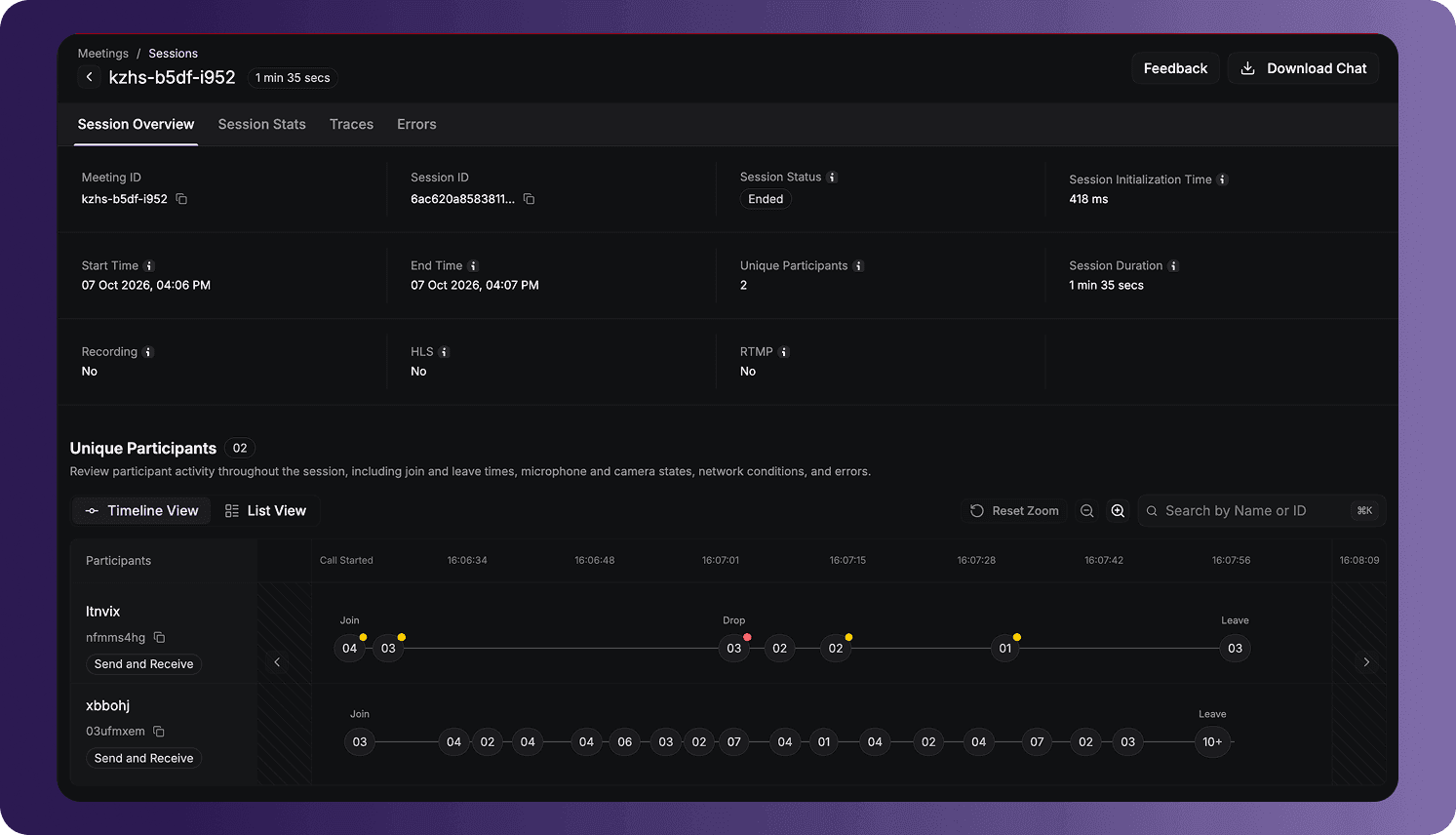
Session Overview combines session metadata with participant-level activity across the call.
Follow participant activity on the timeline
The improved participant timeline makes it easier to understand what each participant experienced throughout the session. Join and leave events sit alongside network and media-related activity so developers can correlate user-reported problems with changes occurring inside the call.
Network events such as bandwidth limitations and congestion can also be inspected directly from the timeline. Tooltips provide additional context around these events, helping developers understand when an issue appeared and when the underlying condition recovered.
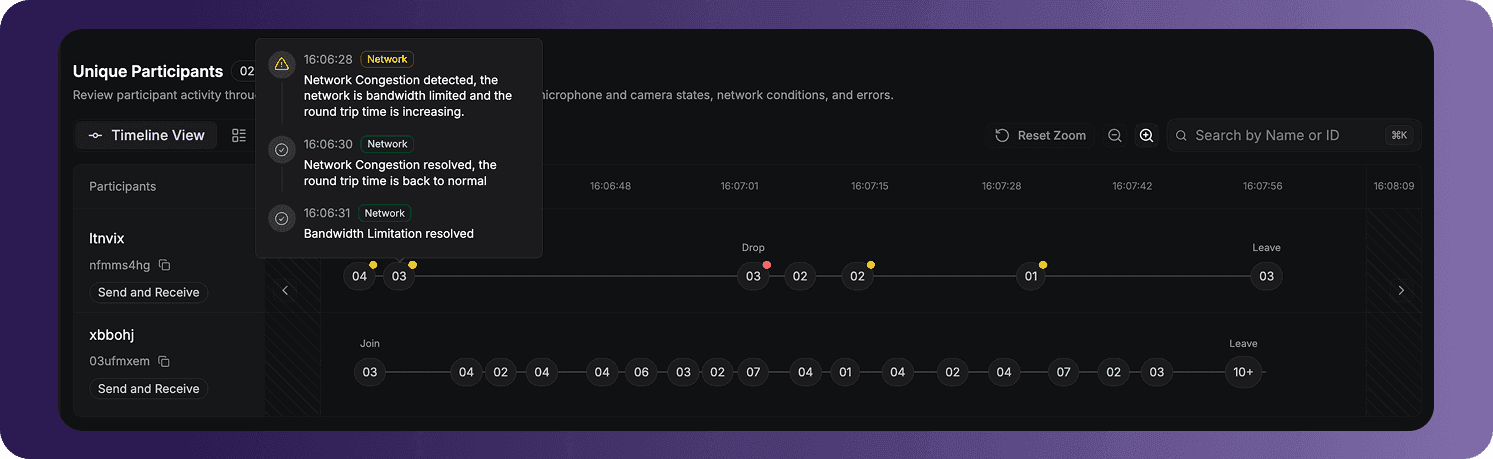
Timeline events expose participant activity and network conditions in the context of the session.
Inspect sender and receiver statistics together
The updated Session Stats view provides deeper media-level visibility across audio, video, screen-share audio, and screen-share video.
For video sessions, developers can inspect signals including:
- Round-trip time (RTT)
- Sent and received bitrate
- Bitrate by simulcast layer
- Jitter
- Packet loss
- Frames per second
- Resolution
- Freezes and pauses
Graph interactions have also been improved. Hovering over a point now surfaces detailed sender and receiver information for that moment instead of requiring developers to interpret the lines in isolation.
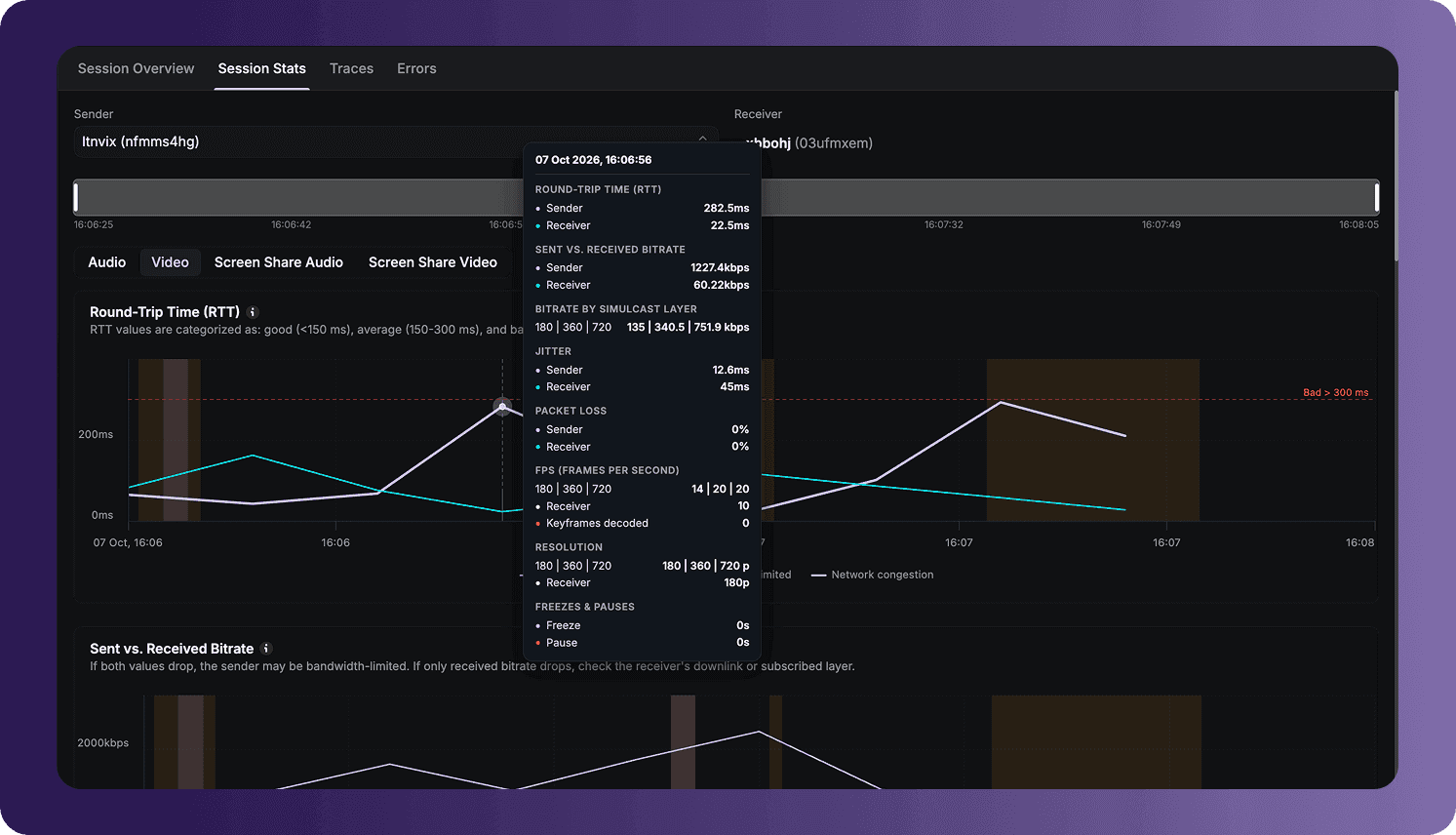
Hover states surface sender and receiver metrics at a specific point in the session.
Additional explanatory tooltips throughout the interface make the metrics easier to interpret without leaving the debugging workflow. The result is a more useful starting point when investigating intermittent network problems, media degradation, or participant-specific quality issues.
Flutter SDK v4.0.0 & v4.0.1: More Reliable PubSub
PubSub is frequently used for chat, reactions, application state, control messages, and other events that accompany the media session. The difficult cases appear when message traffic increases, a subscriber falls behind, or the network briefly disconnects.
Flutter SDK v4.0.0 adds more predictable behavior for those conditions. Live messages can now be delivered in batches, historical messages can stream progressively, dropped messages are surfaced instead of disappearing silently, and subscriptions remain active across reconnects.
Applications can configure the behavior per topic using the new PubSubSubscribeOptions.
The overflow strategy can be selected based on the type of event being delivered. queue temporarily holds messages for a subscriber that falls behind, while drop is appropriate when stale data no longer has value, such as typing indicators.
Failures are explicit now, too
Flutter SDK v4.0.1 extends the reliability work by making unsuccessful PubSub operations visible to application code.
publish(), subscribe(), and unsubscribe() now throw a PubSubException when the requested operation does not take effect. This removes a particularly difficult failure mode where a rejected publish could previously appear indistinguishable from a successfully delivered message.
Invalid subscription configurations are also rejected before the request is sent. This includes negative message limits, invalid queue sizes, and combinations that cannot work together.
⚠️ Migration Note: Existing Flutter applications should review PubSub call sites and explicitly handle asynchronous failures. Unawaited calls such as direct publish() calls inside UI callbacks can otherwise surface as unhandled async errors at runtime. See the Flutter SDK release notes for the complete version details.
JS SDK v1.2.0: WebView and Runtime Improvements
JS SDK v1.2.0 includes a set of practical fixes for browser and embedded WebView applications.
participant.captureImage() now works correctly in WebView environments where media playback requires a user gesture. We also fixed an issue where changeWebcam could attempt to disable the webcam even when no webcam producer was active.
The release also includes several internal runtime improvements:
- Webcam device enumeration is now cached and refreshed only when the operating system emits a devicechange event.
- Additional tracing has been added around participant.captureImage() to improve debugging and observability.
- Proactive pong handling helps keep the server aware that a client remains active when packets are already being received within the expected ping interval.
Together, these changes improve behavior and observability in browser and embedded WebView environments.
Build with VideoSDK Using AI-Assisted Development Tools
We have also expanded the documentation available for developers using AI coding tools as part of their VideoSDK workflow.
The new resources cover four entry points:
- Start with AI — an introduction to building VideoSDK applications with AI-assisted workflows.
- CLI — command-line tooling for development workflows.
- Skills — structured VideoSDK knowledge that can be used by compatible coding agents.
- MCP Server — VideoSDK context for MCP-compatible development environments.
These resources complement the existing SDK documentation by making VideoSDK context easier to bring directly into the tools developers use while writing, exploring, and debugging code.
New Tutorials Across JavaScript, React, React Native, Flutter, Unity, iOS, and Android
We have continued expanding our practical tutorial library around three common real-time application patterns: video calling, audio rooms, and live streaming.
Here are two recent walkthroughs to get started. You can also explore the full tutorial library across JavaScript, React, React Native, Flutter, Unity, iOS, and Android.
Build a Video Calling App with JavaScript
Build a Video Calling App with Flutter
The full tutorial set now covers JavaScript, React, React Native, Flutter, Unity, iOS, and Android, with walkthroughs for video calling, audio rooms, and live streaming across the supported platforms.
Browse the platform playlists: JavaScript, React, React Native, Flutter, Unity, iOS, and Android.
Other SDK Fixes and Improvements
Alongside the larger releases, we continued shipping smaller maintenance fixes and improvements across other SDK surfaces.
For example, iOS SDK v3.2.1 includes bug fixes and general improvements without introducing a new feature surface.
Platform-specific changes can be followed through the individual SDK release notes as they ship.
✨ Community Spotlight
SDK Sketches
Real-time systems tend to look simple when everything is healthy. The interesting engineering starts when traffic spikes, networks fluctuate, or applications need to explain why an operation did not behave as expected.
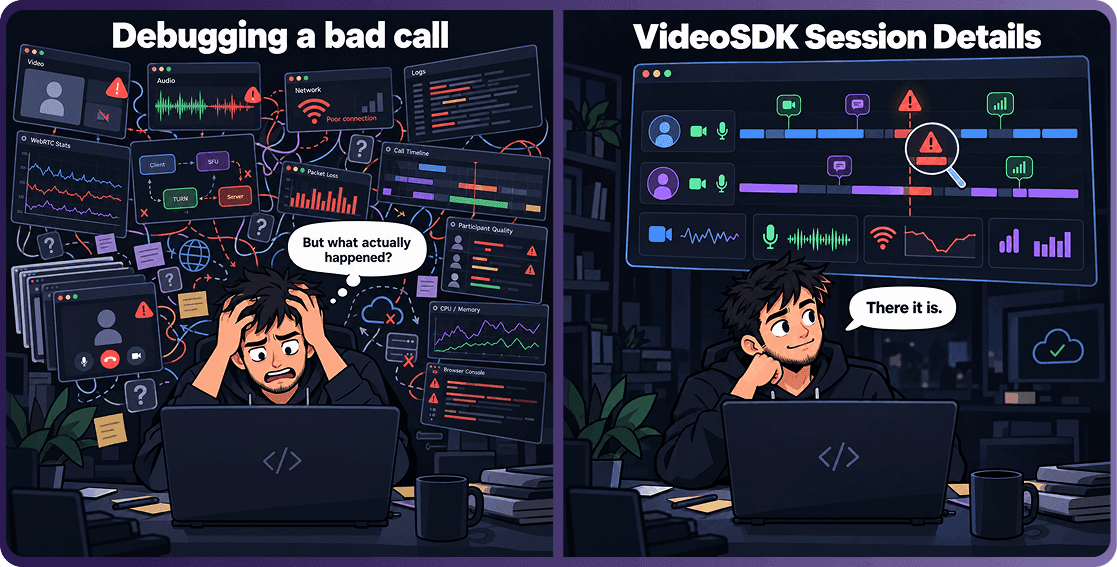
This month's SDK Sketch - How improved Session Details helps developer.
September in Review
September's work improves both sides of operating real-time applications: understanding what happened during a session and making application behavior more predictable when conditions change.
The new Session Details experience brings participant activity, network events, and media statistics into a clearer debugging workflow. Flutter PubSub is more resilient under load and now exposes unsuccessful operations directly to application code. JS SDK improvements address WebView and runtime edge cases, while the new AI development resources and implementation tutorials make the build side easier to navigate.
Build with September's Updates
Explore the new Session Details experience, review the latest SDK changes, and try the updated developer resources.
Dashboard Join our Discord
Happy building!
Team VideoSDK