


An online tutoring marketplace connects students and parents with independent tutors, and handles matching, booking, payment and the live lesson in one place. To build one, seed tutors in one niche, ship a booking loop that holds payment until the lesson ends, run the lesson inside your own app, and pay tutors automatically once it is complete.
This guide covers what to build in each phase, what it costs, how one booking flows from payment to payout, and the payment and child-data rules for marketplaces run from India.
How does an online tutoring marketplace work?
An online tutoring marketplace is a two-sided platform: tutors supply lessons, and students or their parents buy them. In school tutoring the parent usually pays, so the parent is a customer to keep informed.
The money moves in a loop: the student pays when booking, the platform holds the money, the lesson happens, and the tutor is paid the fee minus commission. Marketplaces sell single lessons, packages or subscriptions, and some add small-group classes.
Major tutoring marketplaces at a glance
These four marketplaces show the main ways a tutoring platform charges for the match (fees from each company's own help pages, as of 13 November 2026):
| Marketplace | Model | What tutors pay |
|---|---|---|
| Preply | Global, mostly language lessons, pay per lesson | 18% to 33% of each lesson, falling as hours grow; 100% of a new student's trial lesson |
| Wyzant | US academic tutoring, pay per lesson | 25% platform fee; students also pay a 9% service fee |
| Superprof | Global directory; students buy a monthly pass to contact tutors | Nothing on lessons paid directly; 10% when payment runs through the site, per its terms |
| UrbanPro | Indian lead marketplace for tutors and institutes | Coins, from a premium membership, to contact students |
They compete on liquidity and trust, not features: enough good tutors to match fast, and enough reviews and checks for strangers to book each other.
The tutoring marketplace flywheel
The tutoring marketplace flywheel is the loop that lets a marketplace grow on its own: more verified tutors mean faster matches and more first lessons, good lessons earn reviews, reviews lift ranking, better ranking brings students, and students attract more tutors.
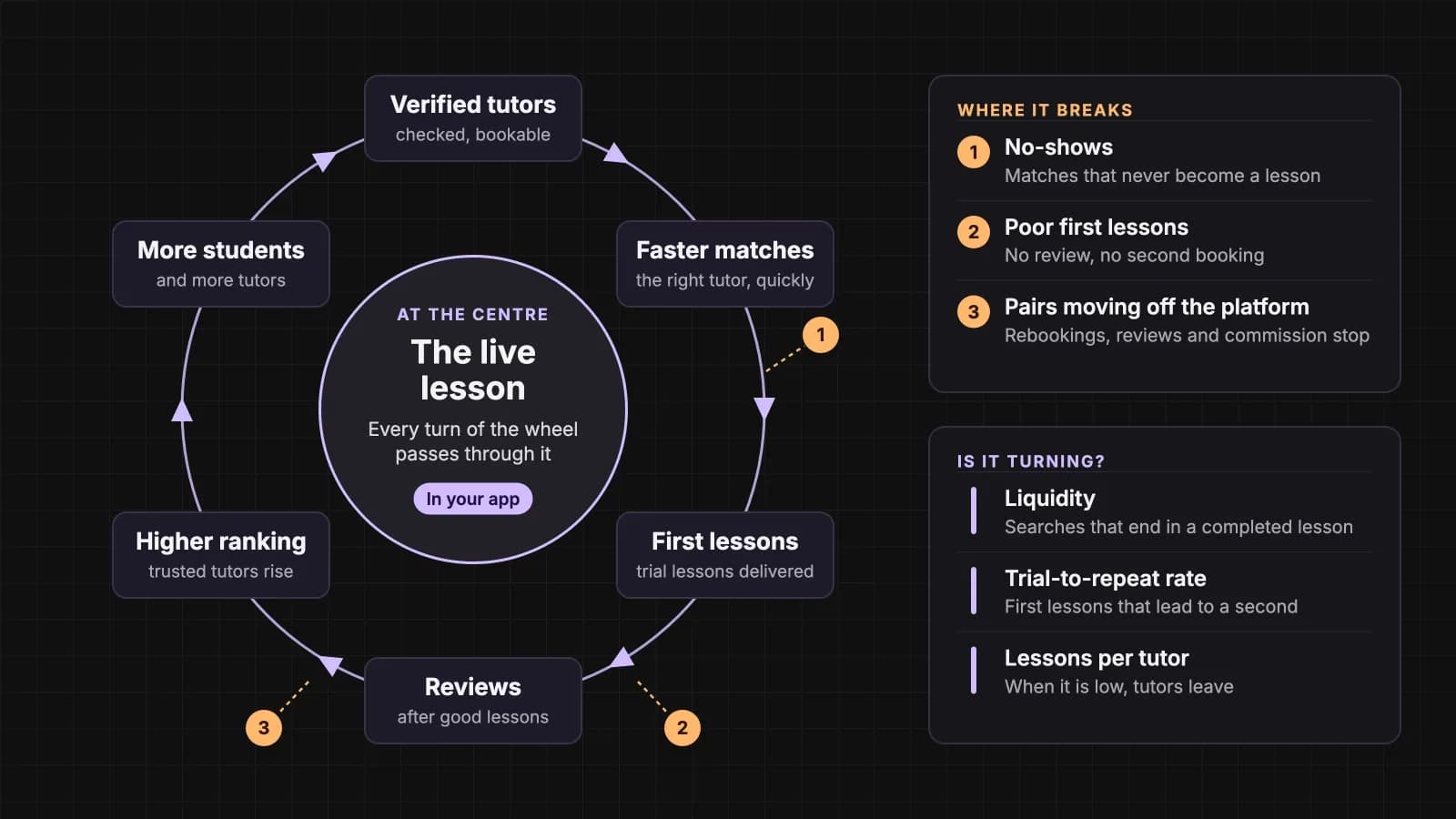
Three numbers show whether it is turning:
- Liquidity: the share of searches that end in a completed lesson.
- Trial-to-repeat rate: the share of first lessons that lead to a second booking.
- Completed lessons per tutor: when it is low, tutors leave.
The flywheel breaks at no-shows, poor first lessons, and pairs that move off the platform. Imagine a learner booking one $20 lesson a week for 40 weeks at 20% commission: the platform expects $160. If the pair swaps phone numbers after lesson 3, $148 of it is gone. Every turn passes through the live lesson, so the lesson needs the most care.
Part 1: What to build
Essential features for a tutoring marketplace
A tutoring marketplace has six parts, each with its own features and a typical way it fails:
| Part | Key features | Where it goes wrong |
|---|---|---|
| Discovery and matching | Search by subject, grade, exam and language; tutor profiles with intro video | Poor first results, so the student never books |
| Scheduling and booking | Time zones, availability, rescheduling, reminders to parents | Double bookings and no-shows |
| The live lesson | Video, whiteboard, screen share, chat, recording, audio-only mode, captions | Left to a meeting link, so nothing is tracked |
| Payments and payouts | UPI and cards, payment held until the lesson ends, refunds, commission | Booking confirmed before payment |
| Trust and safety | ID and credential checks, reviews, safeguards for minors | Unverified tutors teaching children |
| Retention | Lesson notes, parent reports, packages, one-tap rebooking | Learners stop after the trial |
The same six parts apply whether you start with a website or with tutor app development; the mobile app is a later channel, not a different product.
Why the lesson belongs inside your app, not a meeting link
A meeting link costs a tutoring marketplace four things: proof the lesson happened, so payouts need manual checks; evidence when a parent disputes a lesson; a reason for tutors and students to stay, since they now meet in another app; and your brand on the most important hour of the product.
An in-app lesson fixes each of these. The student joins from the booking, and events for who joined, who left and when the session ended tell your backend the lesson took place, so payment is released without manual checks. An optional recording gives evidence for disputes and a safeguarding record for lessons with minors, and a transcript can become a summary for the parent.
A 1:1 lesson puts the shared whiteboard at the centre with two video tiles. A small group of three to twelve learners also needs a tutor view of every learner, hand raising and room-wide mute.
Part 2: How to build it
How to build a tutoring marketplace in 6 steps
Building a tutoring marketplace starts with supply, not code:
- Pick a niche: one subject, exam or language where you can judge tutor quality.
- Seed tutors first: marketplace guides commonly suggest 10 to 20 vetted tutors per subject before launch.
- Set the model and commission: per lesson, packages or subscription, and what share you keep.
- Map the booking loop: book, pay, lesson, payout, review. Every V1 feature serves one step.
- Choose a build approach: see the comparison below.
- Launch narrow, then expand: one niche and one city or exam until liquidity holds.
If you are working out how to make an online tutoring website rather than an app, the steps are the same.
What to ship first and what can wait
A tutoring marketplace ships in three phases, and VideoSDK covers the lesson layer in each.
| Phase | What to build | What VideoSDK covers | Move on when |
|---|---|---|---|
| V1: the booking loop | Profiles with basic checks, search, booking with time zones, payment held until the lesson, in-app lesson with whiteboard, reviews, admin panel | Lesson, whiteboard, pre-call check, webhooks | Learners rebook steadily in your first niche |
| V2: retention | Packages, rescheduling rules, payout and parent dashboards, lesson reports, recording, captions, referrals | Recording, transcription, lesson summary | Repeat rate is stable and payouts need no manual work |
| V3: scale | Mobile apps, smarter matching, AI practice, group classes, school partnerships, multi-currency | Mobile SDKs, group lessons, AI agents | You expand to new niches or countries |
Mobile apps wait for V3 because a responsive web app covers phones well enough to test demand.
Development approaches, and when off-the-shelf stops being enough
There are three realistic ways to build a tutoring marketplace:
| Approach | Time to launch | Branding and data | The lesson |
|---|---|---|---|
| No-code builder or ready-made tutoring software | Days to weeks | Limited; the platform holds much of your data | Usually a meeting link |
| Custom marketplace with an embedded video SDK | About 3 to 5 months for V1 | Your brand, data and matching rules | In your app, with recording and captions |
| Custom marketplace and your own video stack | Longer, plus a media team | Full control | Your team runs media servers |
For a solo tutor or a small centre, ready-made tools are cheaper and good enough. Building your own video stack rarely pays off: media servers, network recovery and recording are the same for every marketplace and give you no edge.
Off-the-shelf stops being enough when the commission or subscription eats your margin, you cannot control how tutors are ranked, you need parent accounts and consent for minors, you need Indian payment flows such as UPI, or you want your own branded app. Custom builders are usually niche marketplaces (exam prep, coding for kids, English for learners in the Gulf or the US), tutoring companies with 50 or more tutors, and edtechs adding 1:1 tutoring. Our e-learning app development guide covers the wider platform decisions for course-led products.
How much does it cost to build an online tutoring marketplace?
Building an online tutoring marketplace costs from a few thousand to several hundred thousand dollars. Published estimates checked in November 2026 put a no-code marketplace at roughly $3,000 to $15,000 in its first year, white-label tutoring software at $5,000 to $15,000 to set up, and a custom MVP at $30,000 to $180,000. A full custom platform with mobile apps runs to $200,000 or more.
After launch, budget monthly for hosting, payment gateway fees, background checks, support, video minutes and recording storage; one agency puts a custom marketplace at $1,200 to $3,500 a month.
At VideoSDK pricing (as of 12 November 2026), video is billed per participant-minute:
| Lesson (60 minutes) | Participant-minutes | Cost |
|---|---|---|
| 1:1 lesson in HD (720p), $0.004 per minute | 120 | $0.48 |
| Same lesson with cameras off (audio-only), $0.001 per minute | 120 | $0.12 |
| Group of 6 learners plus the tutor, HD | 420 | $1.68 |
| Recording the lesson in HD, when you need it | 60 recorded minutes | $0.90, plus $0.18 a month to store |
On a $20 lesson at 20% commission, the platform earns $4 and the video costs $0.48, about 12% of the commission. To keep it there, record trial lessons, lessons with minors and flagged lessons rather than every lesson, set a retention period, and switch learners on weak networks to audio-only. New VideoSDK accounts get $20 of free credit, as of 12 November 2026.
Part 3: Run it well
How one booking runs, end to end
The online tutoring platform architecture behind one booking has three players: a licensed payment partner, your backend, and VideoSDK running the lesson. VideoSDK is a real-time video and audio platform with calling and interactive live streaming SDKs and APIs.
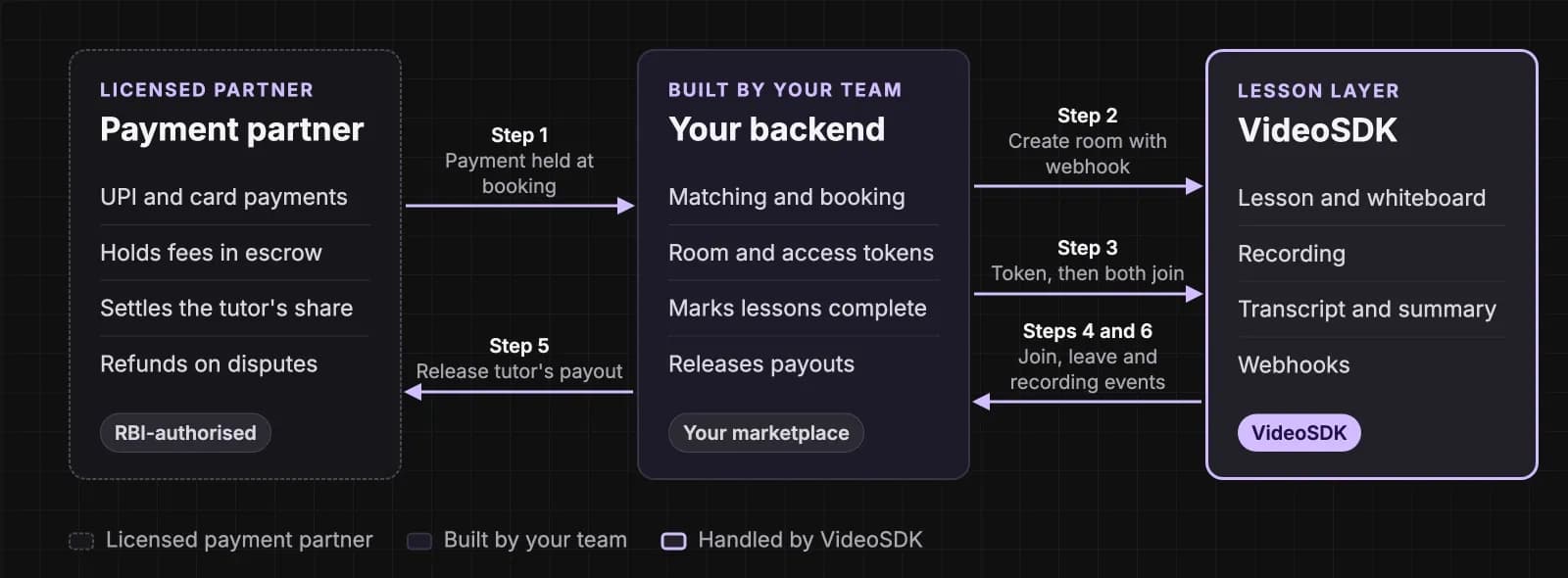
- Book and pay. The student or parent pays through an RBI-authorised payment aggregator, which holds the money until the lesson is complete.
- Create the room. At booking, your backend creates the lesson room with the create room API and your webhook URL.
- Check and join. Ten minutes before the lesson, a pre-call check tests camera, microphone and network. Your backend issues each a short-lived access token, and both join with the whiteboard ready.
- Mark it complete. Webhooks for participant-joined, participant-left (with the reason) and session-ended tell your backend who attended and for how long.
- Release the payout. After a short dispute window, your backend tells the payment partner to settle the tutor's share.
- Share the lesson. If recording was on, the file lands in your own cloud storage bucket, and post-lesson transcription and summary turns it into a note for the parent.
- Ask for a review. Both sides rate the lesson, which feeds ranking.
On mobile data, network quality monitoring lets the app suggest turning the camera off before the lesson breaks up.
Success factors and mistakes to avoid
Tutoring marketplaces that grow tend to get a few things right:
- Tutor quality over tutor count: fewer, vetted tutors give better first lessons, and the first lesson decides the repeat rate.
- Fast matching: a student who waits a day books elsewhere.
- Visible trust: checks, reviews and clear refund rules on every profile.
- Updates to parents: a short note after each lesson keeps the payer engaged.
- Reasons to stay: in-app chat, cheaper packages, and contact details hidden until a booking exists.
The common mistakes: confirming bookings before payment, sending lessons to meeting links, pooling lesson fees in your own bank account, launching in every subject at once, ignoring time zones, having no no-show policy, recording minors without consent or a retention period, and overfilling V1.
Compliance: India & selling abroad
A tutoring marketplace in India handles children's data and other people's money, and both are regulated.
- Children's data: under the Digital Personal Data Protection (DPDP) Act, 2023, anyone under 18 is a child. You need verifiable parental consent before processing their data, and you may not track, behaviourally monitor or target ads at them (Section 9). The DPDP Rules were notified on 13 November 2025, and the children's consent obligations apply from May 2027.
- Recordings: a recording is personal data. Tell parents before the first lesson why lessons may be recorded, who can watch and how long you keep them, and erase recordings once their purpose is served (Section 8(7)). Recording encryption with your own key keeps stored files readable only by you, and our CERT-In compliance page covers Indian cybersecurity rules.
- Payments: the RBI's Payment Aggregator Directions, 2025 bar a payment aggregator from running a marketplace and require it to hold merchant funds in an escrow account. A marketplace that pools and settles lesson fees itself risks being treated as a payment aggregator, so collect through an authorised one and onboard every tutor as a seller on your platform before paying them.
- Tax: GST applies to your commission, and collecting fees for tutors may bring tax collection at source under Section 52 of the CGST Act (0.5% since July 2024). Confirm with your tax adviser.
- Selling abroad: COPPA covers US children under 13 and treats a child's photo, video or voice recording as personal information. GDPR needs parental consent below age 16, which member states can lower to 13. Background-check every tutor who teaches minors.
This is a planning summary, not legal advice.
Current and future trends in tutoring marketplaces
In our view, these are the tutoring marketplace shifts worth planning for:
- AI between lessons, humans in them: AI handles practice and quick doubts; the tutor's hour goes to coaching.
- Lesson summaries for parents: a few lines after each lesson, generated from the transcript.
- Hindi and regional-language tutoring: our real-time transcription supports Hindi and Indian English, so captions can follow the lesson; for other languages, contact our team.
- Indian tutors, learners abroad: time zones and prices make India a source of tutors for the Gulf, UK and US.
- Next: AI voice agents as practice partners and tutor assistants, real-time translation between tutor and learner, and short on-demand doubt sessions.
How VideoSDK fits into a tutoring marketplace
VideoSDK provides the lesson layer: video and audio calling SDKs for web, iOS, Android, React Native and Flutter, a whiteboard, recording to your own storage, real-time transcription, summaries, webhooks and AI agents. Your team builds the marketplace: matching, booking, payments, payouts and trust. Recording, transcription and summaries are billed on top of video minutes, so turn them on where they earn their cost. For group lessons, see how a virtual classroom API works; for turning recordings into a library, our lecture capture guide.
Key takeaways
- An online tutoring marketplace grows on liquidity and trust: seed vetted tutors in one niche before adding features.
- Keep the lesson in your app, so join and session events prove it happened and release the payout.
- Ship the booking loop first, retention features second, and mobile apps and AI third.
- On VideoSDK, a 60-minute 1:1 HD lesson costs about $0.48 in video, roughly 12% of the commission on a $20 lesson.
- Collect fees through an RBI-authorised payment aggregator, and plan DPDP parental consent before recording minors.
The marketplace is yours to design; the lesson need not be built from scratch. Book a demo with our team to plan the lesson layer for your tutoring marketplace.
Frequently asked questions
What is an online tutoring marketplace?
An online tutoring marketplace is a platform where independent tutors offer lessons and students or parents find, book and pay for them. The platform handles search, scheduling, payment and often the live lesson, and earns a commission or fee. Unlike a tutoring company, it does not employ the tutors.
How long does it take to build a tutor app?
A tutor app built on a no-code tool or ready-made software can launch in days to weeks. A custom V1 with an embedded video SDK takes about three to five months, and a full platform with mobile apps, parent dashboards and AI features takes most of a year. Recruit tutors while you build.
How do tutoring marketplaces make money?
Tutoring marketplaces earn mainly from commission, a share of each lesson fee. Others charge students a service fee or a monthly pass to contact tutors, sell tutors premium listings or lead credits, or sell packages and subscriptions. Many combine two, such as a tutor commission plus a student service fee.
Can I use Zoom or Google Meet links instead of in-app video?
You can, and many marketplaces start that way, but a meeting link gives you no record that the lesson happened, no evidence for disputes, and an easy route for pairs to leave the platform. In-app video lets join and session events trigger payouts and keeps recordings in your own storage.
How do I stop students and tutors from leaving the platform?
Give both sides more value on the platform than off it. Hide contact details until a booking exists, keep chat and the lesson in-app, sell cheaper packages, pay tutors quickly, and send parents a summary after every lesson. Clear terms help, but value is what keeps pairs on the platform.
What does video cost for one tutoring lesson?
On VideoSDK, as of 12 November 2026, a 60-minute 1:1 HD lesson uses 120 participant-minutes at $0.004 each, about $0.48, or about $0.12 with cameras off. Recording adds $0.90, plus $0.18 a month to store, so record only the lessons that need it.
Do I need parental consent to record online tutoring lessons in India?
Yes, if the learner is under 18. The DPDP Act treats anyone under 18 as a child and requires verifiable parental consent before processing their data, including a lesson recording, with these obligations applying from May 2027. Tell parents why you record, who can watch and when recordings are deleted.