


Mental health app development for live therapy means building the booking, session, records and safety layers around a video visit between a clinician and a patient. Three early decisions set most of the cost and risk: which rules apply to your data, what you record, and whether you build or integrate the video layer.
This guide follows one therapy session from lobby to goodbye, shows what each compliance choice switches on or off, and explains how to estimate the cost of a session. It explains how United States (US) rules affect product design; it is not legal advice.
What is mental health app development, and which type are you building?
Mental health app development is the product, design and engineering work behind software that supports mental health care. The type you build decides your rules, your team and your budget, so name it first.
| Type | What the patient does | Is a clinician live? | What changes in rules | Cost direction |
|---|---|---|---|---|
| Self-help app | Tracks mood, journals, follows exercises | No | Generally outside the Health Insurance Portability and Accountability Act (HIPAA) when consumers choose it for their own use | Lowest |
| Live therapy platform | Books and joins sessions with a licensed clinician | Yes, by video or audio | HIPAA, state licensure, records rules | Highest; video and compliance are core |
| Hybrid | Self-help between live sessions | Some of the time | Rules of the live part cover shared data | Middle to high |
The decision rule for HIPAA is about who the app works for. An app a consumer chooses for their own use is generally outside it; an app built for or offered by a provider or health plan to handle patient data on its behalf brings HIPAA in. Decide which side you are on before you scope a single feature.
In a live therapy platform, the work splits cleanly. Your app owns appointments, clinician assignment, intake, notes and records. The video layer owns the call: joining, media, reconnection and recording. Mental health application development goes faster when that boundary is drawn on day one, because each side can be tested on its own.
Which rules shape a live therapy platform?
If you are working out how to build a mental health app that connects patients with clinicians, these US rules decide product features, not just paperwork. Status is as of 18 November 2026.
| What the rule says | What it means for your app |
|---|---|
| HIPAA requires a business associate agreement (BAA) with every vendor that handles protected health information for you | Sign a BAA with your video, cloud, messaging and analytics vendors before the pilot, not before launch |
| Psychotherapy notes are a clinician's session notes kept separate from the medical record (45 Code of Federal Regulations (CFR) 164.501), and most uses need the patient's authorization (45 CFR 164.508(a)(2)) | Store them apart from the chart, with stricter access, and never send them to analytics or artificial intelligence (AI) tools |
| Substance use disorder treatment records fall under 42 CFR Part 2; the updated rule's compliance date was 16 February 2026 | If you treat substance use, tag those records and limit their disclosure separately |
| Clinicians must be licensed where the patient is located, and states set mandated reporting duties | Store each clinician's licensed states, confirm the patient's location every session, and give clinicians a reporting path |
| In 2023 the US Federal Trade Commission finalized a $7.8 million order against a therapy platform for sharing health questionnaire data for advertising | Keep tracking pixels and ad tools off intake, booking and session screens |
| Drug Enforcement Administration telemedicine flexibilities for prescribing controlled medications run through 31 December 2026 | If clinicians prescribe them, keep an in-person or referral path ready |
| The US Food and Drug Administration (FDA) regulates software that diagnoses or treats a condition | Avoid treatment claims for app features unless you plan for clearance |
Turn the table into a one-page worksheet: list every feature in the left column, and for each one, write which of these rules it touches and who on your team owns it. Review it with counsel before the design is final.
What belongs in version one, and what to cut
Therapy app development succeeds when version one does a few things well: get the patient into a reliable session with the right clinician, safely.
| Version one | Second release | Cut for now |
|---|---|---|
| Booking and reminders | Secure messaging between sessions | Gamification (points, streaks) |
| Lobby and clinician admission | Intake and outcome assessments | Virtual reality exposure therapy |
| Video session with audio-only fallback | Electronic health record (EHR) sync | Mood prediction from AI |
| Notes handoff to the clinician's system | Group sessions | Public community features |
| Crisis path that works without video | Payments and insurance checks |
Gamification can backfire for people with anxiety or depression, because missed streaks feel like failure. AI features add compliance work before they add clinical value. Leave both until the core session is reliable.
Designing the session, from lobby to goodbye
A live therapy session is a sequence of handoffs between your app and the video layer, and each handoff is a place where the session can fail. Design each step on purpose.
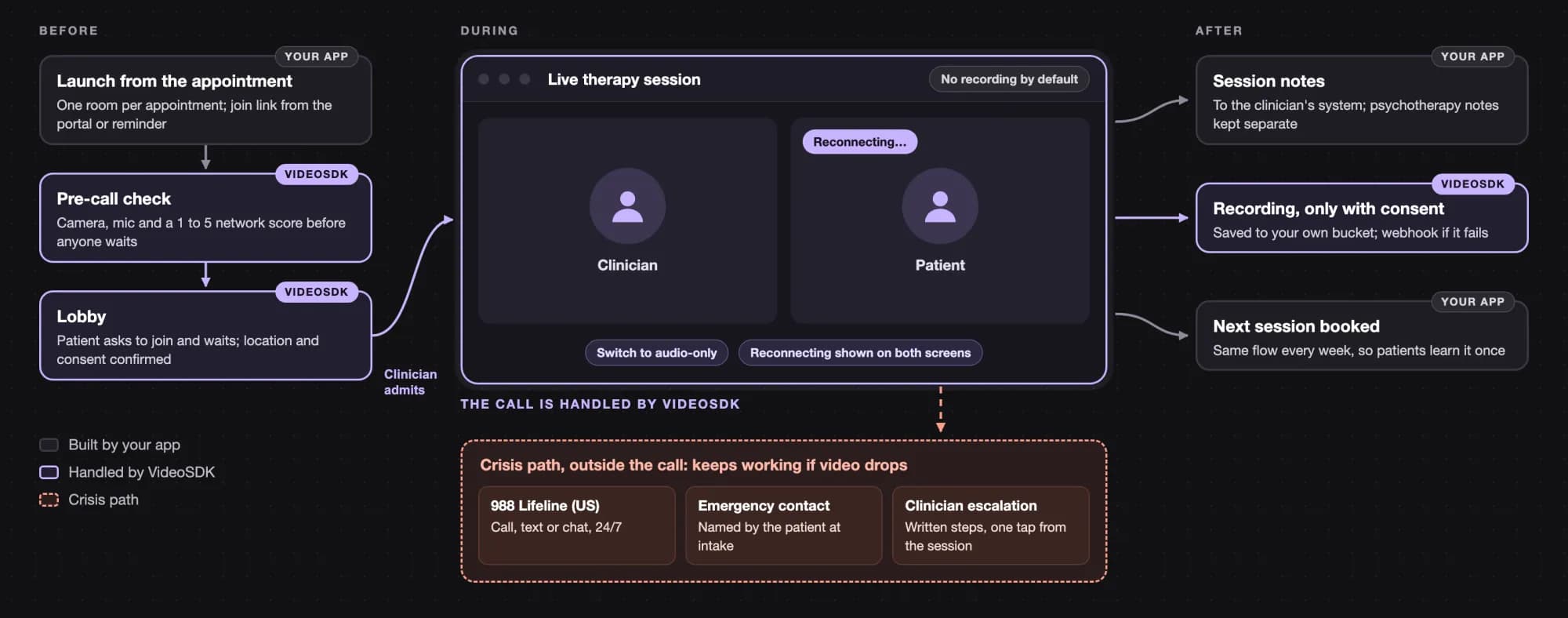
- Launch from the appointment. Your backend creates one room for each appointment and stores the room identifier with it, so the session opens from the patient's portal or reminder link (telehealth use case).
- Check devices before the clinician waits. A pre-call check tests permissions, camera, microphone and speakers, and scores the patient's upload and download network from 1 (bad) to 5 (excellent). Below a 3, suggest audio-only before the session starts.
- Hold the patient in a lobby. In the waiting lobby, the clinician's token lets them join directly and the patient's token asks to join, so nobody enters a session the clinician has not opened.
- Show reconnection on both screens. When a network drops, the meeting connection state moves to reconnecting and the software development kit (SDK) tries to rejoin. Tell both people what is happening, offer audio-only if video keeps dropping, and send both back to scheduling if the call ends.
- Protect privacy in the room. Recording is off unless the clinician turns it on with consent. A short "who can see and hear you" prompt before admission reminds patients to find a private space.
For recurring one-to-one therapy, reuse the same flow for every session, so patients learn it once.
What happens when a patient is in crisis during a call?
A crisis path in a mental health app must work even when the video session does not, because a dropped call can be the moment the patient most needs help. Build it as a separate path from the session.
- One tap to the 988 Suicide and Crisis Lifeline, which takes calls, texts and chats 24 hours a day, plus a clear "call 911 for immediate danger" line.
- Patient location confirmed at the start of every session, so the clinician knows which local emergency service to contact.
- An emergency contact, a family member or friend the patient names at intake, visible to the clinician during the session.
- A written clinician escalation protocol, with who to call and what to document, available from the session screen.
Before launch, run a drill: a test patient signals crisis, then the call drops. Time how long the clinician takes to reach the patient again, and fix whatever slowed them down.
Recording, transcription and AI: what each compliance choice changes
Recording and AI features in a therapy session decide how much protected health information you hold, so treat each as a design choice with consequences. Each option below links to its VideoSDK docs page and reflects how it works as of 18 November 2026.
| If you need | Choose | Plan for |
|---|---|---|
| Media that only the participants can decrypt | End-to-end encryption, with keys your team generates and distributes | Sessions run without recording or transcription; chat and signalling stay protected by Transport Layer Security (TLS) |
| A BAA and HIPAA-aligned processing | Our HIPAA compliance add-on | Composite recording (to your own storage), chat, noise cancellation and Session Initiation Protocol (SIP) calling run in HIPAA mode; for transcription or AI summaries on patient data, talk to our team |
| Recordings only you can open | Recording encryption with your own Rivest-Shamir-Adleman (RSA) key, and storage in your own Amazon Web Services (AWS), Microsoft Azure or Google Cloud Platform (GCP) bucket | Recording encryption and transcription run on separate application programming interface (API) keys |
The decision rule for therapy: default to no recording. Record only when there is a clinical or supervision reason, with separate patient consent and a retention period you set. When recording is on, a failed recording sends a notification to your server, so someone on your team owns the follow-up.
Build or integrate the video layer?
The build-or-integrate decision for the video layer comes down to what your team wants to own, and what your BAA chain has to cover.
| Option | What you own | What the BAA covers | Time to first session |
|---|---|---|---|
| Build on raw Web Real-Time Communication (WebRTC) | Media servers, signalling, recording, scaling, on-call | Only your own cloud vendors | Longest |
| Integrate a video SDK | Your app, workflow and data; the vendor runs media | Your vendor's BAA covers its processing layer | Shorter |
| Buy a finished telehealth product | Little; you adopt its workflow | The product vendor's agreement | Shortest, with least control |
Whichever you choose, test it against the problems therapy platforms report most: failed joins, dropped calls and slow support. Use this checklist:
- Joining and reconnection that work across browsers and mobile devices
- Control over what the patient and the clinician each see
- Diagnostics your engineers can use to find why a session failed
- Support that responds while a session is still failing
- A cost per session you can predict
- Security terms that match your deployment
Name five roles before you start: a clinical advisor, a compliance lead, a mobile engineer, a backend engineer and a quality assurance (QA) engineer. If you want a finished product instead of your own app, contact us and we will point you the right way.
VideoSDK provides real-time video and audio calling SDKs and APIs that you embed in your own web and mobile apps.
For engineers: building the session with VideoSDK
- Tokens and roles. Generate tokens on your server. The clinician's token carries join and moderator permissions; the patient's token asks to join the lobby.
- Failed-call diagnostics. Error codes, transport stats and log levels are documented in the same telehealth use-case guide. Forward them to your own monitoring and keep patient data out of logs.
- Recordings. Send them to your own bucket and subscribe to the recording webhooks.
Our post on building a telehealth video platform covers the architecture layer by layer.
What a live therapy platform costs, and how to estimate one session
Mental health app development cost depends mostly on scope, integrations and compliance work, with video as a smaller, usage-based line. Published agency estimates for a whole app, checked November 2026, run from about $40,000 to over $800,000, and one agency puts ongoing cost of ownership at two to four times the build.
| Cost layer | What drives it |
|---|---|
| Core build (apps, backend, admin) | Number of platforms and user roles |
| Integrations | EHR, payments, insurance, identity |
| Compliance | Security reviews, audits, policies; for HIPAA and General Data Protection Regulation (GDPR) options on our side, talk to our team |
| Video and audio | Session minutes and the video quality each person receives |
| Ongoing | Hosting, storage, support, updates |
To estimate the video line, follow our pricing frequently asked questions (FAQ). Participant-minutes equal the session length multiplied by the number of participants, so a 50-minute one-to-one session is 50 × 2 = 100 participant-minutes. Each participant's rate depends on the total resolution of the video they receive, including any screen share. As of 18 November 2026, high-definition (HD) video is $0.004 per participant-minute and audio-only is $0.001 (audio and video pricing). Model your own mix of video, audio-only and screen shares; at high volume, Enterprise pricing is quoted, so talk to our team for your number.
A roadmap from pilot to scale
A roadmap to develop a mental health app should be judged by its exit gates, not its dates. Typical lengths below come from published agency roadmaps.
| Phase | Typical length | Exit gate |
|---|---|---|
| Discovery | 4 weeks or more | Rules-by-feature worksheet signed off |
| Design and compliance specification | 2 weeks or more, overlapping discovery | Session flow and crisis path approved by clinicians |
| Build the minimum viable product | 2 to 6 months | Join, lobby, reconnect and crisis path pass testing |
| Clinician pilot | Set with your clinical lead | Completed-session rate and crisis drill results reviewed |
| Launch gate | 1 week, or 6 months or more if certification is needed | Security review, consent audit, BAAs signed |
| Scale | Ongoing | Session failure rate tracked every week |
For mental health mobile app development, allow time for Apple and Google to review your app before it appears in the App Store and Google Play, and test on the older phones your patients actually use.
Selling outside the US
Selling a therapy platform outside the US adds buyer checks on top of privacy law. Ask these questions before you enter a market.
| Market | Ask before entering |
|---|---|
| United Kingdom | Will National Health Service (NHS) buyers assess you against the Digital Technology Assessment Criteria (DTAC)? |
| Canada | Which provincial procurement and privacy rules apply to your buyers? |
| European Union (EU) | Where is data hosted, and who signs the data processing agreement under the GDPR? |
On our side, GDPR compliance includes EU hosting and a data processing agreement; System and Organization Controls (SOC) 2 Type II, International Organization for Standardization (ISO) 27001 and geo-fencing are available too. For other needs, talk to our team.
Why live therapy teams build on VideoSDK
Teletherapy platforms have moved their sessions to VideoSDK when reliability or support held them back. Felicity, a mental health and teletherapy platform, reports 70% fewer technical session issues after moving to VideoSDK in 48 hours (Felicity's story). Talk Your Heart Out, an online therapy platform, reached an 88% referral rate after moving from its previous provider (Talk Your Heart Out's story). For the code behind a therapy session, see our guide to building a mental health video consultation app.
Key takeaways
- Decide whether you are building self-help, live therapy or a hybrid, because that choice sets your rules, team and budget.
- Map every feature to the rules it touches, including psychotherapy notes, 42 CFR Part 2 and state licensure.
- Design the session step by step: device check, lobby, admission, reconnection and a crisis path that works without video.
- Default to no recording, and know what each encryption and compliance choice changes before you promise a feature.
- Estimate video cost in participant-minutes and gate each roadmap phase on results, not dates.
Start with one session type and measure how many sessions complete. Sign up for VideoSDK and run an end-to-end test session with sample data, using the $20 credit every new account gets (as of 18 November 2026).
Frequently asked questions
How much does it cost to create a mental health app?
Published agency estimates, checked November 2026, range from about $40,000 for a basic self-help app to over $800,000 for a platform with live therapy, integrations and advanced features. Live therapy adds compliance work and usage-based video cost. Price your own version from the cost layers above, not from a single headline figure.
Can ChatGPT build a mental health app for me?
AI tools and no-code builders can produce a prototype, such as mood tracking screens or a resource library. A live therapy platform still needs licensed clinicians, BAAs, secure session handling, a tested crisis path and security reviews, which a generated prototype does not provide on its own. Use AI to speed up the work, not to replace it.
How long does it take to build a mental health app?
A minimum viable product typically takes two to six months to build, after four or more weeks of discovery, according to published agency roadmaps checked November 2026. Plan a clinician pilot before launch. Certification or FDA clearance, when needed, can add six months or more before release.
Do I need FDA approval for a mental health app?
It depends on what your software claims to do. The FDA separates general wellness apps, low-risk self-management functions it does not actively enforce, and software that treats a condition, such as computerized behavioral therapy for psychiatric disorders, which it oversees. Review your claims with a regulatory specialist before launch.
Should therapy sessions be recorded?
Most therapy platforms keep recording off by default. Record only for a clinical or supervision reason, with separate patient consent, a set retention period and storage you control. Recordings increase the protected health information you hold and the breach risk you carry.