


A Video Interview API lets a hiring product create, run, record, and review remote interviews through programmatic workflows. The right option depends on whether you need one-way screening inside an ATS or a custom live interview room. VideoSDK is the strongest fit for teams building a branded, real-time interview product, while Hireflix, Willo, and myInterview are purpose-built for asynchronous screening.
Most teams pick a video interview API twice. Once quickly, and once eighteen months later, after discovering the first choice owned a layer they needed to control or left them building a layer they never wanted. The expensive mistake is almost never latency or price. It is picking the wrong category.
If candidates need to record answers before a recruiter reviews them, a specialist hiring-workflow API can save a great deal of product work. If candidates, interviewers, observers, and technical-assessment tools need to meet live inside your product, you need a real-time communication layer with controlled access, media events, recording, and a UI you can shape.
This guide separates those two categories, then ranks ten documented options by fit. It is a documentation-led comparison, not a latency benchmark, security certification, or claim that every provider was hands-on tested.
What Is a Video Interview API?
A video interview API is defined as a set of programmatic interfaces for creating, joining, managing, recording, and observing remote interviews. A video interview API works by connecting an application's backend, identity rules, interview workflow, and media or recording service.
The category contains two different products:
- Hiring-workflow APIs manage one-way questions, candidate invitations, recorded answers, recruiter review, and ATS-oriented objects.
- RTC APIs and SDKs manage rooms or channels, participants, audio and video tracks, recording, events, and embeddable live interfaces.
A Video Interview API is not automatically an applicant tracking system. VideoSDK provides rooms, meeting tokens, client SDKs, recordings, transcription APIs, and participant controls for live interviews. Your recruiting product still owns applicant data, scheduling, evaluator feedback, consent records, and retention policy.
How We Evaluated These Video Interview APIs
This is a developer-first fit model, based on public documentation checked on August 24, 2026. It rewards the ability to deliver either a complete async screening workflow or a controlled custom live product. It does not use unverified quality, pricing, privacy, or AI-performance claims.
| Evaluation area | What was assessed |
|---|---|
| Interview-mode fit | Purpose-built async workflow or capable live interview room |
| Workflow and review | Invitations, candidate controls, recordings, transcripts, review events |
| Integration surface | REST or GraphQL APIs, webhooks, tokens, SDKs, and documentation |
| Product ownership | Custom UI, roles, access policies, branding, and backend orchestration |
| Delivery options | Prebuilt UI, browser and mobile delivery, or self-hosting |
Interview-mode fit carries the most weight in the ordering below, because a provider that cannot deliver your interview mode is not a candidate at any price. Product ownership and integration surface come next. Delivery options break ties.
The ranking is deliberately conditional. A provider placed lower overall can still be the better choice for your exact job. If one-way screening inside an ATS is your requirement, start with Hireflix, Willo, or myInterview. If you need a branded live interview across web and mobile, start with VideoSDK, then evaluate the other real-time platforms against your technical constraints.
Top 10 Video Interview APIs in 2026
| Rank | API | Model | Best for | Main trade-off |
|---|---|---|---|---|
| 1 | VideoSDK | Real-time communication API and SDK | Custom live interview products | You build ATS workflows and scorecards |
| 2 | Hireflix | Hiring-workflow API | One-way interviews with ATS integrations | Not a custom live media platform |
| 3 | Willo | Hiring-workflow API | Embedded async video screening | Less control over bespoke live UX |
| 4 | myInterview | Hiring-workflow API | API-led async interview journeys | Live interview infrastructure is not its focus |
| 5 | Daily | Video API | Configurable, web-first live rooms | You build hiring workflows around it |
| 6 | 100ms | Video SDK | Role-based interview rooms and Prebuilt delivery | Recruiting data model remains your responsibility |
| 7 | Zoom Video SDK | Video SDK | Teams already aligned with Zoom's developer platform | Custom UX still needs SDK work |
| 8 | Agora | RTC SDK | Cross-platform real-time media control | Hiring workflows are not included |
| 9 | Whereby Embedded | Embedded video API | Branded browser interview rooms | Best when its supplied room UX suits your flow |
| 10 | Jitsi Meet | Open-source meeting stack | Self-hosting or open-source control | More infrastructure and integration work |
1. VideoSDK
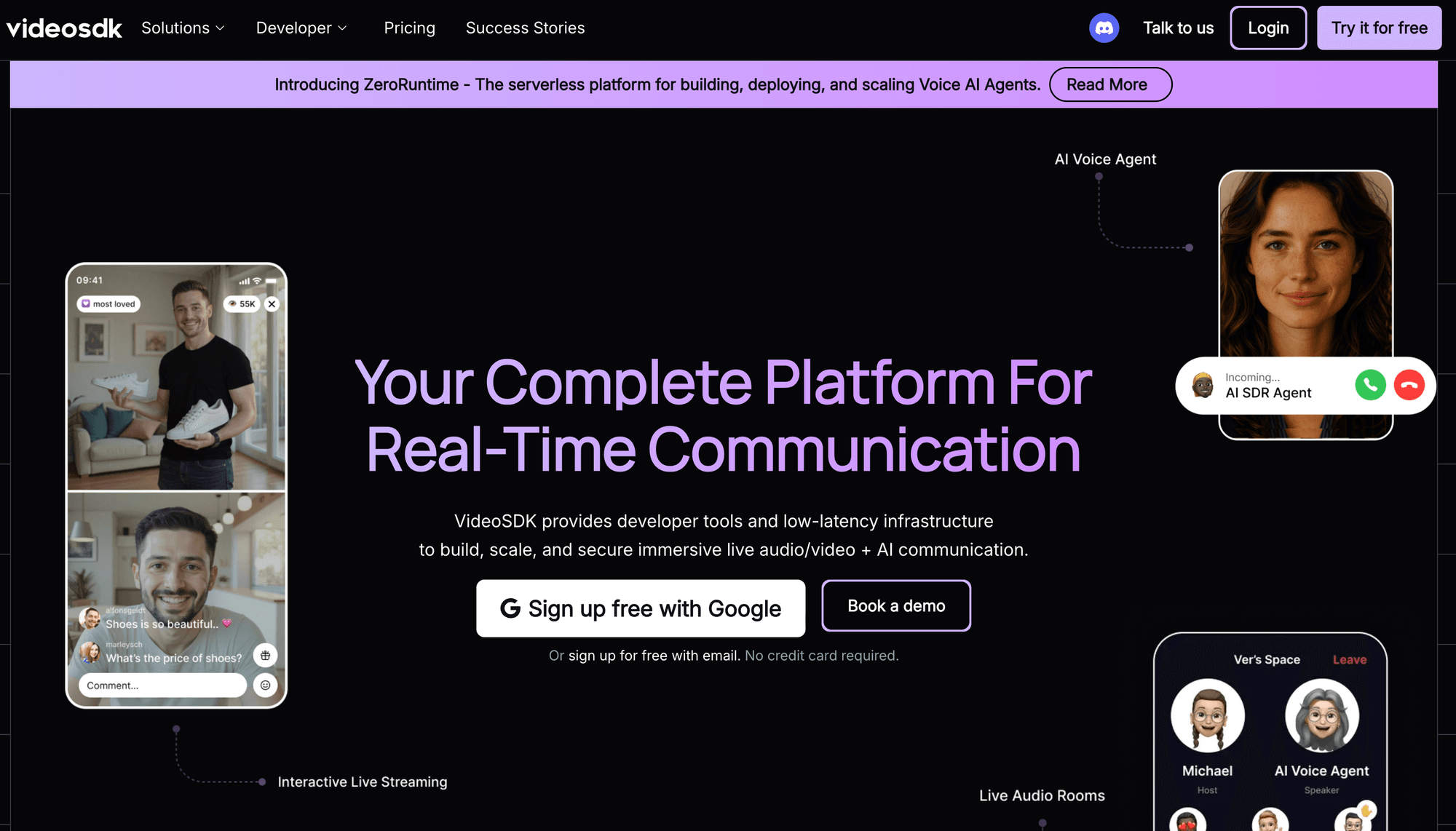
VideoSDK ranks first for teams that want the live interview experience, UI, and application data model to remain their own. Its documentation covers React, JavaScript, React Native, Android, iOS, Flutter, Unity, Python, C++, and IoT paths, alongside room, session, recording, transcription, and webhook APIs.
For an early release, the VideoSDK prebuilt UI can supply a faster interview room. For a product with custom candidate flows, role-specific controls, branded layouts, or technical-assessment widgets, use the full SDK and your own frontend. VideoSDK is not an ATS, so you must implement invitations, calendar rules, scorecards, consent, and recruiting-system write-backs yourself.
Best for: A talent marketplace, technical-interview product, or ATS extension that needs a live, branded experience on web or mobile.
2. Hireflix
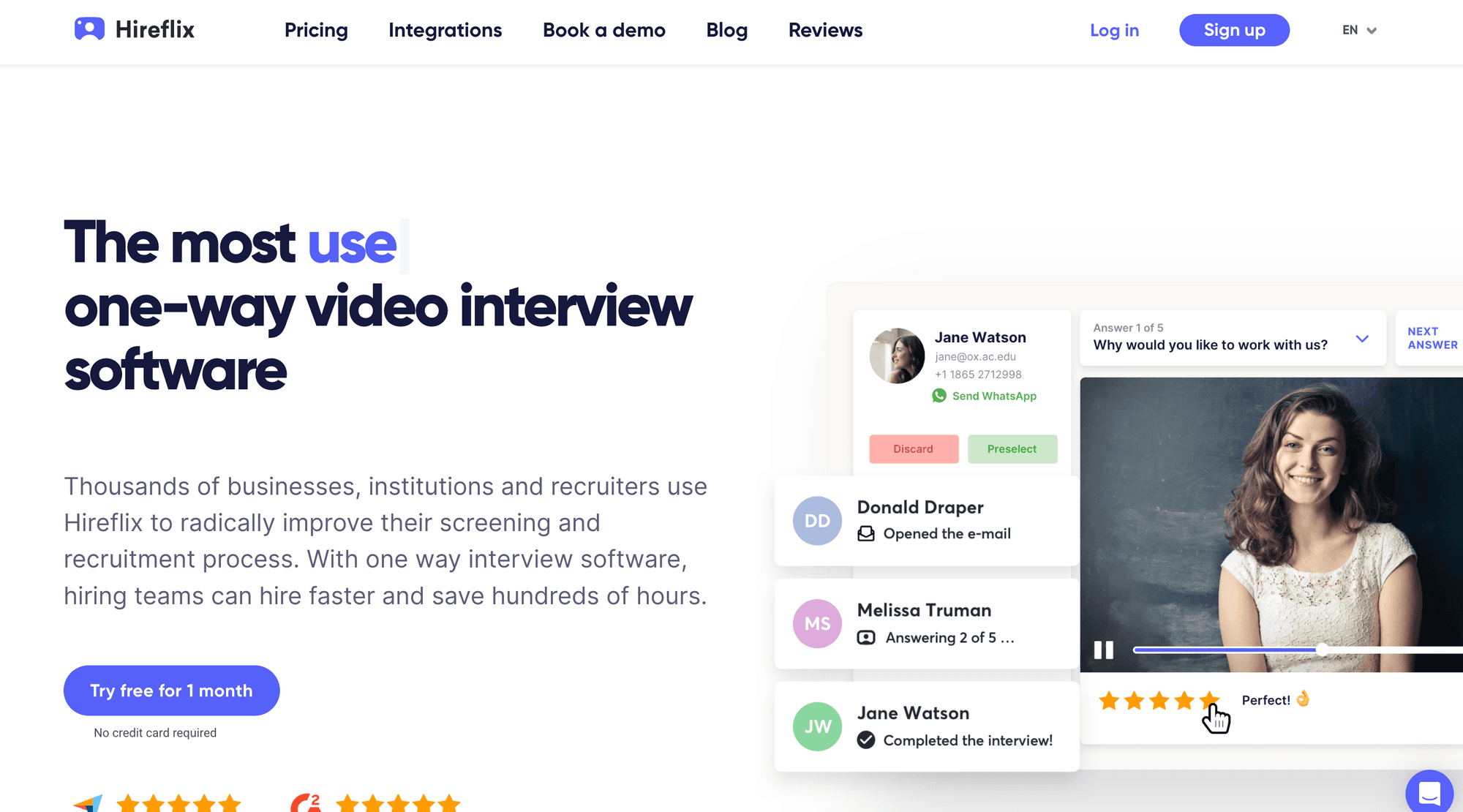
Hireflix is a strong choice when asynchronous, one-way interviewing is the product requirement. Its public documentation describes native ATS integrations, Zapier and Make connections, a GraphQL API, webhooks, candidate invitations, interview data, transcripts, and downloadable answer media. See the Hireflix integration guide.
That is a compelling surface for a recruiting team that wants to automate invitations and collect candidate responses without building the recording workflow from scratch. It is not the right category when you need a deeply custom two-way interview room with your own real-time media controls.
Best for: One-way screening that needs established ATS integrations and custom workflow automation.
3. Willo
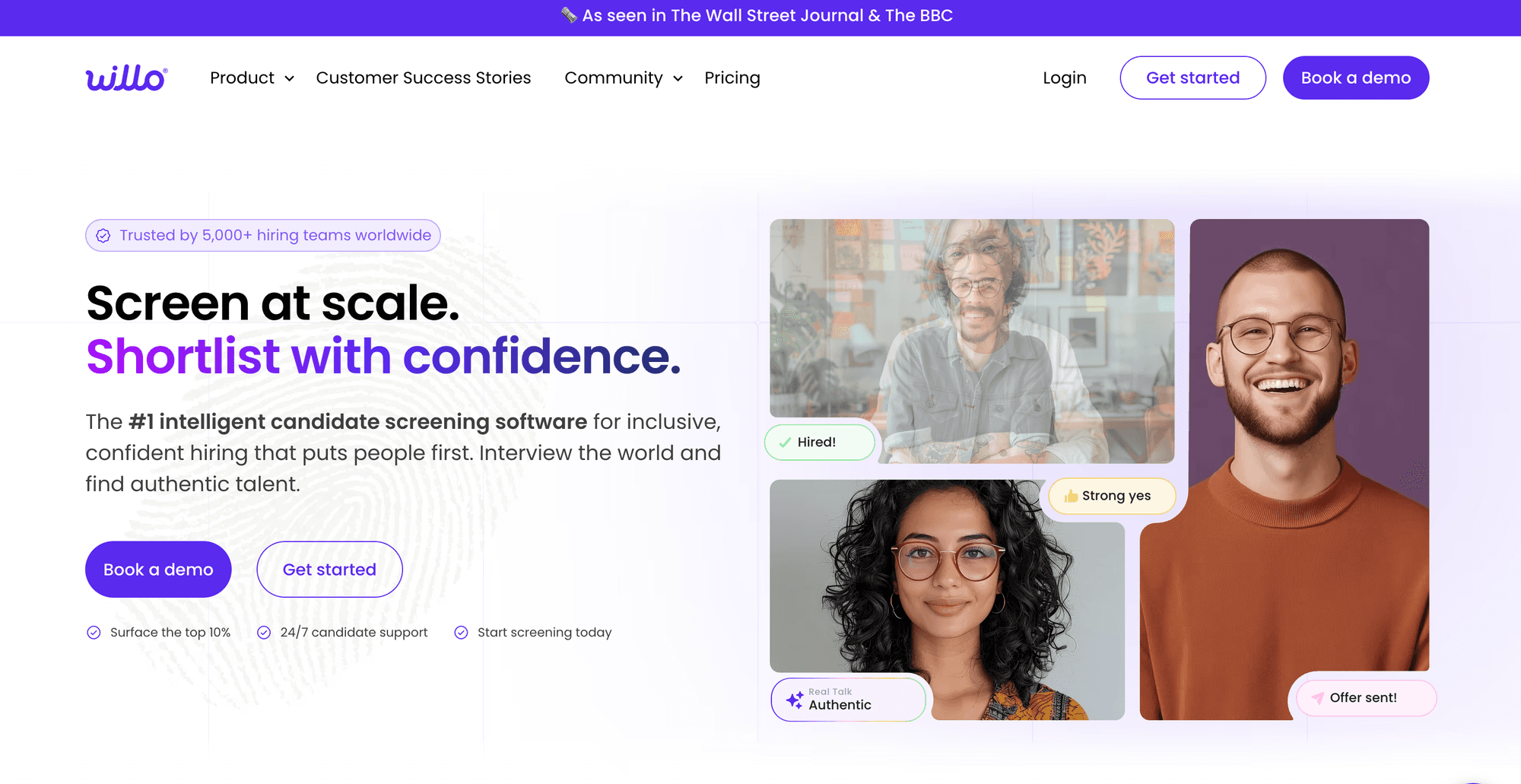
Willo positions its Video Interview API around embedding one-way interviews into job boards, application processes, ATSs, and staffing platforms. Its public materials describe API-key access, OpenAPI documentation, browser-based candidate access, and an asynchronous candidate experience.
Choose Willo when the candidate should answer structured questions on their own time and recruiters need a focused hiring workflow. Validate the operations, retention settings, accessibility needs, data location, and ATS connector you need before committing to the integration.
Best for: An async screening step embedded in an existing hiring product.
4. myInterview
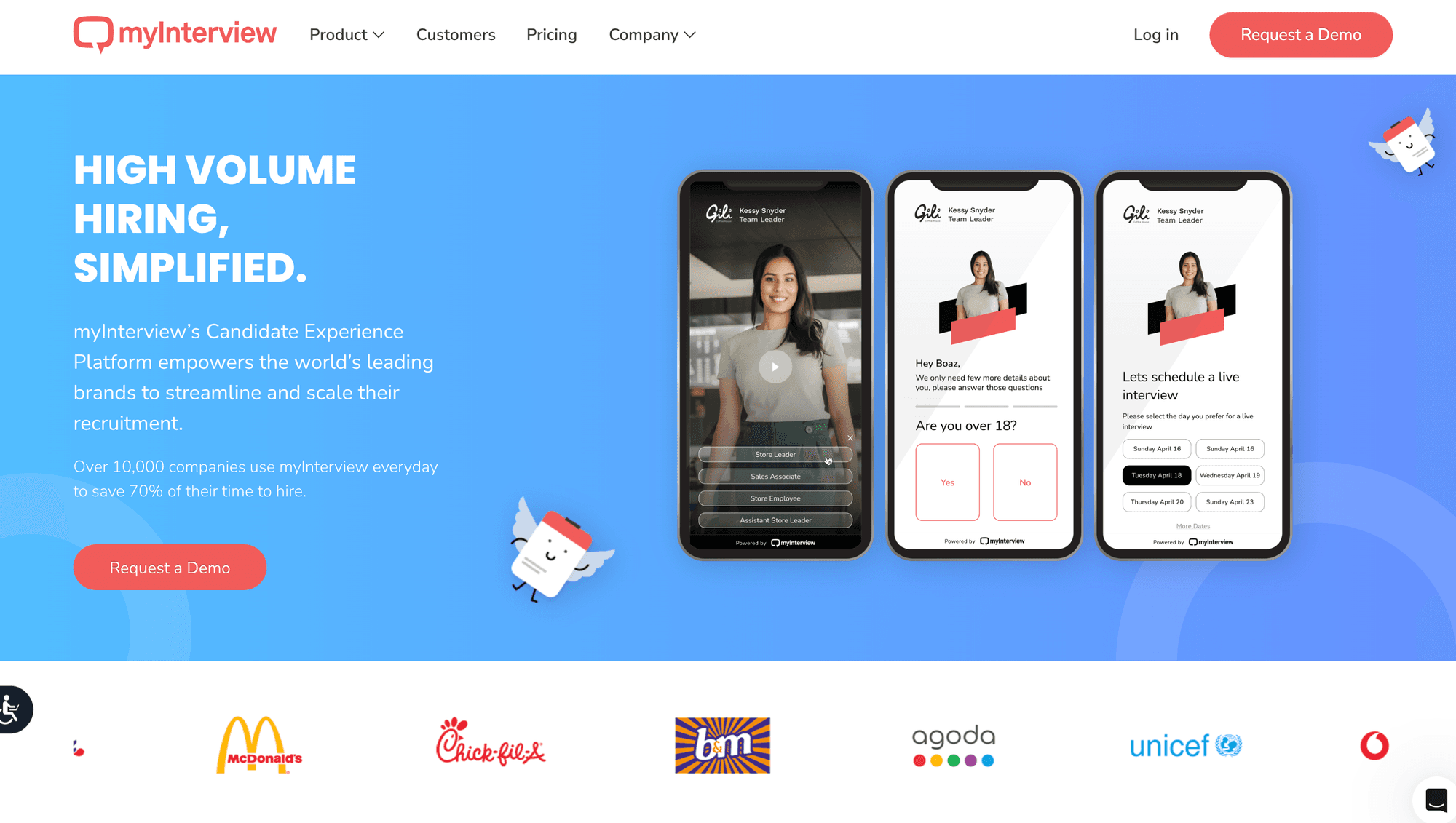
myInterview offers a REST API specifically for one-way video interviews. Its API documentation describes a workflow for creating a job, adding candidates, sending interview links, receiving webhook notifications, and retrieving completed-video analysis. It also documents createJob and createJobWithCandidates flows.
This model fits recruiting systems that need to create and track async interview tasks directly from their own application. It is less relevant when the core requirement is a fully custom live interview room rather than an application-and-review workflow.
If you use its completed-video analysis features, read the AI and law section below before you ship them. Automated analysis of candidate video is the most heavily regulated part of this entire category.
Best for: API-led, one-way candidate journeys with job and candidate objects.
5. Daily
Daily is a live-video option for web products that need room-level configuration. Its Create Room API documents room privacy, expiry, pre-join UI, captions, noise cancellation, screen sharing, chat, recordings, transcription settings, and permissions. Its documentation also exposes recordings, transcripts, and webhooks.
Choose Daily if your team wants a configurable live video layer and plans to build the hiring workflow around it. Candidate records, scheduling, scorecards, and the review experience remain application concerns.
Best for: Web-first products that need detailed room configuration and a documented API surface.
6. 100ms
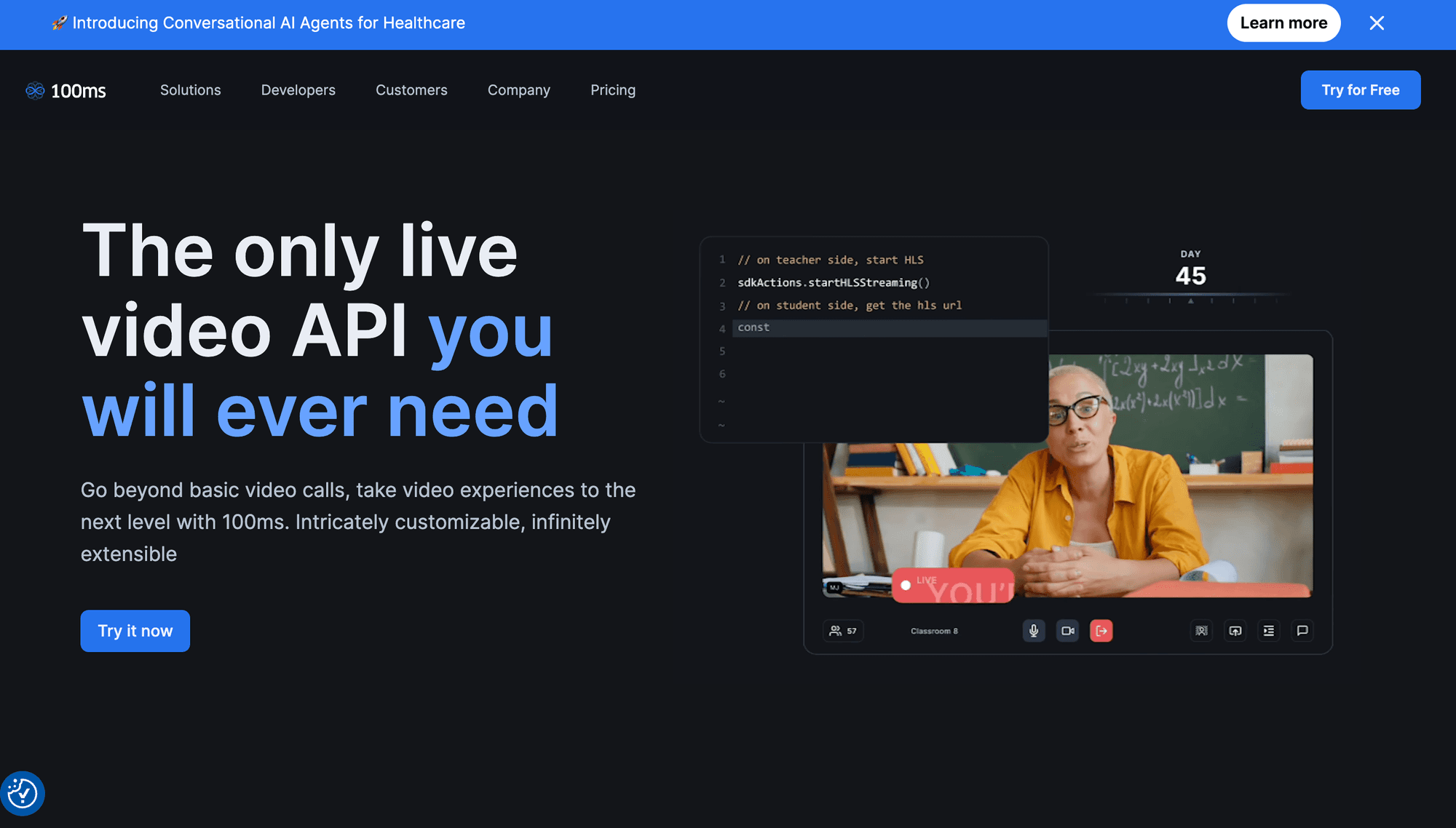
100ms combines real-time SDKs with Prebuilt room delivery. Its Prebuilt quickstart documents role-specific room links and native Prebuilt components for React, iOS, Android, Flutter, and React Native. Its templates can define roles, permissions, recording, livestreaming, and transcription behaviour.
This is useful when candidates, interviewers, observers, and coordinators need different room roles. Build a proof of concept around the exact platform mix you support, because prebuilt feature parity and UI customisation can vary by platform.
Best for: Role-aware live interview rooms with a prebuilt path for web and mobile delivery.
7. Zoom Video SDK
Zoom Video SDK is intended for embedding video sessions into your own application rather than dropping users into a standard Zoom meeting. Its developer documentation and event resources support SDK integration and server-side event handling for session awareness.
It is sensible for organisations already operating in Zoom's developer ecosystem and comfortable implementing their own interview interface. Check the exact SDK support, event coverage, recording requirements, and commercial terms for your target platform.
Best for: Teams that already use Zoom's developer platform and need an embedded session layer.
8. Agora
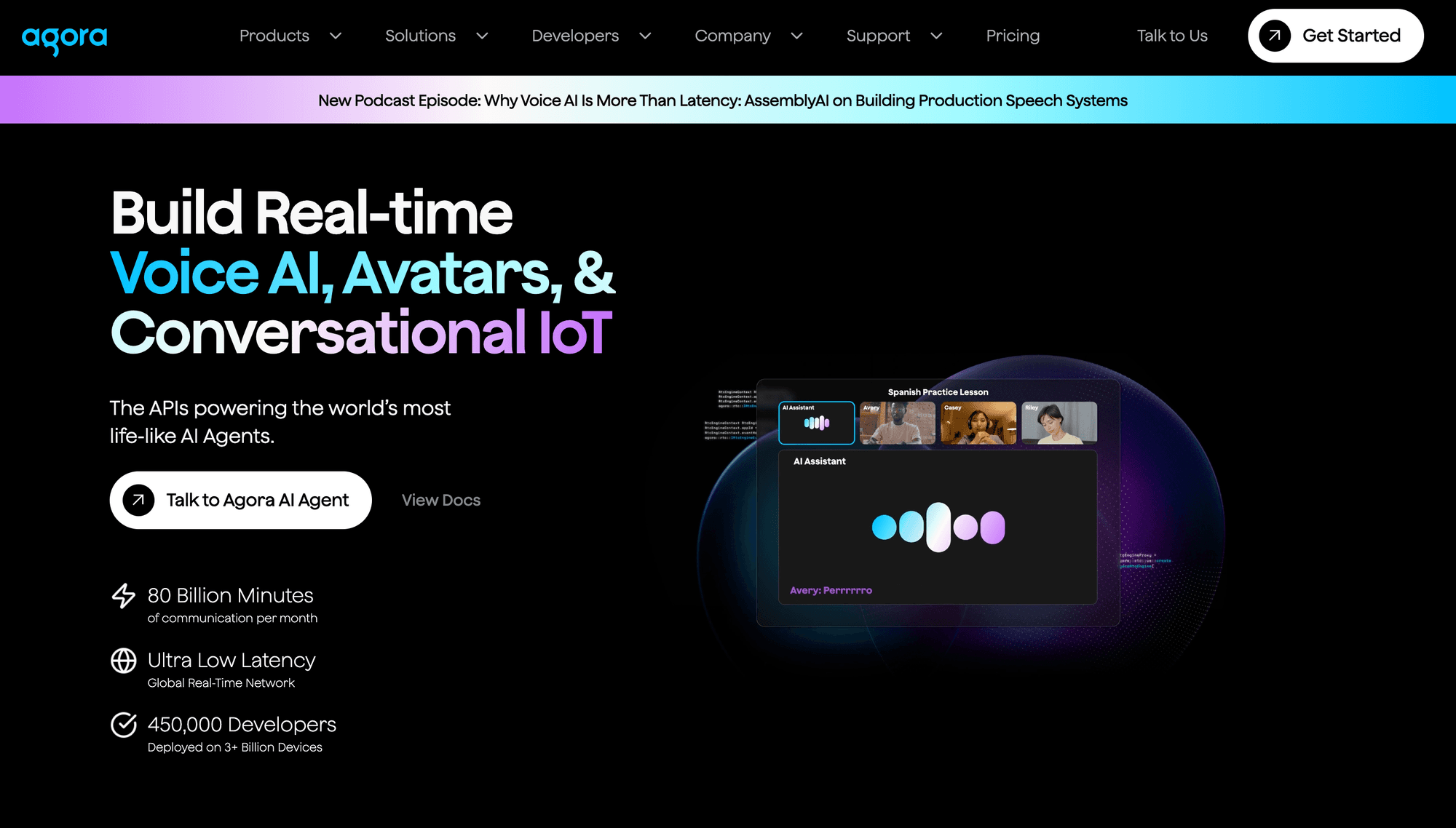
Agora supplies real-time engagement SDKs for video calling. Its video calling quickstart documents the client SDK flow for creating a project, joining a channel, and publishing or subscribing to media. That makes it a viable building block for a bespoke interview product.
Choose Agora when cross-platform media control is the primary engineering concern and your team owns the hiring workflow. It does not replace the ATS, invitation system, scorecard, or post-interview review experience.
Best for: Engineering teams building their own interview UI and workflow on top of an RTC SDK.
9. Whereby Embedded
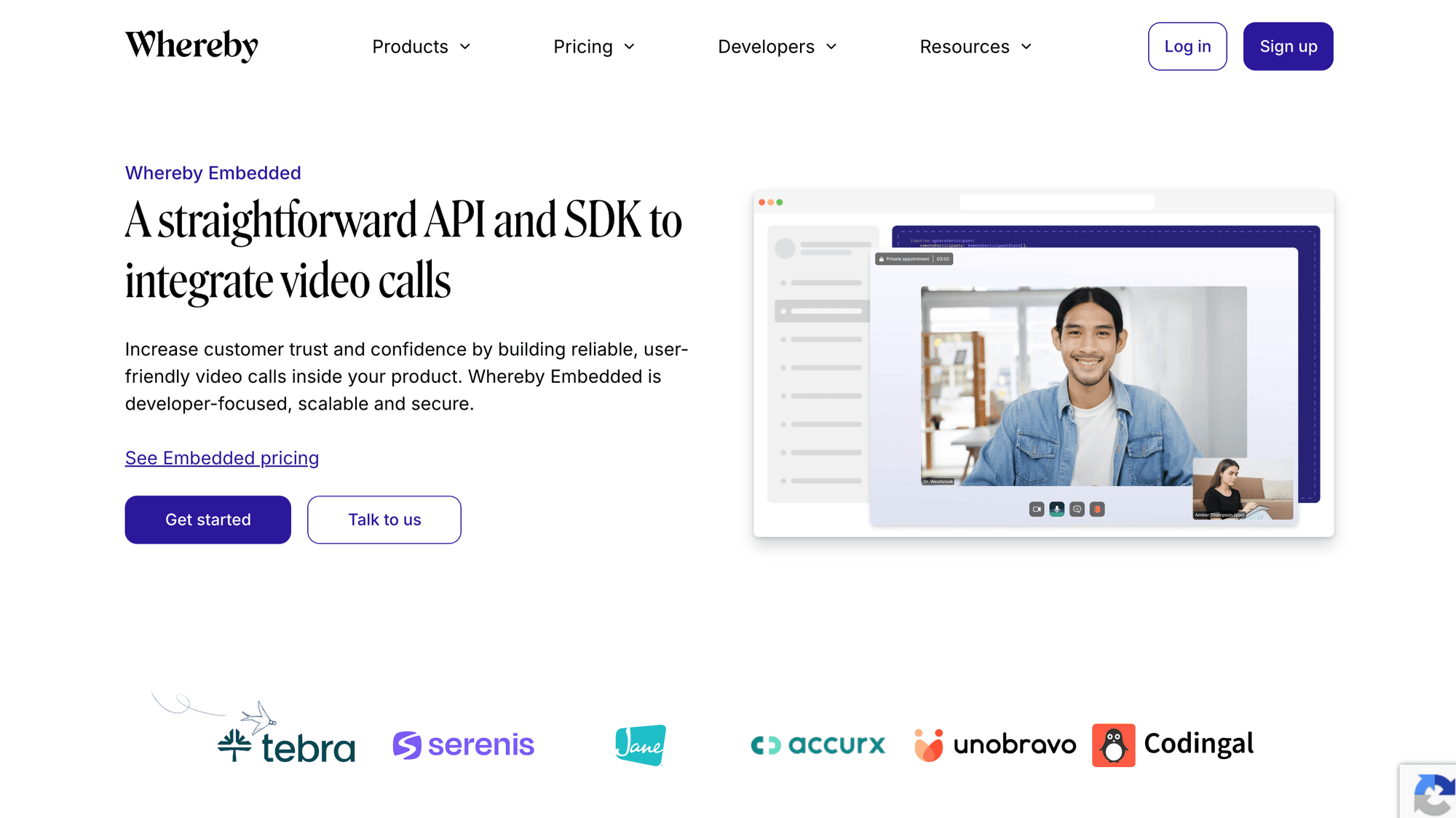
Whereby Embedded is aimed at putting branded browser-based meeting rooms inside another product. It deserves evaluation when you want a faster embedded-room route and the supplied meeting experience is close to the one your candidates and interviewers need.
Whereby is usually a less natural fit for products that need full media-level control or a broad native SDK plan. Review its current developer documentation against your pre-call checks, host controls, recording requirements, and branding rules before selecting it.
Best for: Web products that want an embedded interview room with limited custom media work.
10. Jitsi Meet
Jitsi Meet is an open-source meeting stack with an IFrame API for embedding meetings and a route for self-hosting. It is not ranked tenth because it lacks capability. It ranks here because self-managed interviewing adds operational work that a managed API absorbs.
Choose Jitsi when infrastructure control or open-source ownership outweighs managed-service convenience. Plan for authentication, capacity, observability, upgrades, recording, browser support, and incident response before treating self-hosting as the lower-effort option.
Best for: Teams with the operational capacity to run or deeply customise their own meeting stack.
What a Video Interview API Actually Costs
Price is the question most comparison pages either dodge or get wrong, because the two categories do not bill on the same unit. Compare the shape of the bill before you compare the number.
Hiring-workflow APIs usually bill per seat, per active job, or per completed interview. Cost scales with hiring volume. That is predictable, and it maps cleanly onto a recruiting budget, but it also means a high-volume seasonal hiring push is a linear cost increase with no way to engineer it down.
RTC APIs almost always bill per participant-minute, with separate line items for recording, storage, egress, transcription, and sometimes region. Cost scales with interview duration × number of people in the room, which is a different curve entirely. A four-person panel interview costs roughly four times a one-to-one at the same length. Recording is typically billed on top, and stored recordings accrue.
Three cost traps specific to interviewing:
- Panel size. Interview products tend to add observers, a second interviewer, a hiring manager, a note-taker, and a scribe bot. On per-participant-minute pricing, every silent observer is a paying participant.
- Storage tail. Interview recordings are usually kept for months for compliance or dispute reasons. Storage and egress can quietly exceed the live-media bill within a year of steady volume.
- Transcription. Often priced per minute separately from media, and often the single biggest surprise once you turn on transcripts for every interview rather than for a sample.
Self-hosting an open-source stack such as Jitsi moves the cost from a vendor invoice to your infrastructure and payroll. That trade is real, not a discount: budget for TURN capacity, media server scaling, observability, upgrades, browser-compatibility regressions, and on-call.
VideoSDK Pricing for a Live Interview
VideoSDK's pay-as-you-go rates make the live-media portion of an interview forecastable from participant count, duration, and selected artifacts.
The following rates were verified against the VideoSDK pricing page:
| Video interview component | Pay-as-you-go rate | Billing unit |
|---|---|---|
| HD video, 720p | $0.004 | Per participant-minute |
| Full HD video, 1080p | $0.008 | Per participant-minute |
| HD composite meeting recording | $0.015 | Per recorded minute |
| Full HD composite meeting recording | $0.030 | Per recorded minute |
| Participant video recording | $0.006 | Per participant-minute recorded |
| Separate participant video track | $0.001 | Per track-minute |
| Real-time transcription | $0.020 | Per transcription minute |
| Post-call transcription | $0.004 | Per transcription minute |
| Video storage | $0.003 | Per stored video minute per month |
VideoSDK also provides $20 in credit to a new account. The pay-as-you-go plan is prepaid, has no minimum usage commitment, and lists volume pricing and custom terms for enterprise workloads.
For a 45-minute HD interview with one candidate and two interviewers, a composite recording, post-call transcription, and one month of storage, the estimated VideoSDK usage is:
HD media:          3 participants × 45 min × $0.004 = $0.540
HD recording:      45 min × $0.015                   = $0.675
Post-call text:    45 min × $0.004                   = $0.180
One-month storage: 45 min × $0.003                   = $0.135
                                                      -------
Estimated total:                                      $1.530
Using real-time transcription instead of post-call transcription changes the transcription line from $0.18 to $0.90, producing an estimated total of $2.25. This example excludes taxes, premium support, compliance add-ons, extra concurrency packs, and application-level engineering costs.
How to Choose a Video Interview API
The best Video Interview API is the one that matches your interview mode and ownership boundary. Pick the category before you compare feature pages.
Choose async or live first. Use Hireflix, Willo, or myInterview for one-way candidate responses. Use VideoSDK, Daily, 100ms, Zoom, Agora, Whereby, or Jitsi when candidates and interviewers must meet live inside your product.
Write down the workflow you must own. Include scheduling, invite delivery, candidate identity, waiting-room rules, evaluator roles, scorecards, consent, recordings, retention, and ATS write-back.
Test the pre-call journey. Run a realistic candidate test on your target browsers and devices. Check camera and microphone permissions, device switching, network recovery, captions, join instructions, and the no-show path.
Trace every recording and transcript. Decide who can start, access, download, delete, and retain them. A provider's storage feature does not define your business retention policy.
Prototype the access model. Generate room credentials only after your backend verifies the candidate or interviewer, their role, their invitation, and the access window.
Interview-Specific Capabilities to Test
Interview products need role, assessment, review, and candidate-experience checks that generic video API comparisons often miss.
| Area | Acceptance question | Why it matters |
|---|---|---|
| Observer roles | Can an observer join without publishing media, and can visibility be configured? | Panels should not create avoidable candidate pressure |
| Waiting flow | Can candidates wait until an interviewer admits them and recover after refresh? | Join failures become support incidents and no-shows |
| Role permissions | Can recording, screen share, removal, and moderation differ by role? | Candidates, interviewers, and coordinators need different powers |
| Assessment surface | Can the product place a code editor, whiteboard, or artifact beside the room? | Technical interviews need more than a generic call UI |
| Recording format | Are composite, participant, or track-level outputs available? | Review, redaction, and speaker attribution depend on the artifact |
| Event coverage | Are join, leave, recording, transcript, and session-end events documented? | Reliable workflow automation needs server-side evidence |
| Mobile delivery | Does the interview work on target mobile browsers without an app? | Hourly and field candidates may not have a laptop |
| Network recovery | What happens after a mid-answer drop or accidental refresh? | Recovery behavior directly affects fairness and completion rate |
| Accessibility | Are controls keyboard reachable, labeled, captioned, and screen-reader tested? | The interview interface is part of the hiring process |
| Data lifecycle | Can you locate and delete every copy of video, transcript, and derived score? | Retention and deletion are product requirements |
Require documentation or a reproducible test for every answer. A marketing checkbox is not enough for a hiring-critical workflow.
AI Interview Features and Legal Boundaries
AI analysis changes the risk profile of a Video Interview API because hiring decisions are regulated differently from media transport.
Separate these features during architecture and procurement:
- Recording and transcription
- Summary or note drafting for a human reviewer
- Candidate scoring or ranking
- Automated selection or rejection
- Emotion, affect, confidence, or personality inference from face or voice
The EU AI Act prohibits emotion inference in workplace settings, including recruitment, except for narrow medical or safety uses. It also lists AI used to evaluate candidates as high-risk. The 2026 AI Omnibus timeline moves the application of Annex III high-risk rules to December 2, 2027, but it does not remove the classification.
The Illinois Artificial Intelligence Video Interview Act requires notice, an explanation, and consent before AI analyzes an applicant-submitted video. It also requires deletion within 30 days of an applicant request and instructing other recipients to delete their copies.
NYC Local Law 144 guidance requires a recent bias audit, public information about the audit, and candidate notices when an automated employment decision tool falls within the law. Colorado's automated decision-making rulemaking page reflects a revised law scheduled for January 1, 2027, so older summaries of SB 24-205 should not be reused without checking the current text.
These rules should become engineering requirements: consent records, model and prompt versioning, human review, audit logs, deletion propagation, accommodation paths, and a non-automated alternative where required. This section is a product checklist, not legal advice. Confirm obligations with counsel for every jurisdiction in which candidates are located.
Production and Accessibility Checklist
A production interview room succeeds only when access, media, evidence, and candidate accommodations work as one system.
- Issue short-lived, server-generated credentials rather than permanent shared room links.
- Explain recording and transcription before capture, then store the consent outcome.
- Provide a pre-call camera, microphone, speaker, and network test.
- Preserve a recovery path for weak connections and accidental refreshes.
- Verify webhook signatures and make event processing idempotent.
- Restrict recordings and transcripts to authorized reviewer roles.
- Define retention and deletion for video, transcripts, notes, and derived scores.
- Provide captions and keyboard-accessible controls with meaningful accessible names.
- Test screen-reader behavior and focus order on the actual embedded experience.
- Offer an accommodation route and an alternative interview format that reaches a human.
- Test a mid-range Android device on a mobile network, not only a laptop on office broadband.
The W3C WebRTC Recommendation defines browser APIs for real-time media. It does not define your invitation policy, consent model, evaluation process, or retention schedule.
Definitions Glossary
Video Interview API: An interface that lets a product create, operate, or review remote interviews, either asynchronously or in real time.
Room: A VideoSDK meeting space, identified by a room ID, where participants join and exchange media streams.
Meeting token: A server-generated JWT that authenticates permitted access to a VideoSDK room.
One-way interview: An asynchronous interview where a candidate records responses to prepared questions for later review.
Pre-call check: A candidate-facing test of the camera, microphone, device selection, and connection before joining.
Participant-minute: The common RTC billing unit one participant present for one minute. Panel interviews multiply this.
AEDT: Automated Employment Decision Tool, the defined term in NYC Local Law 144 for tools that score or classify candidates.
Per-participant recording track: A recording that stores each participant's media separately rather than as one composited file, which simplifies review, redaction, and speaker attribution.
Key Takeaways
- Video Interview APIs split into hiring-workflow products for asynchronous screening and RTC platforms for custom live interviews.
- VideoSDK is the strongest fit when you need a branded live interview experience across web and mobile, but your product must own the recruiting workflow.
- Hireflix, Willo, and myInterview are better starting points for one-way screening, candidate invitations, and recruitment-system integration.
- The two categories bill on different units. Async pricing tracks hiring volume; RTC pricing tracks interview length multiplied by room size, plus recording, storage, and transcription.
- AI features carry the heaviest constraints in this category. Emotion inference from candidate video or audio is prohibited in the EU; scoring candidates triggers audit, notice, and impact-assessment duties in several jurisdictions.
- Access tokens, recording consent, transcripts, retention, and review rights should be designed as one system.
- A proof of concept using real candidate devices is more valuable than selecting an API from a feature checklist alone.
Conclusion
The strongest Video Interview API is not the provider with the longest feature list. It is the provider that matches your interview mode and the product layer you want to own. Choose a specialist workflow API for fast one-way screening. Choose VideoSDK when you need to build a live, branded interview product around your own candidate and evaluation workflows.
Start with the VideoSDK React quickstart or Prebuilt UI quickstart, then validate the candidate journey before you scale it.
Frequently Asked Questions
What is the best Video Interview API for a custom live product?
For a custom live product, VideoSDK is a strong fit when you need to own the UI, room rules, participant controls, and application data. Its SDKs, Prebuilt UI option, and REST APIs provide the real-time layer, while your product connects interviews to its own scheduling, candidate, and evaluation workflows.
Can a Video Interview API support asynchronous interviews?
Yes. A Video Interview API supports asynchronous interviews when it includes candidate recording, invitations, and reviewer workflows. Hireflix, Willo, and myInterview are designed around one-way video interviews, while VideoSDK is better suited to a custom live experience or an async workflow you build yourself.
Does VideoSDK include an ATS or interview scorecard?
No. VideoSDK provides real-time communication infrastructure, so your application owns applicant records, scheduling, scorecards, hiring permissions, and workflow integrations. This separation is useful when those elements must match an existing ATS or a proprietary hiring process.
How should a Video Interview API secure candidate access?
Secure candidate access with server-generated, time-limited credentials and backend checks for the invitation, role, room, expiry, and attempt limit. VideoSDK documents JWT-based tokens that can include room and participant restrictions, keeping the secret key out of client-side code.
How much does a Video Interview API cost?
Hiring-workflow APIs typically bill per seat, per job, or per completed interview, so cost tracks hiring volume. RTC APIs typically bill per participant-minute, with recording, storage, egress, and transcription as separate lines, so cost tracks interview length multiplied by the number of people in the room. Model your peak month with panels and recording enabled rather than an average, and confirm current rates on each provider's pricing page.
Can I use one API for both live and asynchronous interviews?
Yes, with a caveat about who builds what. An RTC API like VideoSDK can record a candidate answering prepared questions with no interviewer present, but you build the question sequencing, retake rules, timers, and reviewer experience yourself. A hiring-workflow API ships that flow but will not give you a custom live room. Teams needing both at production quality usually run one of each rather than forcing a single vendor to cover both.
Is AI analysis of video interviews legal?
It depends on what the AI does and where the candidate is. Inferring emotion from a candidate's face or voice is prohibited outright in the EU under the AI Act's Article 5. AI that scores or ranks candidates is treated as high-risk under the EU AI Act and triggers notice, audit, or impact-assessment duties under NYC Local Law 144, Illinois HB 3773 and the Illinois AI Video Interview Act, and Colorado's AI framework. Transcription and summarisation for a human reviewer carry substantially lighter obligations. Confirm current requirements with counsel for your candidates' jurisdictions.
How many people can join a live interview room?
Enough for any realistic panel on every provider listed here, so capacity is rarely the deciding factor. The questions that matter more are whether observers can join without appearing to the candidate, whether roles can carry different permissions, and how per-participant billing treats a silent fifth attendee.
Does a Video Interview API work on mobile browsers without an app?
Usually yes for web-based rooms, but support varies by browser, OS version, and feature screen share and virtual backgrounds are the common gaps. If you hire for hourly, field, or high-volume roles, treat mobile browser support as a hard requirement and test it on a mid-range Android device on a mobile network before you shortlist.
What should teams compare besides price?
Compare interview mode, client platforms, pre-call experience, access model, role control, recording and transcription options, webhook coverage, data paths, retention, ATS integrations, and operating model. Check current pricing separately because media, storage, transcription, and support costs can change independently.