
The best voice call APIs in 2026 include VideoSDK, Twilio, Agora, Sendbird, Plivo, Sinch, EnableX, Vonage, and MessageBird. VideoSDK ranks first for developer teams needing fast WebRTC voice SDK integration with sub-second latency across web and mobile. Select based on latency, PSTN support, participant limits, and total cost including recording and transcription.
A dropped support call during a billing dispute costs you a customer. A gaming voice channel that lags behind gameplay breaks immersion. Your team needs embedded voice calling, but building WebRTC audio infrastructure from scratch consumes months of engineering time on codec negotiation, TURN relays, echo cancellation, and cross-platform SDK maintenance. This article defines what voice call APIs are, provides a step-by-step evaluation framework, compares the ten leading platforms with VideoSDK listed first, and covers hidden costs, production pitfalls, and scenarios where a managed API is not the right fit.
What Is a Voice Call API?
A voice call API is defined as a programmatic interface that lets developers embed real-time, bidirectional audio communication into web, mobile, and desktop applications without building VoIP infrastructure from scratch.
A voice call API works by exposing REST endpoints and client SDK methods for session creation, participant management, audio stream routing, recording, and analytics while the vendor operates signaling servers, STUN/TURN relays, and media routing clusters globally. Your application calls createMeeting() or equivalent methods; the platform handles encrypted audio transport, bandwidth adaptation, noise suppression, and session state.
Voice call APIs differ from raw in scope. WebRTC is a browser protocol for peer-to-peer media. A voice call API is a managed Communications Platform as a Service (CPaaS) layer that wraps WebRTC (or proprietary protocols) with multi-platform SDKs, PSTN bridging, compliance controls, and operational tooling. You integrate the SDK; the vendor maintains uptime, scaling, and protocol updates.
According to Grand View Research, the global mobile VoIP market size was valued at USD 44.99 billion in 2023 and is projected to grow at a CAGR of 12.9% from 2024 to 2030. That growth tracks with the shift from custom SIP stacks toward API-first platforms that let product teams ship voice features in weeks instead of quarters.
What Should You Look for in a Voice Call API?
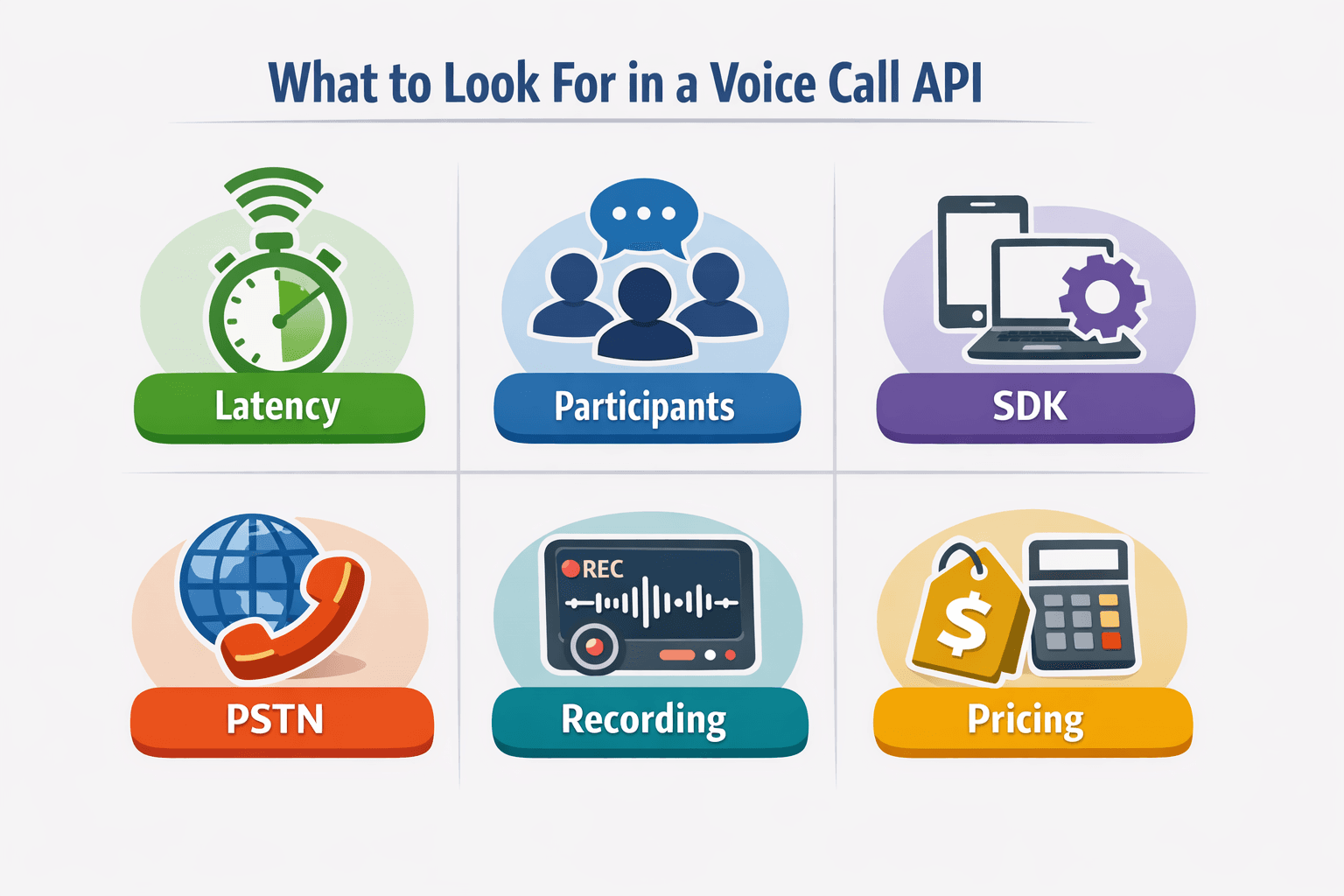
A voice call API must match your latency target, audio quality profile, SDK platform coverage, and PSTN requirements before per-minute price becomes the deciding factor.
Latency and audio quality. Interactive gaming, telehealth consultations, and customer support calls need sub-300ms mouth-to-ear delay. Verify whether the provider routes audio through WebRTC SFUs, Opus codec optimization, and geographic edge nodes close to your users.
Participant limits and room models. Some APIs cap active speakers at 25 participants while others scale to thousands with role-based publishing. Document your peak concurrent users per room and total concurrent sessions before comparing vendors.
SDK breadth. If your product ships on iOS, Android, React Native, Flutter, and web simultaneously, confirm unified SDK coverage. VideoSDK provides client libraries across all five platforms with optional pre-built UI kits, reducing the integration surface compared to stitching separate audio and PSTN vendors.
PSTN and SIP support. If your application bridges in-app voice to traditional phone numbers, confirm programmatic PSTN termination, SIP trunking, and per-minute carrier rates. Not every WebRTC-first API includes carrier connectivity.
Recording and compliance. Regulated industries need server-side recording, encrypted storage, audit trails, and HIPAA Business Associate Agreements. Confirm whether recording is a first-class API or a bolt-on with separate billing.
Pricing transparency. Per-participant-minute billing is standard, but PSTN termination, transcription, storage fees, and support tiers inflate bills beyond headline rates. Model total monthly cost at projected scale, not demo-day usage.
In practice, engineering teams that evaluate voice call APIs on price alone without testing under throttled mobile networks report rework cycles averaging three to six weeks when production conditions expose SDK gaps.

Key Features to Look for in an Audio Call API
Voice calling APIs serve as the essential bridges that empower companies to seamlessly incorporate voice call functionality into their applications, facilitating connectivity and enabling business transactions to thrive.
In a sea of voice conferencing system APIs available in the market, it's imperative to navigate based on specific criteria to pinpoint the optimal voice API for your needs.
Let's delve into four crucial criteria that should guide your selection process:
- Variety in API Features: Seek out an API that boasts a diverse range of features, enhancing the capabilities and distinctiveness of your application.
- Popularity and Market Demand: Gauge the popularity and demand for the API in the market. This assessment helps you gauge the API's value and relevance in the broader landscape.
- Cost and Investment: The financial aspect plays a pivotal role in any development endeavor. It's essential to thoroughly evaluate the pricing and investment required for the chosen APIs, as it significantly shapes your development journey.
- Compatibility and Ease of Integration: Prioritize APIs that align seamlessly with your existing infrastructure. Ensuring compatibility and ease of integration into your pre-existing or ongoing projects is paramount.
Discover the top 10 voice call APIs to revolutionize your VoIP and programmable voice apps. These APIs empower developers to build advanced communication solutions with ease, from call routing to real-time analytics. Enhance your app's capabilities with industry-leading APIs for an unparalleled user experience
Top 10 Audio Call APIs & SDKs in 2026
The 10 best voice-calling APIs and SDKs are Video SDK, Twilio, MirrorFly, Agora, Sendbird, Plivo, Sinch, EnableX, Vonage, and MessageBird.
1. VideoSDK: A Synthesis of Speed and Flexibility
Step into the realm of VideoSDK, an extraordinary integration solution that has garnered a reputation for its remarkable speed in seamlessly infusing audio calling capabilities into applications, all accomplished within an astonishing 10-minute span. This platform represents a paradigm shift in efficiency, offering a harmonious blend that caters to the needs of both end-users and developers alike.
A standout feature of Video SDK is its inherent versatility, a quality that resonates through its cross-platform compatibility. It effortlessly spans an impressive array of programming languages and frameworks, encompassing the likes of JavaScript, React JS, React Native, Android, Flutter, and iOS.
Features offered by VideoSDK
- High availability with zero maintenance
- Unlimited parallel room in real-time
- Support up to 300 attendees, including 50 presenters
- Global Infrastructure for every use case.
- 100% Fully customizable UI
- Accelerate your time-to-market with our code samples
- Customize template layouts, in any orientation
- PubSub feature to build engaging features.
Schedule a Demo with Our Live Video Expert!
Discover how VideoSDK can help you build a cutting-edge real-time video app.
2. Twilio: Enhancing Phone Services with Programmable Voice API
- Twilio is a widely known programmable voice API that aims to enhance phone services by enabling users to engage in phone calls and manage text messaging.
- While it aspires to facilitate personalized interactions and engage users on a broad scale, there are certain considerations worth noting.
- The REST API does offer voice chat capabilities, yet its implementation for routine purposes might be accompanied by certain limitations.
- Additionally, while it provides access to carrier networks and tools to address communication challenges, there could be certain complexities associated with solving these issues.
See how Twilio compares with its competitors
3. MirrorFly: White-Label Voice API for Unlimited Communication
- There's no need for different SIP and voice call APIs for each feature MirrorFly covers everything with its single platform. As a leading voice and video API provider, MirrorFly offers a customized self-hosted solution that covers everything without any limitations. From unlimited audio conferencing to WebRTC video capabilities, this API platform provides complete flexibility to developers.
- MirrorFly voice SDK platform is best for its global infrastructure and flexible hosting options. Users can choose between on-cloud/on-premise hosting and deployment on their own servers.
- Our key features include Unlimited one-on-one and group calls, 100% customizable voice API, SIP/VoIP calls, and more.
4. Agora: Real-Time Voice Calls with Cross-Platform Support
- Although Agora's voice call API offers real-time voice interactions and the convenience of cross-platform support, some users have reported occasional connectivity issues and a learning curve when integrating the API into their applications.
- It's important to thoroughly test the API within your specific use case to ensure its performance meets your expectations and requirements.
See how Agora compares with its competitors
5. Sendbird: Proven Infrastructure with Integration Challenges
- While SendBird offers a proven managed infrastructure for voice communication, some users have reported occasional challenges with the integration process and a learning curve when using the APIs.
- Additionally, the pricing structure might not be the most budget-friendly option for smaller businesses or startups.
- It's recommended to thoroughly assess your project's requirements and budget before committing to SendBird's voice API.
6. Plivo: Comprehensive Voice and Text Integration
- While Plivo does provide a wide range of carrier network connections and the ability to embed voice calling and text messaging into apps, some users have encountered challenges in terms of the complexity of the API documentation and integration process.
- Additionally, there have been reports of occasional latency issues during voice calls.
- It's important to carefully review the documentation and consider the potential learning curve before opting for Plivo's voice-calling APIs.
7. Sinch: Communication APIs with Quality Concerns
- While Sinch does offer a range of communication APIs, including voice calls, some users have expressed concerns about the quality and reliability of the voice calls when using their APIs.
- Reports of call drops and audio quality issues have been noted in certain cases.
- It's important to thoroughly test Sinch's voice APIs for your specific use case to ensure that the call quality meets your standards and that there are no unexpected interruptions during critical communication moments.
8. EnableX: Rich Voice Calls with User Experience
- While EnableX does offer a range of voice calling features through its APIs, some users have reported challenges with the overall user experience and the quality of voice calls.
- Delays in call setup, audio disruptions, and occasional call drops have been reported by certain users, impacting the seamless communication experience that is essential for audio-calling applications.
- It's recommended to thoroughly evaluate EnableX's voice calling capabilities and conduct extensive testing to ensure that the platform meets your performance and reliability expectations.
9. Vonage
- While Vonage's voice chat API does bring innovative features to the table, some users have reported challenges with the integration and customization process.
- The flexibility touted by the API might come with a learning curve, and developers might find themselves needing to invest additional time to fully adapt the API to their specific business needs.
- Furthermore, the voice control and voice bot features, while promising, may require careful implementation and tuning to achieve the desired level of performance and user satisfaction.
- It's advised to thoroughly assess the API's documentation and support resources to ensure smooth integration and optimal utilization of its advanced voice features.
See how Vonage compares with its competitors
10. Messagebird
- While MessageBird offers a range of communication channels and features, some users have highlighted certain limitations in the voice API's performance and reliability.
- Reports suggest that occasional call drops or delays might occur, which could impact the quality of real-time voice communication.
- Additionally, the pricing structure for MessageBird's voice API might not be the most cost-effective solution for businesses with high call volumes, as the costs can escalate with increased usage.
- Prospective users should carefully evaluate the API's performance and pricing against their specific requirements to determine whether it aligns well with their communication needs.
Elevate Your Audio Calling App with the Ideal Audio Calling API Integration Today
Embracing the power of voice communication, numerous platforms have emerged, catering to the global demand for interactive conversations. This comprehensive article dives into the realm of voice chat APIs, presenting an array of 10 prominent options that expedite the creation of voice call applications with efficiency and minimal resources.
Among these, VideoSDK's voice-call API stands as a standout recommendation, celebrated for its exceptional attributes and robust support. Notably, Video SDK's offering boasts the remarkable capability of ultra-low latency, empowering developers to craft applications that seamlessly accommodate up to 10,000 users per audio call.
Conclusion
The best voice call APIs in 2026 give your team production-grade real-time audio without owning global media infrastructure. VideoSDK leads for multi-platform SDK coverage and unified pricing, while Twilio, Agora, Sendbird, Plivo, Sinch, EnableX, Vonage, and MessageBird each fit specific scale, PSTN, compliance, and budget profiles. Run a timed proof of concept in your target geographies, model hidden costs, and validate compliance before committing. Sign up for a free VideoSDK account to test your first voice session in under ten minutes.
Frequently Asked Questions
What are the best voice call APIs?
The best voice call APIs in 2026 are VideoSDK, Twilio, MirrorFly, Agora, Sendbird, Plivo, Sinch, EnableX, Vonage, and MessageBird. VideoSDK ranks first for teams needing fast multi-platform SDK integration with transparent per-minute audio pricing. The right choice depends on your participant count, PSTN requirements, compliance needs, and total cost at projected scale.
What is a voice call API?
A voice call API is a programmatic interface that lets developers embed real-time bidirectional audio into applications through REST endpoints and client SDKs. The API provider operates signaling servers, TURN relays, and media routing infrastructure so your team does not build WebRTC stacks from scratch. Your application creates sessions via API calls and participants join through platform-specific SDKs.
How much does a voice call API cost?
Voice call API costs typically range from $0.0006 to $0.014 per participant-minute depending on the provider and whether the session includes PSTN bridging. Additional charges apply for cloud recording ($0.0025 to $0.10 per minute), transcription, PSTN termination, storage, and support tiers. Most providers offer free monthly minute allocations between 2,000 and 10,000 minutes for development and testing.
What features should a voice calling SDK include?
A production-ready voice calling SDK should include one-to-one and group calling, microphone mute and device switching, noise suppression, echo cancellation, adaptive audio bitrate, cloud recording, and cross-platform support for web and mobile. Advanced features like real-time transcription, push-to-talk, PSTN bridging, and PubSub messaging differentiate platforms for gaming, telehealth, and customer support use cases.
Is VideoSDK better than Twilio for voice calling?
VideoSDK is better than Twilio for teams prioritizing in-app voice-first multi-platform SDK integration with unified conferencing and live streaming pricing. Twilio is better for products where PSTN termination, programmable IVR, and SMS are primary channels alongside in-app voice. Run a proof of concept on your target platforms and compare total monthly cost including recording and PSTN fees.
Can you build voice calling without an API?
You can build voice calling without a managed API by implementing raw WebRTC with self-hosted signaling and SFU servers using open-source projects like Jitsi or LiveKit. This approach requires dedicated engineering expertise for NAT traversal, codec negotiation, cross-platform SDK maintenance, and global infrastructure operations. Managed voice call APIs trade per-minute fees for faster time-to-market and operational reliability.
How do you test a voice call API before production?
Test a voice call API by implementing join, leave, mute, and recording on every target platform, then throttling network speed to 3G and simulating 20 to 30% packet loss. Measure time-to-first-audio, voice continuity during packet loss, and automatic reconnection after network drops. Load-test at twice your projected peak concurrent sessions and validate compliance documentation for your industry.