


The best AI voice agent platforms for developers in 2026 are VideoSDK, Vapi, LiveKit Agents, Retell AI, ElevenLabs Conversational AI, Deepgram Voice Agent API, Synthflow and Bland AI. VideoSDK leads for developers who need a unified voice-plus-video infrastructure with fully managed inference, while Vapi offers maximum component flexibility, LiveKit suits infrastructure-owning teams, and ElevenLabs wins on voice quality. The right platform depends on your latency budget, compliance requirements, and whether you want a managed pipeline or a bring-your-own-stack approach.
Voice AI is no longer a prototype experiment. The global voice AI agents market crossed $22 billion in 2026, growing at a 34.8% CAGR, and Gartner projects contact centers will save $80 billion this year from conversational AI alone. If you are building an app that needs to listen, reason, and respond, the platform you choose will determine your latency, your cost structure, and how fast you ship to production.
This guide evaluates seven leading AI voice agent platforms, with detailed coverage of features, pipeline architecture, pricing, and real-world developer considerations for 2026.
What Is an AI Voice Agent & Platform?
An AI voice agent is a software application powered by artificial intelligence that can converse with humans using spoken language. Unlike traditional robotic phone systems, where you have to say specific keywords or "Press 1 for customer service," modern AI voice agents allow you to speak naturally, just as you would to another person.
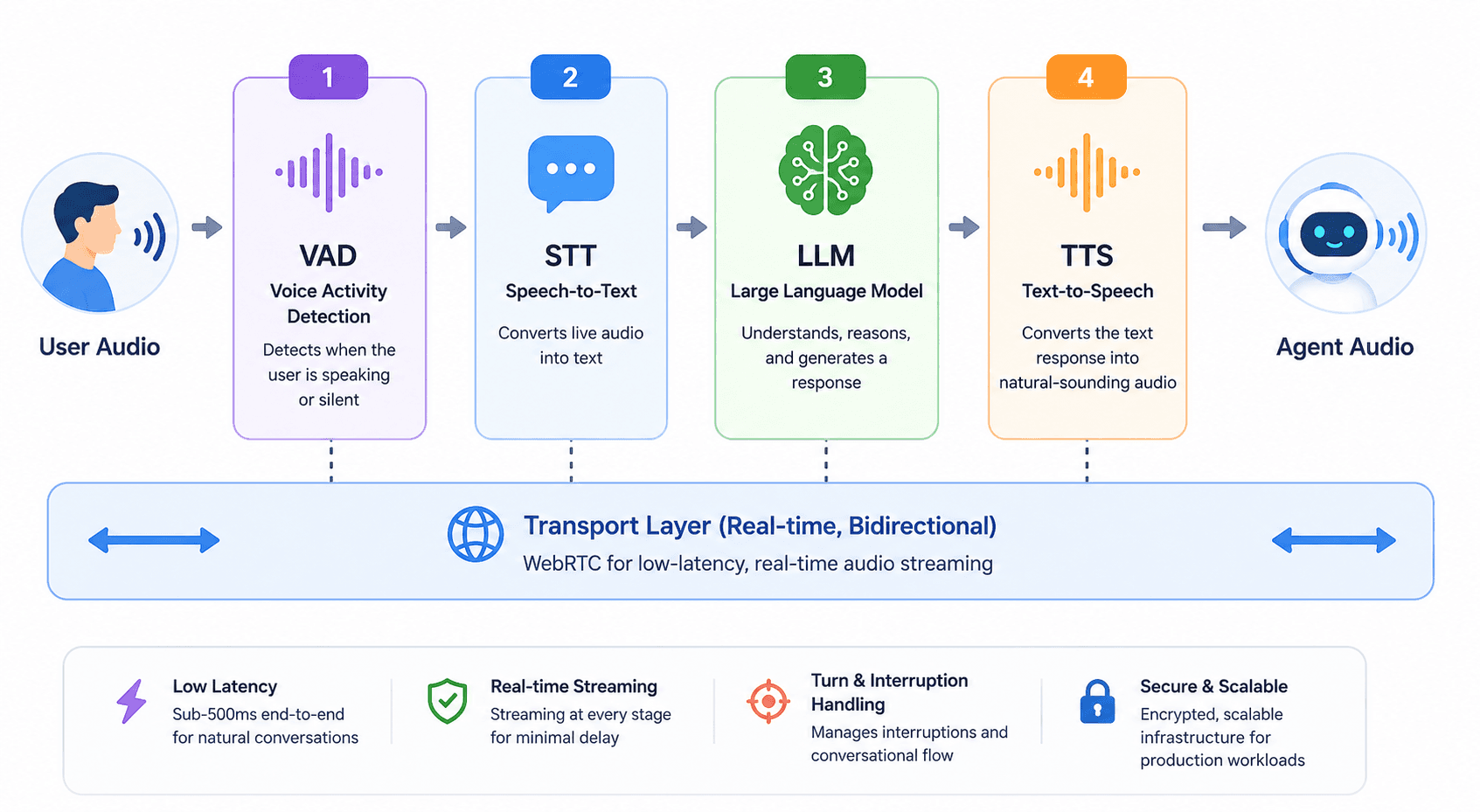
An AI voice agent platform is defined as an infrastructure layer that connects speech recognition, language model reasoning, and voice synthesis into a real-time conversational pipeline. It works by accepting raw audio from a user, transcribing it to text (STT), processing the text through a large language model (LLM), and converting the response back to spoken audio (TTS), all within a latency window that keeps the conversation feeling human.
The core technical stack inside every AI voice agent platform includes:
- Speech-to-Text (STT): Converts live audio to text for LLM processing
- Large Language Model (LLM): Reasons over the transcript and generates a response
- Text-to-Speech (TTS): Synthesizes the response into natural-sounding audio
- Voice Activity Detection (VAD): Determines when the user has finished speaking
- Turn Detection: Manages interruptions and conversational flow
- Transport Layer: Delivers audio in real time, typically over WebRTC
The fundamental distinction between platforms is whether they provide a managed, integrated stack (you get one API, they manage each component) or an orchestration layer (you bring your own STT, LLM, and TTS providers and the platform wires them together). Each approach trades control against operational simplicity.
Why Latency Is the Only Metric That Matters
Sub-500ms perceived latency separates a voice agent from an IVR. Below 300ms feels human. Between 300ms and 600ms is sluggish but acceptable. Above 600ms, users revert to press-key mental models and start tapping buttons.
According to production data published by Hamming AI, which analyzed over 4 million voice agent calls across 10,000+ agents in 2025–2026, published industry medians sit around 1.4–1.7 seconds, and p99 runs 3–5 seconds. The 500ms benchmark is achievable, but only with streaming at every component, co-located infrastructure, and a disciplined model selection strategy.
Every platform review below includes latency benchmarks drawn from 2026 production data.
The 7 Best AI Voice Agent Platforms for Developers in 2026
1. VideoSDK — Best for Developers
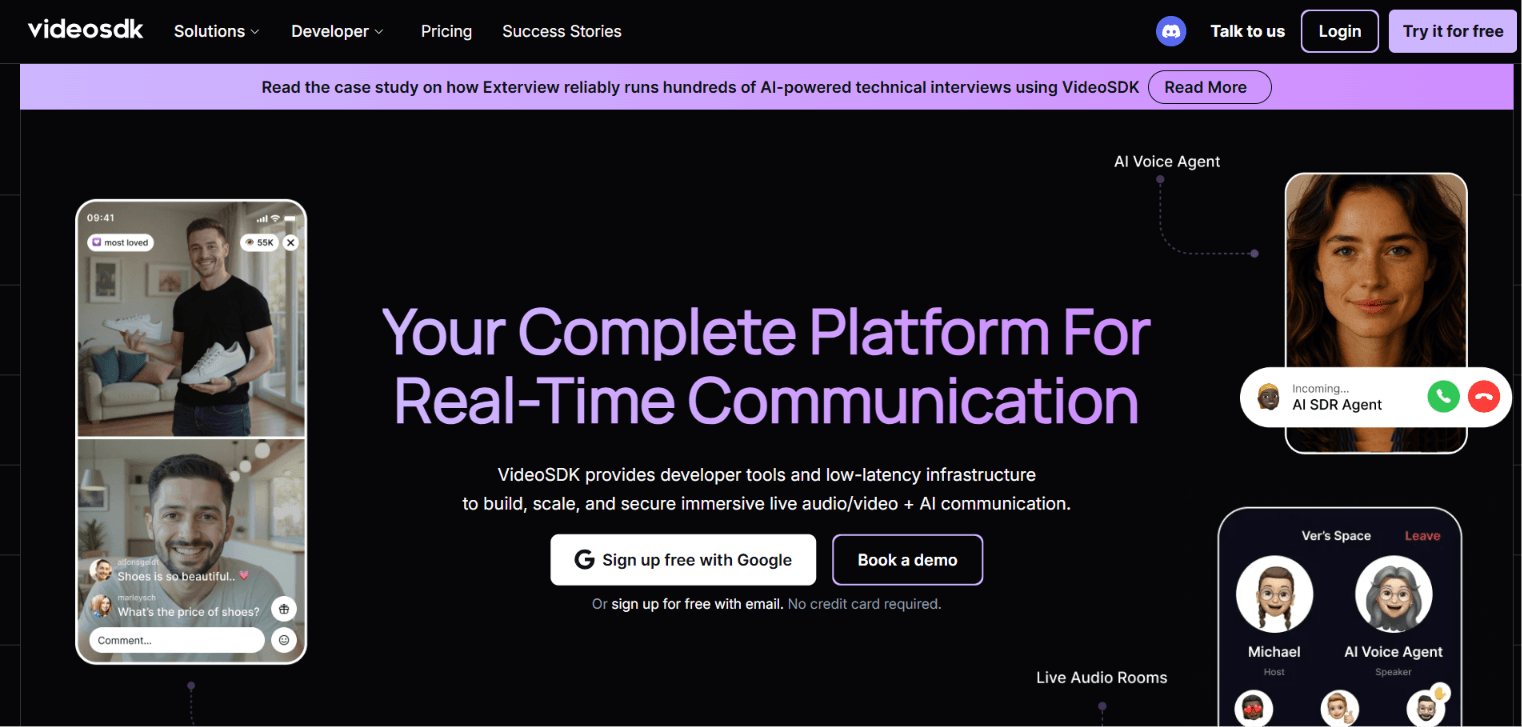
VideoSDK is the most complete real-time AI communication infrastructure for developers who want managed inference, full pipeline flexibility, and native video support in a single SDK.
VideoSDK launched its Agents SDK v1.0.0 in March 2026, marking a complete architectural shift for the platform. The release unified two previously separate execution models, CascadingPipeline (STT → LLM → TTS) and RealtimePipeline (speech-to-speech), into a single Pipeline class that automatically detects the optimal execution mode based on the components you provide.
Three Pipeline Modes, One Unified API
This is what separates VideoSDK from every other platform on this list. You do not choose between a managed pipeline and a custom stack, you configure what you need, and VideoSDK selects the mode:
- Cascade Mode: Full STT → LLM → TTS control. Bring any combination of Deepgram, OpenAI Whisper, Google, or custom STT models; wire in any LLM including OpenAI GPT, Anthropic Claude, Google Gemini, AWS Nova, or xAI Grok; choose ElevenLabs, Cartesia Sonic, or Deepgram TTS for voice output. You own every component selection.
- Realtime Mode: Provide a speech-to-speech model (OpenAI Realtime API, Google Gemini Live, AWS Nova Sonic) and the pipeline collapses to its lowest-latency configuration automatically.
- Hybrid Mode: Combine a realtime model with a custom external STT or TTS, a use case that was architecturally impossible on the previous framework. For example: use Google Gemini Live as the LLM but swap in a custom ElevenLabs voice instead of the model's built-in TTS.
Managed Inference: The Infrastructure Differentiator
In January 2026, VideoSDK launched managed inference, allowing developers to run complete voice agent pipelines through the VideoSDK Gateway without managing multiple AI provider accounts, API keys, or rate limits. You can now run STT, LLM, TTS, and realtime models directly inside your pipeline through a single dashboard, the Agent Runtime Dashboard, eliminating the multi-vendor billing overhead that affects Vapi and LiveKit deployments.
Managed inference also includes:
- Built-in denoising via Krisp, ai-coustics, and Sanas
- Voicemail Detection for outbound calls, so agents leave messages instead of speaking into silence
- Provider Fallback for production resilience (if your primary LLM endpoint goes down, the agent automatically switches to a fallback)
- Conversational Graphs for multi-step dialogue flows with state management
- First-party phone numbers via VideoSDK Phone Numbers, connecting agents directly to the PSTN without a separate Twilio or Vonage account
Agent Participant SDK: Real-Time Agent State in Your UI
VideoSDK is the only platform that ships native AgentParticipant support across every client SDK, React, React Native, JavaScript, iOS, Flutter. When an agent joins a VideoSDK room, it registers as a distinct participant type. Your application can track agent lifecycle state (IDLE, LISTENING, THINKING, SPEAKING) in real time via the AgentState enum and receive live transcription with timestamps.
This is what makes VideoSDK the right choice when you are building a customer-facing product with a visual interface, not just an IVR replacement. Your front-end can show a speaking indicator, display transcripts inline, or trigger UI state changes when the agent finishes reasoning.
VideoSDK for Existing Video Applications
No other platform on this list natively embeds voice agents into a video call. If you are already using VideoSDK for WebRTC video healthcare telemedicine, HR interviewing tools, fintech KYC, edtech tutoring adding an AI voice agent requires one additional SDK module, not a separate infrastructure vendor.
Developer Experience and Pricing
VideoSDK's open-source Python agents framework is available at github.com/videosdk-live/agents. New accounts receive $20 in free credits to test voice agents without a credit card. The platform supports LangChain and LangGraph integration for multi-step reasoning workflows and ships Agent-to-Agent (A2A) multi-agent routing out of the box.
Enterprise customers receive dedicated infrastructure, custom SLA guarantees, and on-premises deployment options.
Best for: Development teams building customer-facing AI voice applications that need video, voice, and AI in a single SDK; teams who want managed inference without multi-vendor billing; products that combine WebRTC calls with AI agent participants.
Start building: Sign up now.
2. Vapi — Best for Maximum Developer Configurability
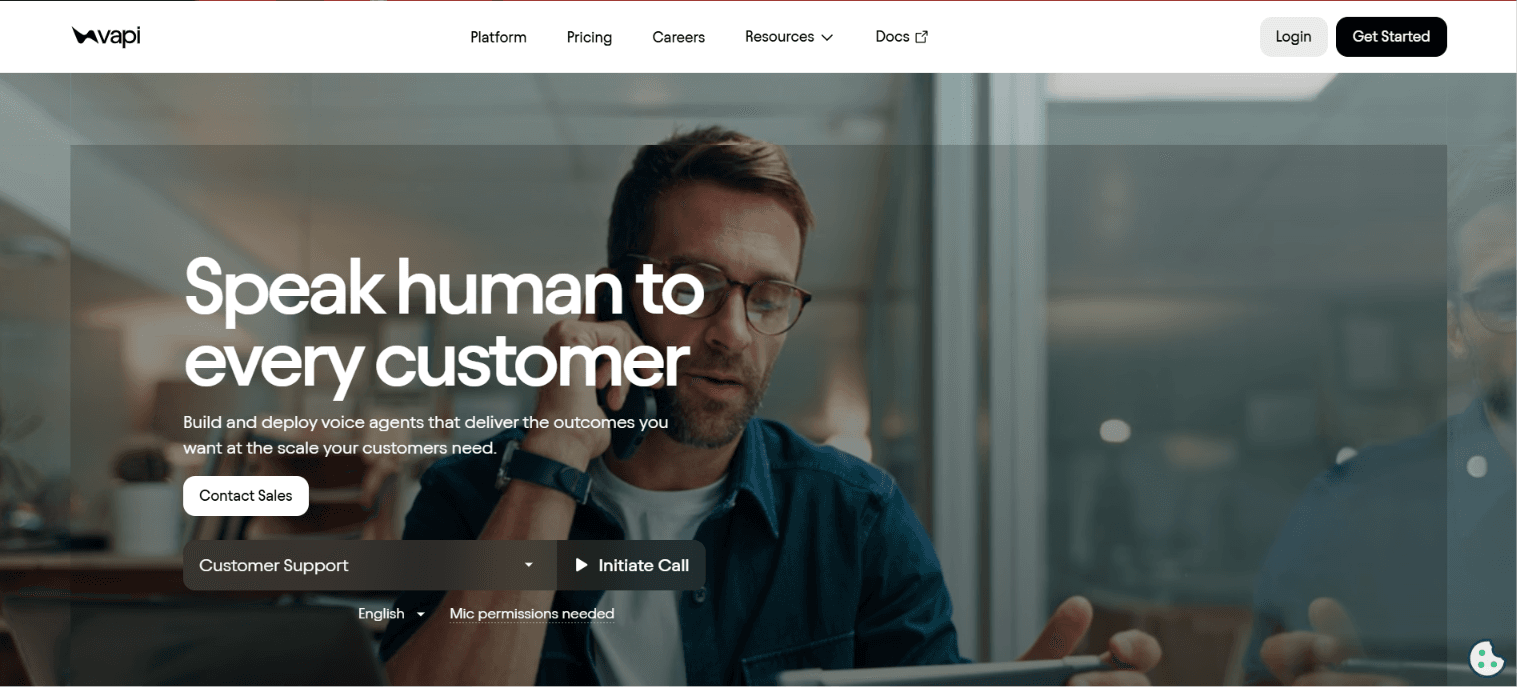
Vapi is the most developer-configurable voice orchestration platform, ideal for engineering teams that want to swap every component in the pipeline independently.
Vapi acts as a pure orchestration middleware. You provide your own API keys for STT (Deepgram, AssemblyAI, Whisper), LLM (any OpenAI-compatible endpoint, Anthropic Claude, Gemini), and TTS (ElevenLabs, Cartesia, OpenAI TTS). Vapi routes audio through the pipeline and handles turn detection, interruption logic, and telephony.
Its Squads feature lets you chain multiple specialized agents within a single call — a greeting agent hands off to a qualification agent, which hands off to a booking agent — without the user experiencing a call transfer.
Latency: 700–1,500ms depending on the component stack. With the optimized configuration (Deepgram Nova-3 STT + GPT-4o mini + ElevenLabs Flash), published benchmarks show ~550ms consistently.
Pricing: $0.05/min platform fee. Total all-in cost (including STT + LLM + TTS) typically lands between $0.13 and $0.31/min in production, depending on model selections.
Best for: Engineering teams with dedicated DevOps resources who want maximum control over cost optimization through model swapping; multi-agent orchestration use cases.
Limitation: Multi-vendor billing overhead and integration complexity increase as you add providers. Production monitoring is self-managed.
3. LiveKit Agents — Best for Open-Source Infrastructure Owners
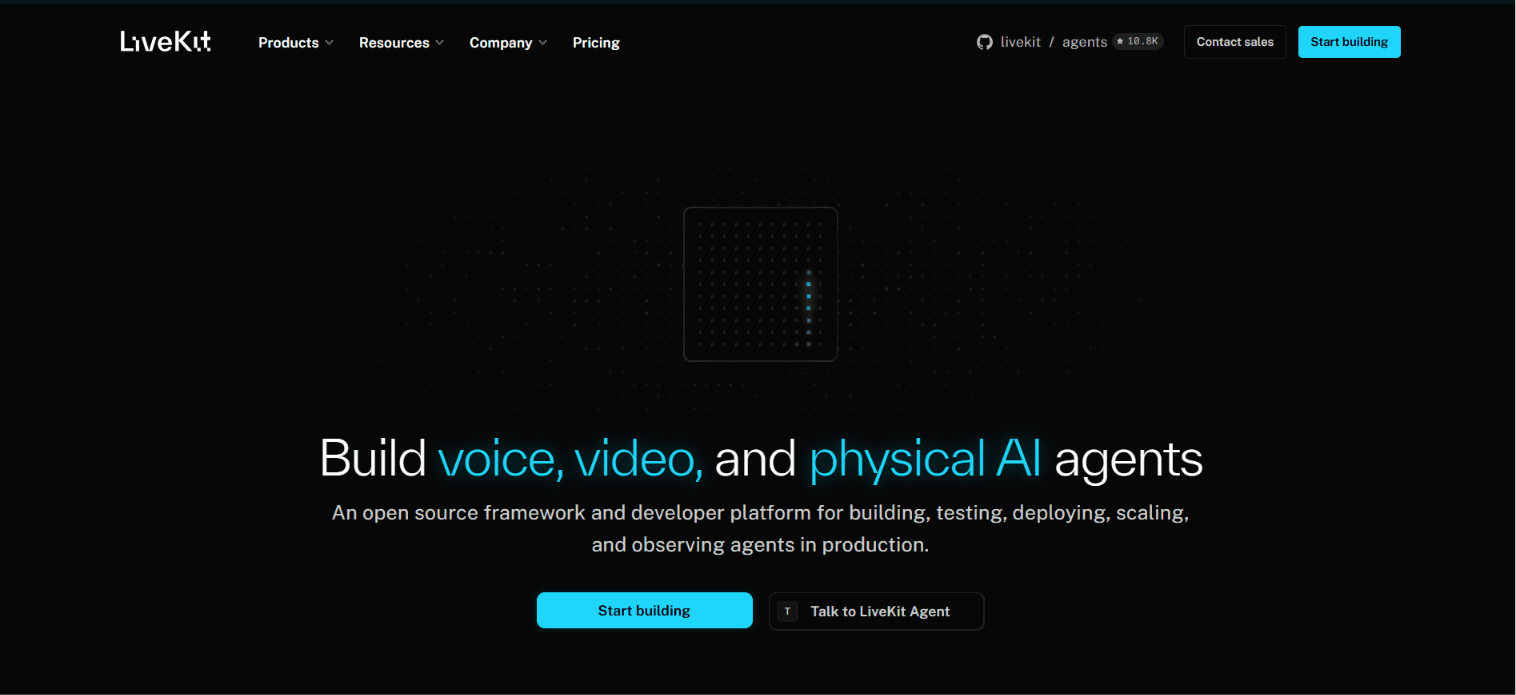
LiveKit Agents is the infrastructure-first choice: an open-source, WebRTC-native agent framework used by OpenAI for ChatGPT Voice Mode and by tens of thousands of developers worldwide.
LiveKit is defined as an open-source real-time communication platform built on WebRTC, with the Agents framework providing an orchestration layer for AI-powered voice and video agents. It handles media routing through a Selective Forwarding Unit (SFU), which routes audio between participants without requiring peer-to-peer connections at scale.
According to Fora Soft's 2026 production analysis, LiveKit handles roughly 5–10% of the cost of a human-staffed call center at sub-second latency for properly configured stacks. The platform has over 12,000 GitHub stars and 1,000+ forks.
Latency: 450ms achievable with streaming at every layer, co-located infrastructure, and optimized model selection. Industry-published p50 sits at approximately 500–700ms in production.
Pricing: LiveKit Cloud Agents charges approximately $0.01/min platform fee, with model costs passed through at vendor rates, the lowest platform overhead on this list.
Best for: Teams who want to self-host and own the entire infrastructure stack; developers comfortable managing SFU servers on AWS or GCP; open-source community projects.
Limitation: Requires significant DevOps investment to operate at scale. No managed inference or built-in telephony, you wire up Twilio or similar yourself.
4. Retell AI — Best for Production Call Center Replacement
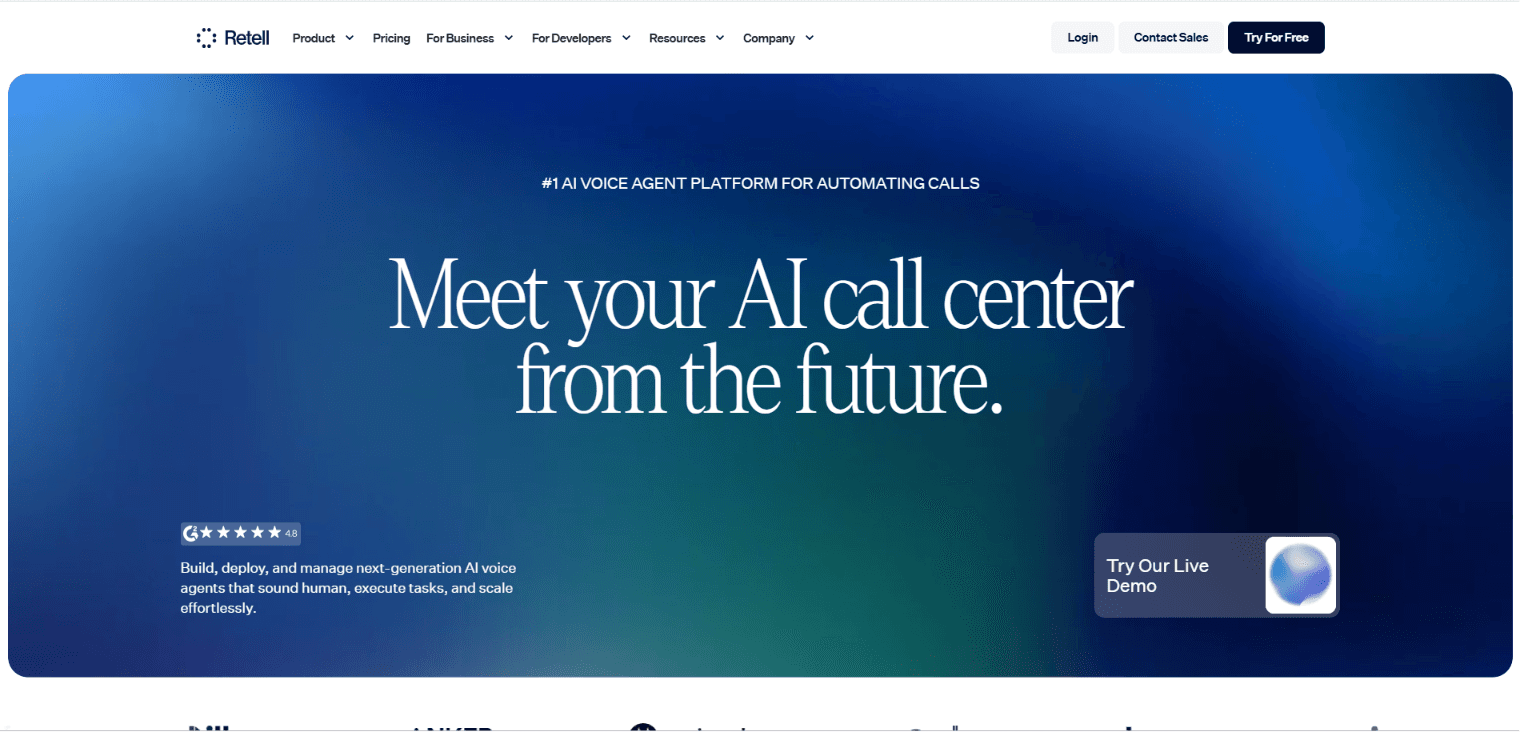
Retell AI is the strongest end-to-end platform for developers building production inbound voice agents focused on call center automation, with industry-leading turn-taking quality and enterprise monitoring.
Retell AI provides an integrated platform with structured conversation flow builders, warm call transfers, auto-synced knowledge bases, and multilingual support. Its G2 rating of 4.8/5 from over 2,400 verified reviews (named G2's 2026 Best Agentic AI Software) reflects deployment success across healthcare, financial services, and customer support.
Medical Data Systems processes approximately 30,000 calls per month using Retell AI's analytics platform, demonstrating production viability at scale.
Latency: 600–800ms in 2026 benchmarks, with consistent turn-taking quality on long conversations that outperforms Vapi on multi-minute calls.
Pricing: Hybrid model combining subscription tiers with per-minute usage. STT/ASR starts at approximately $0.008/min, with LLM costs on top at approximately $0.0001 per 1,000 tokens.
Best for: Healthcare and financial services developers who need compliance monitoring and call analytics; teams replacing legacy IVR systems with conversational AI.
Limitation: Less flexibility than Vapi for custom component swapping; fewer templates for non-call-center use cases.
5. ElevenLabs Conversational AI — Best for Voice Quality-First Applications
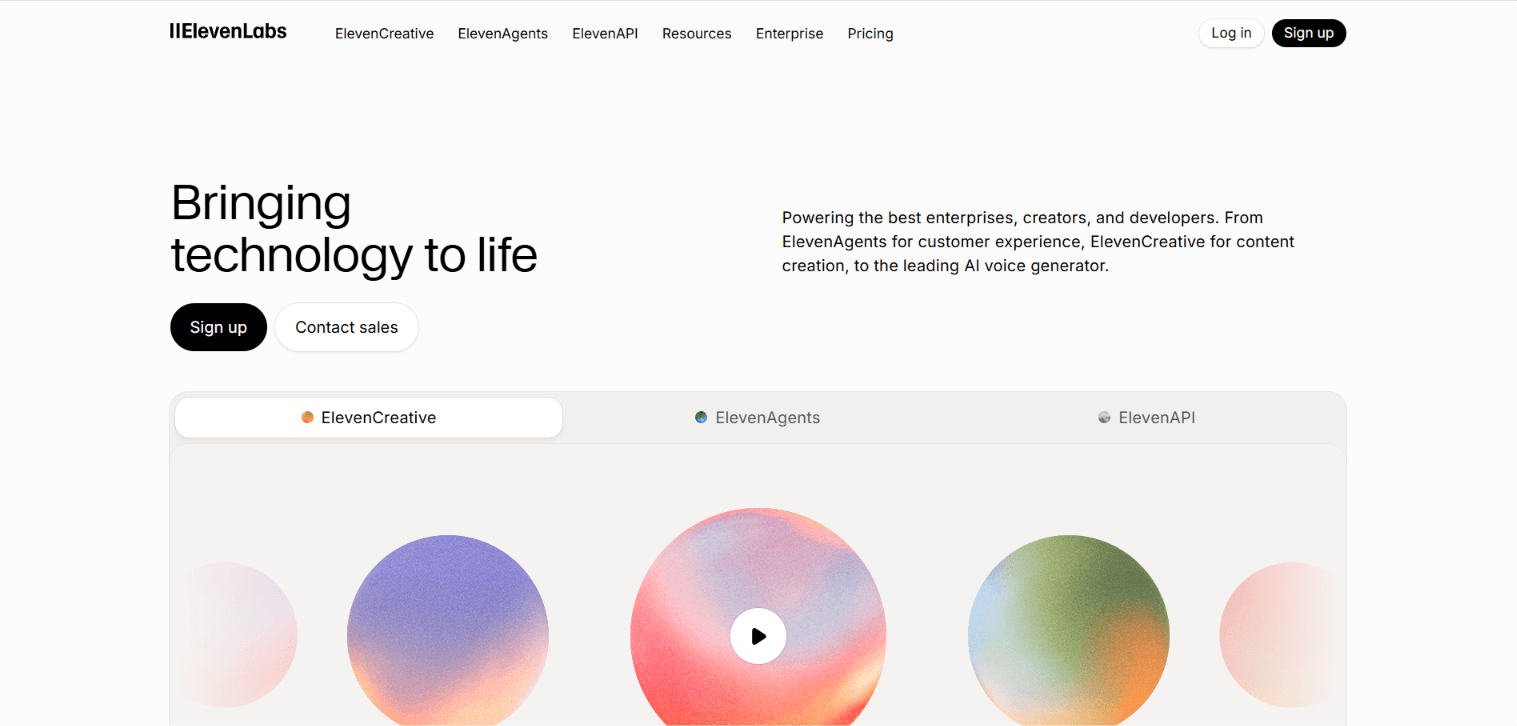
ElevenLabs Conversational AI delivers the most realistic, emotionally expressive synthetic voices available in 2026, built on the company's industry-leading TTS platform.
ElevenLabs raised $500 million in its Series D in February 2026 at an $11 billion valuation, signaling investor confidence in its voice synthesis dominance. The Conversational AI product adds turn-taking, interruption handling, RAG against custom documents, and bring-your-own-LLM support on top of the core TTS engine.
In multilingual use cases, French, Spanish, Arabic, and 26 additional languages, ElevenLabs voices are noticeably more natural than what competing platforms ship by default.
Latency: Flash v2.5 TTS delivers 75ms latency, among the lowest on this list. End-to-end measured latency runs 620–840ms depending on configuration.
Pricing: $0.08–$0.24/min for Conversational AI, depending on plan tier. Starter plans begin at $22/month. Enterprise plans required for production concurrency limits.
Best for: Premium customer experiences, concierge agents, brand-forward interfaces, and multilingual deployments where voice realism is the primary differentiator.
Limitation: The conversation management tooling is less mature than Retell or Vapi for complex multi-step agent workflows. Telephony integration is functional but less battle-tested.
6. Synthflow — Best for Non-Technical Teams and Agencies
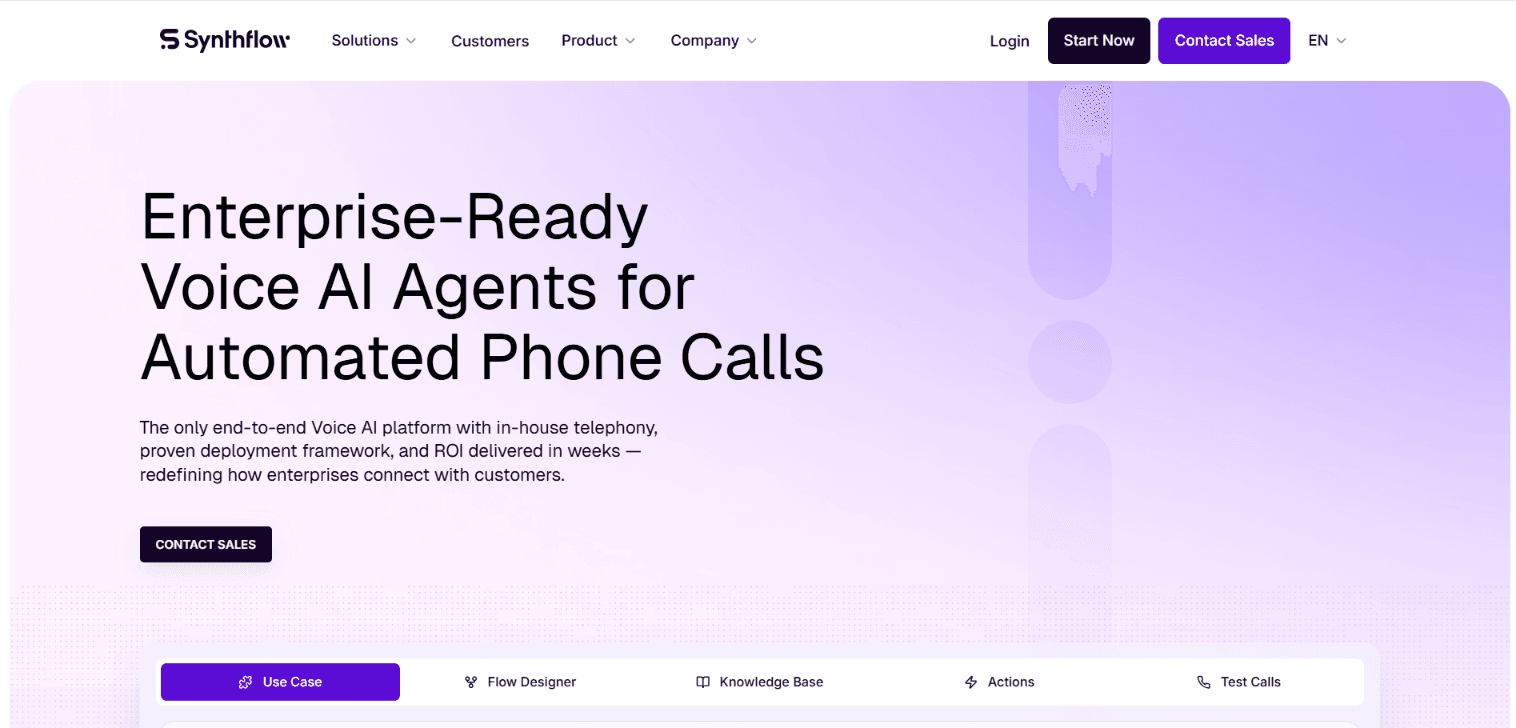
Synthflow is the fastest path from zero to a live voice agent for teams without engineering resources, combining a no-code drag-and-drop builder with bundled premium AI components and white-label agency tooling.
Synthflow AI is a scalable voice AI platform that combines a no-code workflow builder, real-time personalization, and strong CRM integrations. It supports HIPAA compliance, inbound routing, and multi-tenant setups, making it especially attractive for agencies and teams running multiple clients on a single system.
Latency: 500–800ms in production, driven by the bundled pipeline architecture.
Pricing: $0.050–$0.163/min for the Voice Agent API bundle, with concurrency-metered billing at scale.
Best for: Marketing teams, agencies, and SMBs that need a production voice agent live in hours without writing code; multi-client agency deployments that require white-label branding and subaccount billing.
Limitation: Less customizable than Vapi, VideoSDK, or LiveKit for developers who need to swap model components or build custom pipeline logic. The free trial is limited to 10–20 minutes of calls, which is too short to fully stress-test an agent before committing to a paid plan.
7. Deepgram Voice Agent API — Best for Noisy Environment Accuracy
Deepgram's Voice Agent API bundles the Nova-3 STT engine, the industry leader for real-time accuracy in noisy environments, with full agent functionality at a predictable all-in rate.
Deepgram Nova-3 achieves 6.84% word error rate (WER) in independent benchmarks from Hamming AI's analysis of 4M+ production calls, and supports 36 languages with excellent noise robustness. The bundled Voice Agent API pricing eliminates the LLM pass-through surprise cost that Vapi and LiveKit deployments frequently encounter.
Latency: Under 300ms for STT alone; end-to-end varies by LLM selection.
Pricing: $0.050–$0.163/min for the Voice Agent API bundle, with concurrency-metered billing at scale.
Best for: Contact centers handling calls from noisy environments (warehouses, retail floors, outdoor); developers requiring on-premises deployment for data sovereignty; healthcare teams needing HIPAA-compliant infrastructure with a verified BAA.
Limitation: Concurrency-metered billing requires committed capacity planning, which changes cost economics compared to pure pay-as-you-go alternatives.
8. Bland AI — Best for Cost-Optimized Outbound at Scale
Bland AI is purpose-built for outbound voice campaigns at the lowest per-minute all-in pricing on this list, with bundled telephony included.
Bland AI bundles STT, LLM, TTS, and telephony into a single per-minute rate, eliminating the multi-vendor billing complexity that plagues assembled stacks. On-premises deployment is available for organizations with strict data residency requirements.
Latency: Sub-second for standard configurations; the bundled architecture avoids inter-component network hops that inflate latency on separated stacks.
Pricing: $0.11–$0.14/min all-in, including telephony. No separate LLM or TTS provider accounts needed.
Best for: Outbound sales campaigns, appointment reminder pipelines, and lead qualification at volume where cost-per-minute economics drive platform selection.
Limitation: Less customizable than Vapi or VideoSDK for complex agent behaviors; voice quality is below ElevenLabs-tier for premium use cases.
Platform Comparison Table
| Feature | VideoSDK | Vapi | LiveKit Agents | Retell AI | ElevenLabs Conv. AI | Synthflow | Deepgram | Bland AI |
|---|---|---|---|---|---|---|---|---|
| Pipeline Type | Managed + BYOK | BYOK orchestration | Open-source BYOK | Managed | Managed | Managed bundle (no-code) | Managed bundle | Managed bundle |
| Latency (P50) | ~500ms | 700–1,500ms | 450–700ms | 600–800ms | 620–840ms | 500–800ms | <300ms STT | Sub-1s |
| Managed Inference | Yes | No | No | Partial | Yes | Yes (bundled) | Yes | Yes |
| Video + Voice | Yes (native) | No | No | No | No | No | No | No |
| Open Source | Framework only | No | Yes | No | No | No | No | No |
| Agent Participants UI | Yes (all SDKs) | No | Partial | No | No | No | No | No |
| Hybrid Pipeline Mode | Yes | No | No | No | No | No | No | No |
| Native Telephony | Yes (VideoSDK Numbers) | Via Twilio/Vonage | Via Twilio/Vonage | Yes | Partial | Yes (included + BYOC) | No | Yes |
| Multilingual Support | Yes | Depends on providers | Depends on providers | Yes | 29+ languages | Via ElevenLabs | 36 languages | Limited |
| HIPAA / Compliance | Enterprise | Enterprise | Self-hosted | Enterprise | Enterprise only | Yes | Yes, BAA available | On-prem option |
| Free Tier / Trial | $20 free credits | 1,000 free min/mo | Open-source | Available | 10,000 chars/mo | 10–20 min trial | $200 credits | Available |
| Pricing (platform fee) | Usage-based | $0.05/min | $0.01/min | Hybrid | $0.08–0.24/min | $0.08/min PAYG; plans from $29/mo | $0.05–0.163/min | $0.11–0.14/min |
| Best For | Voice + Video + AI | Max flexibility | Infra owners | Call centers | Voice quality | Agencies, non-technical teams | Noisy environments | Outbound scale |
Table note: Latency benchmarks reflect production P50 from 2026 independent data. All-in costs include STT + LLM + TTS on BYOK platforms; bundled platforms include these in the listed rate. Verify pricing at each vendor's current pricing page before production commitment, as rates evolve frequently.
How to Choose an AI Voice Agent Platform in 2026
The right AI voice agent platform is determined by three variables: your latency budget, your compliance requirements, and whether you want to own the infrastructure or delegate it.
Use this decision framework:
Step 1: Define Your Latency Budget
Below 500ms perceived latency is the production standard in 2026. If your use case involves emotional conversations (mental health, patient care, premium sales) where every pause registers, target under 300ms and evaluate VideoSDK's Realtime Mode or LiveKit with co-located infrastructure. For standard customer service automation, 500–800ms is acceptable and gives you more model flexibility.
Step 2: Assess Compliance Requirements
Healthcare and financial services teams should shortlist VideoSDK (Enterprise), Deepgram (BAA available), and Retell AI (monitoring capabilities) as primary options. Teams needing on-premises deployment for data residency should evaluate Deepgram, Bland AI, or self-hosted LiveKit.
Step 3: Match Platform Architecture to Your Team Shape
- Small engineering team, fast shipping: VideoSDK managed inference or ElevenLabs Conversational AI
- Large engineering team, maximum control: Vapi or LiveKit Agents with self-managed STT/LLM/TTS
- Call center replacement, enterprise monitoring: Retell AI
- Outbound campaigns at scale: Bland AI
- Accuracy-critical environments: Deepgram Voice Agent API
Step 4: Calculate Total Cost, Not Platform Fee
Platform fees are the smallest part of your per-minute cost. Add STT (approximately $0.005–$0.012/min), LLM (varies widely), TTS (approximately $0.005–$0.04/min), and telephony (approximately $0.01–$0.02/min). For assembled stacks, total production cost typically runs $0.13–$0.31/min. Bundled platforms like Bland AI and managed platforms like VideoSDK eliminate the accounting overhead of reconciling four separate provider bills.
Real-World Example: Building a Telecom Support Agent with VideoSDK
A mid-sized telecom operator deploying an AI support agent with VideoSDK typically follows this implementation path:
- Initialize the Agent Session using VideoSDK's Python SDK, connecting a Pipeline in Cascade Mode with Deepgram Nova-3 for STT, Anthropic Claude Haiku for the LLM, and ElevenLabs Flash for TTS
- Configure Pipeline Hooks using the decorator-based
@pipeline.on(...)system to intercept transcripts before LLM inference, enabling custom intent classification or PII redaction - Enable Voicemail Detection for outbound callbacks so the agent leaves structured messages instead of silent hang-ups
- Deploy using VideoSDK's YAML-based cloud deployment (
deploy: cloud: true), which handles container orchestration and scaling without Kubernetes management - Track agent state in the front-end using
onAgentStateChangeevents to display a speaking indicator and live transcript to support supervisors monitoring calls
The same agent, once deployed, handles common inquiries, assists with troubleshooting, and escalates complex cases to human agents, with the STT, LLM, and TTS components upgradeable independently as model performance improves, without rebuilding the agent from scratch.
Key Statistics on AI Voice Agent Platforms in 2026
- The global voice AI agents market is valued at $2.4 billion in 2024 and projected to reach $47.5 billion by 2034 at a 34.8% CAGR (Market.us, 2024)
- Gartner forecasts conversational AI will reduce contact center agent labor costs by $80 billion in 2026 (Gartner, 2026)
- Voice AI costs approximately $0.40 per call compared to $7–$12 per call for human agents, a 90–95% cost reduction per automated interaction (Teneo.ai, 2026)
- Hamming AI's analysis of 4M+ production calls shows industry median latency at 1.4–1.7 seconds P50, with P99 at 3–5 seconds, underscoring why platform and infrastructure selection directly determines user experience quality
- 80% of businesses plan to integrate AI-driven voice technology into customer service by 2026 (Nextiva, 2025)
- Voice AI agent deployments grew 340% year-over-year across production environments (Forrester, 2026)
- Companies using voice AI report a 3-year ROI between 331% and 391% (Forrester Consulting / PolyAI, 2026)
Definitions Glossary
STT (Speech-to-Text): A machine learning model that converts live audio input into text transcripts in real time, serving as the first processing stage in an AI voice agent pipeline.
VAD (Voice Activity Detection): A signal processing algorithm that detects when a user has started or stopped speaking, enabling the pipeline to trigger STT transcription and manage conversational turn-taking.
TTS (Text-to-Speech): A neural synthesis model that converts text output from an LLM into natural-sounding spoken audio, representing the final output stage of a voice agent pipeline.
SFU (Selective Forwarding Unit): A server-side WebRTC component that routes media streams between participants without requiring peer-to-peer connections, enabling multi-participant voice and video at scale.
Managed Inference: A platform capability that runs STT, LLM, and TTS models through a single provider gateway, eliminating the need for developers to manage separate API keys, rate limits, and billing accounts for each AI component.
Pipeline Hooks: A middleware system in agent frameworks that allows developers to intercept, inspect, and transform data at specific stages of the voice processing pipeline without modifying the core architecture.
Key Takeaways
- VideoSDK is the only platform on this list that natively unifies voice AI agents with video calls, making it the clear choice for any product that combines WebRTC communication with conversational AI.
- Managed inference is the 2026 differentiator: platforms that handle STT, LLM, and TTS through a single gateway (VideoSDK, ElevenLabs, Deepgram) eliminate the multi-vendor billing complexity that compounds operational overhead on assembled stacks.
- Latency is a deployment problem, not a model problem: the same models perform differently depending on infrastructure co-location, streaming implementation, and VAD configuration. Published benchmarks require verification against your specific production audio before platform commitment.
- Compliance requirements narrow the field quickly: for HIPAA-covered entities, shortlist VideoSDK Enterprise, Deepgram (BAA available), or self-hosted LiveKit as the viable options; evaluate carefully before choosing a platform that does not have documented compliance pathways.
- The cheapest-per-minute platform is rarely the cheapest platform: assembled BYOK stacks like Vapi carry multi-vendor DevOps overhead, integration maintenance, and billing reconciliation costs that bundled or managed platforms absorb. Factor total engineering cost, not just API rates, into your build-vs-buy calculation.
Conclusion
The AI voice agent platforms available to developers in 2026 have matured from experimental SDKs to production infrastructure trusted by enterprise contact centers, healthcare networks, and consumer apps at scale. The right platform depends on what you are building.
For developers who want managed inference, a unified voice-and-video experience, and native agent participant tracking across every client SDK, VideoSDK delivers the most complete developer infrastructure on the market. Start with the free $20 credit tier, explore the open-source agents framework on GitHub, and deploy your first voice agent in under a day.
Frequently Asked Questions
What is the best AI voice agent platform for developers in 2026?
The best AI voice agent platform for developers in 2026 depends on your use case. VideoSDK leads for teams that need voice, video, and AI agent infrastructure in a single SDK with managed inference. Vapi is best for engineering teams who want maximum component flexibility. Retell AI is strongest for call-center replacement with built-in monitoring. ElevenLabs Conversational AI delivers the highest voice quality for premium customer experiences. For most development teams shipping to production, VideoSDK's combination of managed inference, multi-pipeline support, and native UI integration provides the fastest path from prototype to production.
How do AI voice agent platforms handle latency?
AI voice agent platforms reduce latency by streaming data at every processing stage, co-locating infrastructure, and selecting models with low time-to-first-token. In 2026, production P50 latency across platforms ranges from approximately 450ms (LiveKit, optimized configurations) to 700–1,500ms (Vapi, depending on component stack). VideoSDK's Realtime Mode, using speech-to-speech models like OpenAI Realtime or Google Gemini Live, achieves the lowest latency by eliminating the separate STT and TTS hops. Sub-300ms latency feels human; anything above 1.5 seconds causes users to disengage.
What is the difference between Vapi and VideoSDK?
Vapi is a pure orchestration middleware that requires developers to bring their own STT, LLM, and TTS API keys and manage each vendor relationship independently. VideoSDK provides both managed inference (a single gateway for all AI components) and bring-your-own-key flexibility in the same unified SDK. VideoSDK also natively supports video calls alongside voice agents, something Vapi does not offer, and ships AgentParticipant support across all client SDKs so your front-end can track agent state in real time. Vapi's $0.05/min platform fee appears lower, but total all-in cost typically reaches $0.13–$0.31/min once STT, LLM, and TTS providers are added.
How much do AI voice agent platforms cost per minute in 2026?
AI voice agent platform costs in 2026 range from approximately $0.05/min (platform fee on Vapi, before STT/LLM/TTS) to $0.14/min all-in (Bland AI, bundled). Total all-in costs on BYOK orchestration platforms like Vapi typically land between $0.13 and $0.31/min once all components are included. Bundled platforms including Bland AI ($0.11–$0.14/min) and ElevenLabs Conversational AI ($0.08–$0.24/min) provide more predictable per-minute billing. Enterprise AI voice agents (high concurrency, SLA guarantees, custom deployments) typically involve annual commitments in the $40,000–$200,000+ range depending on volume.
What is a managed inference voice agent platform?
A managed inference voice agent platform is one that runs STT, LLM, and TTS models through a single provider gateway, eliminating the need for developers to manage separate API keys, rate limits, billing accounts, and provider outages for each AI component. VideoSDK launched managed inference in January 2026, allowing developers to configure a complete voice pipeline through the Agent Runtime Dashboard without integrating Deepgram, OpenAI, and ElevenLabs as separate vendor accounts. This reduces both the operational complexity and the time-to-production for teams without dedicated AI infrastructure engineers.
Can I use VideoSDK for both voice AI agents and video calls?
Yes. VideoSDK is the only platform on the 2026 market that natively integrates AI voice agents with WebRTC video calls. When an agent joins a VideoSDK room, it registers as an AgentParticipant a distinct participant type that your front-end can track, display transcripts for, and react to via real-time state events. This makes VideoSDK the natural choice for use cases where AI agents participate in video-enabled sessions: telemedicine appointments, HR interviews, financial advisory calls, and customer onboarding flows where a human-AI hybrid experience is the target.
Which AI voice agent platform is best for HIPAA compliance?
For HIPAA-compliant voice AI agent deployments, the shortlist includes VideoSDK Enterprise (with custom compliance configurations), Deepgram (BAA available, self-hosted deployment option), and self-hosted LiveKit (infrastructure fully under your control). Retell AI and Vapi both offer enterprise plans with compliance features, but HIPAA BAA availability should be verified directly with each vendor before production deployment. ElevenLabs restricts HIPAA compliance to the Agents platform on the Enterprise tier only. Healthcare teams should validate current BAA terms with any vendor, as compliance offerings evolve with regulatory guidance.